
Years before Bernie Sanders, AOC, and Zohran Mamdani were household names, Socialist Alternative and our member Kshama Sawant shook the Seattle establishment, becoming the first socialists to win a city council seat in the city in nearly 100 years.
Over the following decade, from 2014 to 2024, Socialist Alternative and Sawant’s council office were able to organize and mobilize significant sections of the working class and oppressed in Seattle to win real gains. From becoming the first major city to raise the minimum wage to $15/hour, to the historic $300+ million/year tax on Amazon and the biggest Seattle corporations to fund affordable housing, to passing landmark renters’ rights laws, Sawant and Socialist Alternative demonstrated on a small scale the massive potential of genuinely independent, working-class politics.
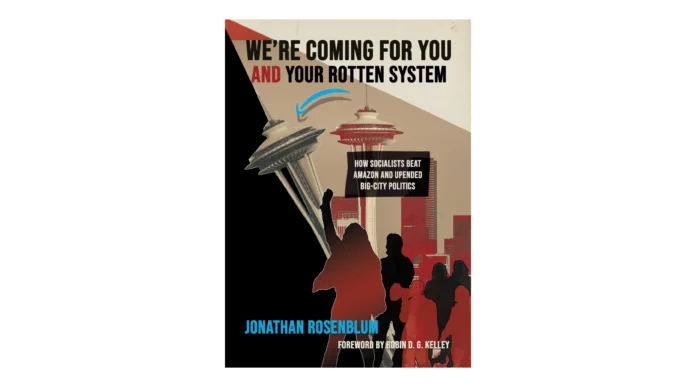
In his 2025 book We’re Coming for You and Your Rotten System, longtime union activist and organizer Jonathan Rosenblum collects and analyzes crucial lessons from this historic decade. From his firsthand experience working alongside Socialist Alternative members in Sawant’s council office for seven years, he demonstrates in great detail how socialists can lead working-class people to win victories under capitalism.
Today, working people everywhere are desperate for political representation that has the backbone to stand up to the likes of Trump and the far right, one that will actually do something about the ever-deteriorating quality of life under capitalism. It’s why Zohran Mamdani’s insurgent campaign for mayor in New York City captured the imaginations of young and working people around the world. It’s why democratic socialists continue to win elections a year later. But having a backbone depends on an uncompromising political approach rooted in the power and fighting capacity of the working class. This is why the example of Sawant and Socialist Alternative stands in sharp contrast to the record of would-be progressive politicians in the Democratic Party, who have again and again fallen to the pressures of their party’s corporate backers. These lessons are especially relevant amid recent victories of self-described socialists like Zohran and others in the Democratic Party.
We’re very proud to have conducted this decade of work. Rosenblum has written an approachable, accurate, and politically relevant piece of history, which we highly recommend to all socialists and class fighters.
“Marxist Insurgent Politics”
Rosenblum identifies three Marxist “pillars” to Socialist Alternative’s council office strategy—what he calls “Marxist insurgent politics”—and comes back to these throughout: 1) a class struggle approach, 2) bold movement-building demands, and 3) movement democracy. We would add a fourth “pillar,” which ties together the other three: a revolutionary socialist organization, rooted in the working class and experienced in class struggle methods.
Rosenblum traces the approach of Sawant and Socialist Alternative back to the work of Vladimir Lenin and the Bolsheviks within the Duma—the Russian parliament in the early 1900s. He recognized that the halls of power were tools of the ruling class that could not simply be conquered by the working class, but that the Duma could be used for agitation, to expose the liberal parties, and to organize working-class movements. As Marxists, we base our strategy on the struggle of our class, the working class, understanding that the process of this struggle itself is essential. As a class we learn lessons, gain confidence, and expose those who are ultimately beholden to the boss.
This is at the heart of Rosenblum’s first pillar, a class struggle approach. No amount of negotiation—with corporate power brokers or with the Democrats and Republicans who serve them—can produce the change workers need. Class struggle doesn’t stop just because workers elected a real representative. Instead, Sawant used her position to raise the level of struggle. Rosenblum recounts how the Democrats sabotaged their own $48 million corporate tax initiative, repealing it within weeks of passage, at big business’s demand. Two years later, our council office had built a movement powerful enough to threaten an Amazon Tax ballot initiative, forcing City Council to pass a tax more than four times larger than the one they repealed.
In a world where so many politicians campaign on vague platforms that morph to please the capitalists, the second pillar—bold movement-building demands—is crucial for socialists. We built formidable movements by using very clear demands that reflected the immediate needs of working people, that we could both win, but that would also point toward the need for fundamental societal change—for socialism. Rosenblum explains that this is the essence of what Marxists call a “transitional program,” quoting Russian revolutionary Leon Trotsky: “the bridge between present demands and the socialist program of the revolution.”
In the years-long fight for rent control, our movement won a slew of renter protections—for instance, organizing tenants of the slumlord Carl Haglund to win a rent freeze for any Seattle apartment buildings with outstanding code violations. We built neighborhood campaigns to keep countless workers in their homes. But we also clearly named the entire private housing market as the culprit behind unaffordability and called to bring housing under public ownership and control. Socialists have an obligation both to fight for immediate reforms and to build the movement against capitalism as a whole.
Movement democracy, Rosenblum’s third pillar, was a constant throughout our work—from the many neighborhood action groups we built to win $15, to the massive grassroots conferences where hundreds debated strategy to tax Amazon, to the general assembly we held in the midst of the George Floyd uprising. We built structures in the movement where working people could participate in real decisions about strategy, tactics, and program. As Rosenblum puts it, “only by building a mass base of support can workers wield the power they need to advance demands, win, and then enforce those victories”—a game-changing contrast to the narrow “democracy” that capitalist society trains us to accept. Marxists believe our class learns far more through the experience of struggle than by any other means, and democratic participation amplifies those lessons—of who the allies and enemies of our movements are, of how to win real gains, and about the limits of the capitalist system to grant the full scale of change needed.
A Revolutionary Organization
Rosenblum’s “pillars” are a useful description of the toolkit socialists in office need to employ, and every socialist elected officeholder should strive to put them into practice. But also crucial to the successes of a principled Marxist in office is a fourth “pillar”: a revolutionary socialist organization, to serve as a political backbone and to provide collective leadership and accountability for every aspect of the work. Without an organization to play this role, it is very likely that any such officeholder will cave to pressure from the Democrats and the bosses they serve—but also to ultra-left pressures, keeping them isolated from our class.
It remains as true today as it was for the Bolsheviks then, if not more so, that no individual alone can navigate the treacherous waters of consistently fighting for the interests of the working class in the completely hostile world of capitalist politics. The Democratic Socialists of America (DSA), which almost a decade ago began running members and winning nationally significant elections, has been debating the question of how to hold these officeholders accountable to a common socialist program and strategy. With a number of primary victories by DSA members this year, it remains an urgent task to solve this question.
Indeed Rosenblum identifies the ten years of this Marxist city council seat as a product of both Socialist Alternative and Councilmember Kshama Sawant, as a leading member of the organization who was also accountable to it. From the decision to run for city council in the first place, to campaign strategy, to the day-to-day work of this “insurgent” council office—Sawant was always the first to say that this was our seat, by which she meant Socialist Alternative and the wider working-class movement.
At each new turn of events, the continual discussion and debate by Socialist Alternative’s collective leadership was fundamental to developing the strategies and methods that would prove decisive for winning against the likes of Amazon, Microsoft, and many more of the most powerful corporations in the world—more than once. Sawant never hid her membership in Socialist Alternative, time and again calling on participants in these struggles to join us.
Sawant concluded her final electoral victory speech in 2021: “This victory was brought to you by the political ideas and clarity of Socialist Alternative, as were all our past election victories, as were the $15 minimum wage and the Amazon Tax and renters’ rights. Full stop…If a small revolutionary socialist organization can beat the wealthiest corporations in the world here in Seattle, again and again, you can be sure that the organized power of the wider working class can change society.” Five years later, the point still holds.
Historic Victories, Despite The Democrats
“Let me make one thing absolutely clear: There will be no backroom deals with corporations or their political servants. There will be no rotten sell-out of the people I represent.”
This declaration, from Sawant’s 2014 inauguration speech, was a red thread through our time on Seattle City Council. Sawant didn’t just speak in support of workers’ struggles, but backed it up with action. She took an average worker’s wage and donated the remainder of her six-figure salary to organizations involved in those struggles, especially to workers on strike. This is a foundational principle for Socialist Alternative, and we believe that every self-identifying socialist elected official, including those in the recent wave of DSA victories, as well as every militant union leader, should do the same.
Winning the $15/hour minimum wage, the Amazon Tax, or anything else was only possible on the basis of being absolutely clear about who is on the side of the working class, and who is not. It was necessary to use Sawant’s position to expose forces like the Democrats who talked the talk—saying that they supported raising the minimum wage to seem progressive—but who actually wanted to keep it far below $15, so as not to risk their relationship with big business interests.
The Democratic Party machine attempted to block the gains of our office at every step. At first, they hoped to co-opt Sawant to their approach: acting progressive enough to garner support and win elections, but avoiding substantial conflict with big business at all costs. Later, they fought to pressure and silence Sawant and our movements, consistently attempted to betray and sell out our demands, and ultimately supported a right-wing recall attempt against Sawant’s position in 2020. After a grueling 14-month campaign, Socialist Alternative, Sawant, and the movement we built defeated the billionaire-backed right-wing recall to win our fourth election in a row as open Marxists.
Today, in contrast, the Democratic Party has shown how incapable it is of mounting a real struggle against Trump and the right. They will actively seek to undermine movements employing class struggle methods because they cannot risk those movements turning their fire against the capitalist system itself, which the Democrats serve and protect. Even if they achieve a “blue wave” in this year’s midterms, as we have argued, they will not be able to decisively halt Trump’s agenda.
Impact Beyond Seattle
Our victorious campaign for a $15/hour minimum wage in Seattle, called 15Now, was also launched in cities nationwide, where it led the way to win $15 in Minneapolis and triggered a wave of other successful battles to implement $15 in cities across the country. Many of these laws are tied to increases in inflation, following what we were able to win in Seattle, where the minimum wage as of writing is now $21.30/hour.
Although it was repealed five years later, the first-in-the-country chemical weapons ban we passed during the George Floyd uprising inspired a series of restrictions on police militarization in other major cities. The Amazon Tax has been a beacon across a nation with an increasingly impossible cost of living and simmering rage against the rich. These victories were a product of the combination of Marxist leadership and the largest protest movement in US history—the Black Lives Matter movement. Rosenblum’s book covers this complex work extensively, as we navigated between misleaders who strove to divert struggle and the ultra-left who, while devoted to struggle, could not lead a movement to win anything concrete.
We also used the council seat to make a broader political impact. On the eve of the largest-ever single climate march in 2014, Sawant shared a stage with Bernie Sanders in New York City, where she called on him to launch his rumored presidential run outside the Democratic Party and was met with huge enthusiasm from the crowd, forcing Bernie to directly respond. In 2016, Socialist Alternative helped organize the walkout of hundreds of DNC delegates to protest the party’s rotten rigging of the primary for Hillary Clinton, and used Sawant’s platform to garner nearly 150,000 signatures for our petition calling on Bernie to run through the November election as an independent. We lent our platform to nationwide labor struggles—for instance, organizing a job defense rally for fired Memphis Starbucks workers, and bringing the fight of Kentucky Amazon workers to Jeff Bezos’ doorstep.
Unfortunately, this stands in sharp contrast to democratic socialist elected officials such as Zohran Mamdani, who recently made very clear that he was not encouraging people to protest Netanyahu’s appearance at the UN in Manhattan this September. While he didn’t explicitly discourage people from protesting Netanyahu’s visit, socialist elected officials cannot be agnostic on these questions. Rather they must clearly and consciously use their positions to build movements, encouraging more ordinary people to get active because that is how change will be won.
Movement Building In The New Trump Era
We won four election races to keep Sawant in office, each time facing more determined and well-funded opposition from the establishment. Meanwhile, the district of Seattle that Sawant represented became more and more gentrified, with many working-class people forced out due to skyrocketing rents.
In 2023, Socialist Alternative and Sawant decided not to contest the seat again. After a decade of winning historic gains, the limits of what we could achieve using this council seat in the absence of a wider wave of class struggle began to assert themselves. We were also unfortunately never joined by more revolutionary socialists in office, in Seattle or nationally. Simultaneously, we were running up against the strain on our small organization to maintain the seat in Seattle, especially in the context of the beginning of a forceful right-wing offensive by the ruling class (particularly pronounced in Seattle) while the wider left was largely on the back foot. At the same time, the nationwide upsurge in labor struggle, which was heating up at that time, demanded significant attention and resources by socialists. Marxists understand that we cannot bring about socialism through elections, and our strategy is not to hold onto elected seats at any cost. What’s necessary is to assess the changing political terrain and decide how our limited forces are best positioned to have an impact.
After she stepped down, Sawant unfortunately decided to pursue a different political trajectory from Socialist Alternative. At that time, she advocated to focus on building a politically broader organization, Workers Strike Back, at the expense of continuing to build the “fourth pillar”—Socialist Alternative as a revolutionary organization—which was at the very core of how we were able to carry out this decade of work. Soon after, she launched a new electoral campaign for Congress—which Socialist Alternative supported—though unfortunately she did not make it past the primary. Had she won, it would have been a major step forward for the workers’ movement to elect a revolutionary socialist to Congress, but unfortunately would not have had the same level of impact as if it were connected to and accountable to a viable revolutionary organization. Regardless of our disagreements today, Sawant played a crucial role in the struggle. Alongside many other class fighters, including tireless revolutionary activists in the council office, she made countless sacrifices on the front lines of working-class politics in Seattle, which will continue to serve as a critical example for decades to come.
As we face up to the new Trump era, the lessons of our decade in office contained in this book could not be more relevant. Rosenblum draws out important insights from these events. He exposes capitalism as the source of the increased crisis facing society. He describes the Democratic Party as clearly a party of big business that cannot be reformed. He points instead to the working class as the vehicle to transform society, and to the necessity of replacing capitalism with a new socialist world. In a period when so many on the left are tied to the Democratic Party and fail to see the possibility or potential for building a new socialist society, this is a breath of fresh air.
Our decade in Seattle shows what is possible on the basis of Marxist ideas and working-class political independence—and why the formation of a new working-class political party remains an urgent necessity. As Rosenblum writes, “1,000 Kshamas wouldn’t solve the problems of the working class; to win radical change we need a powerful working-class movement, centered in the labor movement, that has strength, militancy, and political independence.” It is the role of socialist leaders to help build such a movement.
The working class needs to build organizations, including revolutionary ones, that can organize and mobilize campaigns in working-class communities and in the workplace. By bringing together the best activists of the working class and youth, even a small revolutionary organization can play a decisive role, as described in this book. A revolutionary organization can provide crucial political leadership and build campaigns on the ground to give direction for the struggle of the working class toward fighting for socialism. We highly recommend this book, and urge readers to join Socialist Alternative to join us in fighting for a new, socialist world.