

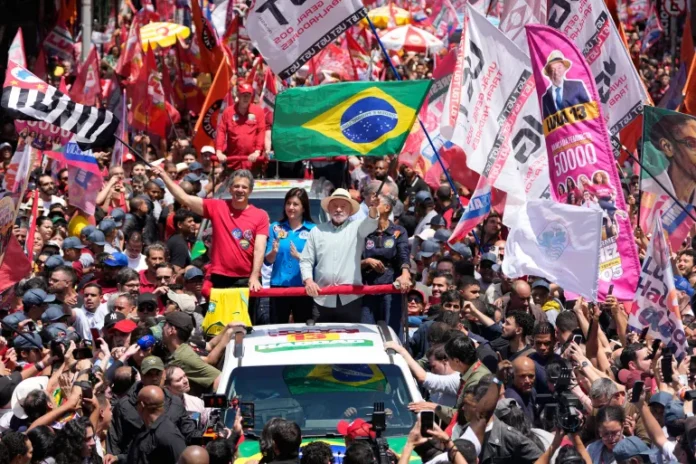
The right wing across the world received a thrashing at the polls over the past few weeks, at the hands of powerful movements. In Brazil, students and workers boldly opposed the rise of Flávio Bolsonaro, spawn of the reviled former president Jair Bolsonaro, by building a movement of massive street demonstrations and assemblies throughout the country. In Serbia, years of youth-led protests against government corruption and repression led to the overwhelming defeat of the corrupt Vučić government.
It’s been mass struggle, not the strength of the establishment political parties, that’s been decisive in these electoral victories. The establishment, like the Democratic Party here, has been as impotent in opposing the rising far right as they have been in addressing the surging cost of living. This has thrust working and young people into mass struggle as they fight these crises, as more than 1.5 million people have participated in protests in ten countries across Europe since mid-September. Elections everywhere are reflecting this anger at the far right, including in the US where Trump’s agenda was rejected by voters in the midterms. In Israel, too, years of protests culminated in a strong anti-Netanyahu vote in late October.
While these defeats for the right are important victories and guideposts for continued struggle, the right is still poised to grow in many countries without a political alternative to the capitalist system. Where movements have ousted right-wing authoritarians from office, there is still a need to rebuild mass organizations that can carry the struggle forward and ultimately take on the capitalist system to kick out the far right for good.
Students Sweep Vučić Aside
In September, after nearly two years of youth-led struggle against government corruption and repression, Serbia’s then-president Aleksandar Vučić was forced to call snap elections. The same day, student movement leaders launched the opposition electoral list “Student List—Students Are Winning.” In an election that saw record turnout, Student List won handily, receiving 53% of votes to the 39% for the Vučić-led “United Serbia” coalition.
Just three days before the election, 150,000 people came out to a Student List rally in Belgrade in support of their slate. This was the result of a years-long struggle sparked by the deadly collapse of a railway station in Novi Sad in 2024 and subsequent cover-up. Student protests were met with police violence, surveillance, and arrests. The movement was flanked by teachers’ strikes and blockades, gaining further momentum from the new mining protests in 2024–2025. Key to this were the student “plenums” that popped up at nearly every major university, which served as democratic centers for the movement where students could discuss their demands and proposals for escalation.
The protests expanded to address the ballooning cost-of-living, youth unemployment, and healthcare crises. In May 2026, students published a five-point health plan demanding “a health worker in every village,” affordable medicines for all, accessible hospitals, investment in public education, and “a system that gives health workers a reason to stay.” This served as the foundation for Student List’s 11-point political platform, which also includes demands around democratic rights, affordable housing, and investment in rural areas.
Student List has filled a void left by the absence of a genuine working-class party and the decline of the trade unions, many of which are controlled by the state and business leaders. However, it is not a clearly left-wing or working-class formation, or even a party. If Student List is serious about delivering on its platform, it must develop into one. Student List prides itself on being “leaderless,” but it could face a crisis if there are no structures in place to continue the struggle and hold leaders to their popular mandate. The best way to avoid this would be for Student List to call mass conferences for all working-class people to decide on its direction, base itself on organizing in the streets and in workplaces, and have a clear eye for taking on the whole capitalist system and its corrupt political machinery.
Workers & Youth Beat Back Bolsonaro (Again)
Brazilian workers and youth rejoiced as the prospect of another Bolsonaro presidency was staved off. Flávio Bolsonaro, a Trump ally, ran on a law-and-order and austerity platform reminiscent of his father’s “Bolsonarismo.” He had a clear lead following the first round with 47% of the votes against the incumbent Lula’s 45%, but just three weeks later, in an astonishing comeback, 10.3 million more voters came out for Lula in the runoff. The decisive factor in defeating the far right was the ingenuity and organizing of millions of young people willing to go much further than Lula’s campaign.
The results of the first round were initially responded to in the universities, where thousands of students marched through the streets of Rio de Janeiro with chants of “Never again Bolsonaro!” The youth leveraged social media, building mass assemblies and street demonstrations using online groups like the “Lula’s Army” WhatsApp channel, bringing together nearly 11 million people. This was soon followed by broad sections of the working class and organized labor movement hitting the streets. It was this movement that won an end to the six-day workweek just before the runoff, which also fueled the Lula vote.
Lula and his Workers’ Party (PT) still have roots in the working class, but today they represent large sections of the capitalist establishment. One student remarked at a demonstration, “We’re fighting for Brazil, not for Lula.” This is no surprise when Brazilian workers face a skyrocketing affordability crisis, as 82% of Brazilian families reported outstanding debts, while Lula has maintained austerity policies. Lula’s approach on the campaign trail rang hollow, talking about how “great” the economy was.
This is exactly why the movement that won this election can’t stop now. More than this, the space exists for a further left alternative to Lula and his PT, which can be built on the back of the movement fighting “Bolsonarismo” and the far right. The left-wing Partido Socialismo e Liberdade (PSOL) must be involved in this process. The party, which includes Liberdade, Socialismo e Revolução (LSR), an organization with which Socialist Alternative is in political solidarity, remains an important point of reference for many workers and young people.
Continue The Mass Struggle Against The Right!
Mass mobilizations of young people and workers have opened up new avenues to fight against the right and for working-class policies. Elections around the world, including the recent US midterms, reflect the mass rejection of far-right ghouls that is taking place at every level of society.
While establishment parties like the Democratic Party and the Brazilian PT have gained a momentary lift from these results, their role in fueling imperialist war and the cost-of-living crisis for working people will be exposed as mass struggle develops. Without a left political alternative, the far right will use the crisis to grow.
This period of inter-imperialist crisis has shown that the establishment cannot be relied upon to deal with the multitude of crises working people face, including the growth of the far right. Only through continued mass organizing in the streets, schools, and workplaces, equipped with a fighting socialist program, can the far right be defeated and working-class liberation won.