

Young people are sick and tired of capitalism. When thinking of our future, all we see is war, poverty, oppression, and climate catastrophe. Both capitalist parties utterly fail to point a way forward. It’s no wonder that, according to a YouGov poll, 62% of Americans aged 18–29 say they hold a “favorable view” of socialism and 34% say the same of communism, reflecting the mass anger at the system on the part of millions.
Many sense the need for fundamental system change to transform society but don’t think revolution is possible within their lifetimes. We do need revolution—a socialist revolution that takes the economic and political power from a corrupt, greedy group of billionaires and transfers it into the hands of the working class. Karl Marx once described revolutions as the “locomotives of history,” bursting through old barriers to speed up human development.
In Socialist Alternative, we are convinced that revolution is both necessary and possible, but it won’t succeed if we’re not prepared. We need a mass movement of working-class and young people, and a revolutionary socialist party at its head. In this article, we will lay out how a revolutionary process can unfold and the role workers and young people can play in it.
Why We Need Revolution
Reforms under capitalism, won by working-class people, have drastically improved our lives. In the US, mass movements in the late ‘60s won civil rights for Black people, the right to an abortion, and basic environmental protections.
But the capitalist class is on the offensive. We are living through a period of inter-imperialist conflict, and to get society ready for war, the capitalist classes across the globe have decisively shifted to the right, seeking to discipline the working class for recent revolts and to crush working-class victories of the past. Establishment politicians are slashing even limited social safety nets in order to increase military spending. In the US, increased authoritarian rule has meant a counterrevolution against the gains of the struggles of the ‘60s and ‘70s—overturning Roe v. Wade, gutting the Voting Rights Act, slashing environmental protections, and more. As long as capitalism remains intact, all reforms can be snatched back.
The recent resurgence of the left in the US and internationally is an inspiring and important step forward but insufficient to address capitalism’s crisis. NYC Mayor Zohran Mamdani ran and won on an exciting platform of improving the lives of working-class people. He has delivered some reforms based on the idea of “good governance,” but without the active participation of the mass movement that got him elected in the first place challenging the system, his further-reaching demands won’t be won. Even electing hundreds of socialists with the same strategy will still not solve the problem, trapped within the confines of the capitalist state.
Reformism represents the adaptation of working-class struggle to the limits of the capitalist system. Historically, it meant the view that a socialist world could be achieved through gradual change and would not require a revolutionary transformation of society. Today, however, reformism almost always refers to a part of the left that believes in the gradual improvement of capitalist society but has given up the fight for a fundamentally different society based on the collective ownership of society’s wealth under workers’ control, rather than concentrated in the hands of the billionaires.
Reformists believe that revolution is neither possible nor desirable. We disagree. Revolutionaries fight tooth and nail for every possible reform, and we do so in a way that raises the expectations of the movement to further the struggle. But we also set our sights far beyond capitalism.
What Makes A Revolution?
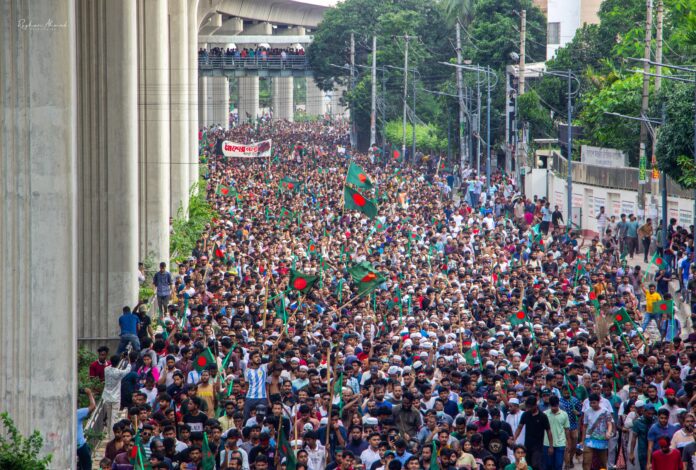
In 2024, Bangladeshi students rose up against their corrupt ruling elite. When the government met them with severe repression, the working class joined the struggle, shutting down production in hundreds of factories, particularly in the highly exploitative and profitable garment industry. This mass uprising successfully toppled the dictatorship thanks to the decisive weight of the working class.
Since then, faced with similarly egregious levels of corruption and bleak futures, young people led rebellions in the Philippines, Nepal, Kenya, Morocco, Peru, Madagascar, and more. The Gen Z revolts have been—and should be—hugely inspiring to youth across the world, in showing the potential power of the masses. But they were missing several key elements—the decisive leadership of the working class and a mass revolutionary socialist party armed with the understanding that the working class needed to take power itself. While many of these revolts drove their leaders from power, none culminated in fully-fledged revolutions.
Revolutionary movements break out rapidly when the masses can no longer tolerate the crises caused by the ruling class that runs society. But what fundamentally makes a revolution is the overthrow of an existing ruling economic class by another class, which then seizes state power and remakes it to construct a new society in its interests. Today, under capitalism, the working class alone holds revolutionary potential. The labor of the working class is the source of all of capitalism’s profits, and its essential position in production gives it the unique power to cause the system to seize, and ultimately to cease functioning. The working class is also the vast majority of humanity, and therefore the only class that can collectively build a society based on our needs—instead of the profits of the billionaire class.
The Russian Revolution provides us with the best example of the working class overthrowing capitalism. In February 1917, women textile workers walked off their looms, marching into the streets of the Vyborg district to demand bread and the end of the Tsarist regime. These strikes snowballed into mass general strikes in Petrograd and by the end of the week, the Tsar was no more. Workers, soldiers, and peasants formed elected councils independent of capitalists or landlords, known as soviets. A provisional, capitalist government also formed at the same time, in which the nonrevolutionaryreformist socialist parties—the Mensheviks and Social Revolutionaries—participated. This government hid itself behind revolutionary-sounding slogans, but in reality, it continued the misery for Russian workers and peasants.
Revolutions require the active participation of the masses. They are not the conspiratorial actions of small groups of hardened activists, but revolutionary leadership still plays an indispensable, decisive role. In Russia, this leadership was the Bolshevik Party, who understood what was necessary to complete the revolution, based on both study of Marxist ideas and their active participation in the working-class movement. The Bolsheviks were educating and organizing workers for years in advance and had built a base of support.
Between February and October, the Bolsheviks exposed the bankruptcy of the provisional government before the eyes of the masses, through their slogans, their written material, and above all their action. Leading with the slogan “All Power to the Soviets,” by October 25, 1917, the Bolshevik party had gained majority support in the soviets and won the workers over to the necessity of a complete transfer of power to the working class. They had so much support that the actual seizure of the Winter Palace was virtually bloodless.
How Do The Masses Become Revolutionary?
Most people don’t instantly turn to revolution when faced with the crises of capitalism. They will initially gravitate to the path of least resistance toward making far-reaching change. The idea of electing socialist representatives and letting them reform our problems away seems a lot easier and safer than organizing for a revolution. However, the opposite is true—history is littered with examples of well-intentioned reformists getting into power and then either 1) getting violently removed from power, or 2) violently suppressing revolutionary movements that they believe are going too far.
Revolutionary conclusions are drawn en masse through the experience of the class struggle, even if that struggle starts with fights for reforms or against counter-reforms. For example, the first Russian Revolution in 1905 began with mass support for a petition, started by an Orthodox priest, asking the Tsar for democratic rights. The masses were far from revolutionary socialists. However, when troops opened fire on the crowd of 200,000, killing hundreds, the demonstrators learned through experience whose side the Tsar and the state were on. In response, hundreds of thousands of workers carried out political general strikes and set up the first-ever soviets to coordinate the struggle. Capitalism was not overthrown in 1905, but the experience led to a leap forward in consciousness, without which 1917 would have been impossible.
The experience of struggle is crucial for the masses to become revolutionary. A Marxist party accelerates this process and is necessary to make a revolution successful. Such a party carries within it the experience and analysis of all class struggle throughout history and distills from it an understanding of the tasks facing the revolutionary working class today. It engages in the working-class struggle to put forward the strategies necessary to win, along with popularizing the need for revolution.
The Transitional Method
To live up to this task, revolutionaries must take care not to politically isolate ourselves from the rest of our class, who largely have not yet drawn the same conclusions. Rooting ourselves in working-class struggles, we must be able to connect their present-day demands to the urgent need for socialist revolution. The Russian revolutionary leader, Leon Trotsky, wrote the Transitional Program in 1938 to bridge this gap. Drawing on many issues that working people still face today, he outlines a method for building a movement that can successfully overthrow capitalist oppression and exploitation.
Central to this method is a system of “transitional” demands that should reflect or build upon the slogans and aspirations of workers in struggle, but should also be so unacceptable to the capitalist class that they could only ever be won through organized working-class struggle. Crucially, they should not stand alone, but be linked together as part of a cohesive program containing both “minimum” demands and farther-reaching transitional demands that likely can’t even be accomplished under capitalism. A transitional program is not a magical key that unlocks class consciousness, but through the process of struggle, can help move workers towards an understanding that capitalism is completely incapable of delivering what the program demands.
The transitional method stands in contrast to the method of a number of small “revolutionary” groups who stand on the sidelines of movements, content to talk about a socialist future while dismissing any fight for reforms as a distraction or a “sell-out.” By refusing to take into account the consciousness of the working class, they cut themselves off from it. Isolation makes revolutionary tasks impossible.
In Socialist Alternative, we engage in all major struggles and always connect these fights with a transitional program that can raise people’s sights about what’s possible.
When ICE occupied the Twin Cities, we participated in rapid response groups, neighborhood assemblies, demonstrations, and labor actions. We also argued, crucially, that mass strike action would be necessary to win the movement’s central demand—to kick ICE out of the state. When union leaders called for a general strike on January 23, we fought to make it as strong as possible. In our activity, we connected the “minimum” demand of getting ICE out of MinnesotaMN with transitional demands such as abolishing ICE to fund social services, as well as legalization and equal rights for all undocumented immigrants. An end to detentions and deportations points beyond the limits of capitalist society. The type of movement necessary to accomplish these demands—one of national general strikes, occupations, and working-class organization—would develop a much more powerful working-class movement: the type necessary to overthrow capitalism.
We use the transitional method in all aspects of our work. For example, in our What We Stand For page (see p. 2), we say “Ban new oil and gas drilling and take the top 100 polluting companies into democratic public ownership. Implement a democratically planned just transition to 100% renewable energy as part of an international plan.” Starting with the climate movement’s “minimum” demand to ban new drilling, we link a call for “democratic public ownership” that directly challenges the capitalist ownership of the polluting industries and counterposes workers’ control. Winning this will require building a mass movement of walkouts, protests, strikes—particularly in polluting industries—and likely workplace occupations. Because they address real issues facing working-class people and walk them to socialist conclusions, transitional demands are better able to connect with the masses than simply shouting for revolution from the sidelines.
The “”Dual Task””
The task of building a mass party capable of leading the working class to revolution is far from straightforward. To navigate our path toward that end, we must understand the changing political terrain.
For much of the 20th century, mass parties of the working class—typically named “socialist” or “communist” parties—grew across the world, fueled in no small part by the legacy of the Russian Revolution. Unions boomed. These workers’ organizations certainly had shortcomings. Nevertheless, genuine Marxists engaged in them and argued for revolutionary ideas, in theory and action. However, the neoliberal offensive of the ‘80s and ‘90s and the collapse of the Soviet Union in 1991 triggered capitalist triumphalism around the world. The then-mass workers’ parties lurched to the right and became thoroughly capitalist parties. The unions shrunk and hollowed out as their leaders largely gave up fighting. A world without vibrant mass organizations for workers makes it much more difficult for revolutionaries to gain an active echo.
Genuine Marxists don’t and never have sat on the sidelines waiting for revolution to come. Amid this setback, our organization developed the concept of the “dual task”: we must continue building a revolutionary Marxist leadership while simultaneously playing a key role in rebuilding the fighting capacity and organizations of the working class. Socialist Alternative and our co-thinkers in International Socialist Alternative continue to apply this method.
We connect the activity of our revolutionary organization with proposals for how the broader movement should grow. For example, in 2012, when we ran then-SAlt member Kshama Sawant as an independent revolutionary socialist for the Washington House of Representatives, we called on the Occupy Wall Street movement to run 200 independent left candidates to contest the corporate Democrats and the Republicans. Though Occupy unfortunately did not run any candidates, we built our campaign to point the way forward. This paved the way for our successful Seattle City Council campaign in 2013, lending us credibility in arguing several years later that Bernie Sanders and the socialist wave needed to build an independent working-class party.
New mass workers’ parties are not likely to initially be revolutionary ones. But part of rebuilding the broader workers’ movement means engaging in the battle of ideas. Revolutionaries must struggle alongside the movement, using every step to raise workers’ confidence to fight for more and to win workers over from the limitations of reformism. Through this process, revolutionaries both push the broader movement forward and temper the forces of Marxism required to lead the working class to socialist revolution.
We firmly believe that revolutionary movements can and will happen within our lifetimes. We need to be prepared to seize the moment when they do. Whether or not they are successful will depend on the strength and ability of the working class’s leadership. Socialist Alternative is hard at work playing a role in forming that leadership—joining us is the best way to organize for revolution in the here and now.