

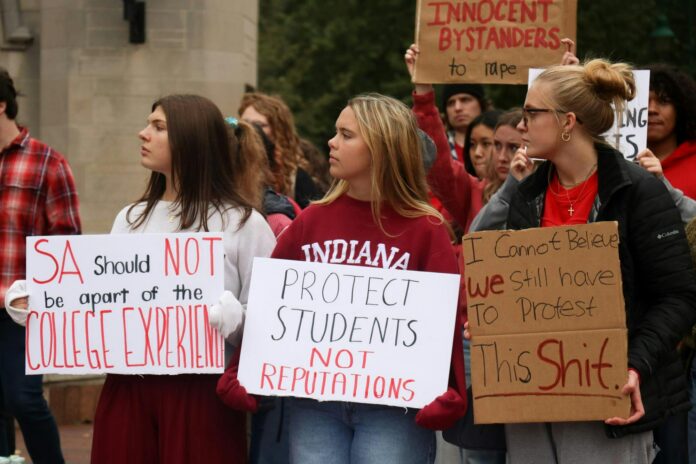
The horrific details of Jane Doe’s rape have sent shockwaves across the US. But the outrage goes beyond the exceptional brutality of the assault itself: it reflects the all-too-common experience of sexual violence and the predictable failure of institutions to hold perpetrators accountable.
Cornell’s hypocrisy could hardly be more glaring. The university touts “free and open inquiry and expression” as a core value, but the administration’s actions reveal its true priorities. As student protesters have painted across campus: “At Cornell rapists are protected, protesters are expelled.”
Since news of Jane Doe’s case broke, women have flooded social media with #IAmJaneDoe solidarity posts, while more than 70,000 Cornell alumni have signed a petition calling for the resignation of complicit university administrators. Protests have rocked Cornell’s campus, including a seven-hour sit-in commemorating each of Jane Doe’s seven torturous hours in the frat house. A national day of action on October 8 under the banner “Stop Sexual Violence: From the Frat House to the White House,” saw more than 100 actions, largely on college campuses.
The feminist movement in the US has faced setbacks in recent years, particularly the repeal of Roe v. Wade without a serious fightback. While the mass anger against the Cornell 7 hasn’t translated into sustained protest, it has opened the door to a potential resurgence of a new women’s movement. Anger against the deep-seated sexism woven into the fabric of capitalist society and the stark contradiction between this reality and the promises of steady social progress previously found expression in #MeToo and the Women’s Marches. While not without their limitations, these movements showed the potential for a mass women’s movement that continues to simmer beneath it. We must urgently draw out lessons from past struggles to distill what is needed to transform this anger into an all-out struggle against the entire sexist and oppressive capitalist system.
From #MeToo To #IAmJaneDoe
While the global wave of feminist struggle in the 2010s included SlutWalks against rape culture in dozens of US cities, the emergence of #MeToo marked a turning point for a new feminist movement in the United States. The hashtag, originally coined by feminist activist Tarana Burke in 2006, went viral in late 2017 following revelations of numerous allegations of abuse against powerful Hollywood producer Harvey Weinstein and a simple tweet from actress Alyssa Milano: “If you’ve been sexually harassed or assaulted, write ‘me too’ as a reply to this tweet.”
It was no small feat that #MeToo helped bring down Harvey Weinstein, who had reigned for decades as one of Hollywood’s most powerful and influential figures while evading accountability for the sexual abuse of over 80 women. Beyond Weinstein, more than 200 powerful men—politicians, business executives, and Hollywood celebrities—lost their jobs in the year following the hashtag’s viral explosion amid high-profile allegations of sexual misconduct.
Of course, #MeToo had significant limitations: it was a predominantly online movement that largely centered the experiences of relatively powerful, elite women with built-in platforms. But it was more than a celebrity trend. While #MeToo is best remembered for exposing powerful men in Hollywood, the movement also briefly extended beyond celebrity hashtags and into powerful workplace actions. McDonald’s workers in ten cities staged walkouts demanding stronger protections against the widespread sexual harassment women face on the job. Roughly 20,000 Google workers around the world walked out to protest the company’s inadequate response to sexual harassment, including its decision to give a senior executive accused of sexual harassment a whopping $90 million exit package.
These actions pointed toward something much bigger than taking down individual perpetrators: confronting the systemic conditions that allow sexual harassment to remain widespread and underreported, while victims face retaliation far more often than perpetrators face consequences. Unfortunately, this potential was never fully realized. #MeToo largely remained focused on exposing individual abusers and demanding personal accountability, without developing a broader challenge to the institutions and economic structures that protect them. Still, the workplace walkouts offered a glimpse of what a different trajectory could look like: collective, united working-class action against the sexism deeply embedded in capitalist society.
While #MeToo did not develop into sustained street protests, it was flanked by two years of Women’s Marches that drew millions, with the 2017 march marking the largest single day of protest in US history at that point. The marches channeled widespread outrage at a sexual predator-in-chief caught on tape bragging about grabbing women by the pussy, offering a glimpse of the potential for a powerful new women’s movement. But without translating this mass anger into escalating collective action and demands for systemic change, momentum stalled.
This outcome was hardly inevitable, but reflected the logical culmination of a movement chained to the Democratic Party—a party more threatened by Bernie Sanders’ democratic socialism than by allegations of sexual assault against Biden, and with little to offer beyond “Vote Blue No Matter Who.” Democrats’ return to power in 2021 did nothing to reverse this trajectory.
One of the central cudgels wielded in defense of lesser evil threats—the specter of Republicans overturning Roe v. Wade—became reality with the Dobbs decision as the Democrats controlled the presidency and both chambers of Congress. Yet even in the face of this historic defeat, Democrats continued to kick the can down the road, insisting that voting blue in the next midterms would somehow fix things instead of launching any serious defense of reproductive rights. Given the abysmal vacuum of leadership on the left, it’s no surprise that demoralization took root, the smattering of protests against Dobbs retreated, and the terrain was left wide open for right-wing backlash to take root. This is a crucial lesson in the context of the massive Democratic victory in the 2026 midterms—we cannot afford to just let them “take it from here.”
Divide & Rule: A New Era Of Reaction
This massive setback for women’s rights was part of a broader reactionary turn following a decade of powerful struggle that culminated with the largest protest movement in US history, the 2020 Black Lives Matter movement. Millions took to the streets and shook capitalist institutions to their core. Without democratic structures to form unified demands and strategy, though, the ruling class was able to regain ground. This initially benefitted the Democratic Party, who posed as the movement’s “allies.” Yet as the facade that “woke capitalism” could deliver fundamental change inevitably began to crumble, a right-wing offensive has taken the upper hand. We’ve now entered a new era of reaction, marked by resurgent nationalism, militarism, and bigotry, with escalating attacks on the working class as a whole. Scapegoating and terrorizing the most oppressed groups—immigrants, trans people, people of color, and women—is central to keeping the working class weak and divided.
While initially unthinkable to many women that Roe v. Wade could be overturned nearly 50 years after abortion rights were won, it is now just one part of an increasingly dystopian reality. The rise of the “manosphere” and the “tradwife” phenomenon reflect a broader reactionary push to isolate and disempower women as they are forced out of the workplace and back into the home and stripped of their bodily autonomy. This counter-offensive against women since #MeToo is a grim reminder that, when its power is threatened, capitalism will shed any veneer of steady social progress and fall back on its age-old strategy of divide and rule.
As its disguises wear increasingly thin, the failures of the system itself are more visible than ever. The case of Lindsay Clancy has also put on full display the failures of the capitalist for-profit healthcare system and its utter disregard for women, especially mothers, leaving women in crisis without the support they need. Meanwhile, the anger directed at the Epstein network has exposed a broader resentment toward the billionaire class: the sense that wealth and influence buy one kind of justice for the powerful, while the rest of us are left to fend for ourselves. Together, these cases have fueled a growing recognition that the fight against women’s oppression cannot be reduced to picking out individual bad apples when the system itself is rotten to its core. The climate was ripe for the case of the Cornell 7 to trigger a new flashpoint for feminist struggle.
Rebuilding a Feminist Movement
The women’s organizations of today are weak and fragmented, often little more than get-out-the-vote arms of the Democratic Party. We urgently need to bridge the gap between this lack of organization and the tasks facing the women’s movement, drawing lessons from both the victories and the weaknesses of the mass women’s organizations of the 1960s and ’70s.
At its peak, the National Organization for Women (NOW) had more than 700 active grassroots chapters, providing a powerful umbrella for the women’s movement. Its leaders included experienced labor activists who combined legal strategies against sexist discrimination with militant tactics. During the 1970 Women’s Strike for Equality, tens of thousands of women walked out of their workplaces and took to the streets, while more radical sections of the movement demanded free abortion on demand, free childcare, and equal pay for equal work. The movement had serious limitations, particularly the influence of liberal currents that centered white, heterosexual, middle- and upper-class women while marginalizing others, and prioritized legal reforms over broader social transformation. Despite these, the second-wave feminist movement won significant advances, including abortion rights, Title IX’s prohibition of sex discrimination in education, and the Equal Pay Act. The movement’s strength was rooted not only in women’s growing participation in the workforce, but in their key role in the powerful labor militancy sweeping the country as women and men fought alongside one another in major class battles.
Fighting on a class basis, which means working people recognizing that their interests are diametrically opposed to those of the capitalist class, will be fundamental in addressing issues of women’s oppression. Working-class women today face a multitude of challenges. Of the almost half a million women who dropped out of the workplace in 2025, 55% were Black women, despite Black women making up only 14% of the workforce. By the end of 2025, 13 states had total abortion bans in effect, while six more had six- or twelve-week bans. An estimated 142,000 people crossed state lines to obtain abortion care in 2025, including 62,000 people from states with total bans. For those who cannot afford travel, time off work, childcare, or the procedure itself, abortion rights remain out of reach.
The 2025 reconciliation law is projected to reduce Medicaid enrollment by about 12.9 million people by 2034 and cut SNAP spending by roughly $211 billion through 2035. These programs are lifelines for millions of working-class women, children, disabled people, and families. Cutting them means more people going without healthcare and food, while women are expected to take on even more unpaid care work.
Poor women also face a disproportionately high risk of sexual violence. The 2017 National Crime Victimization Survey found that people with household incomes under $7,500 experienced rape or sexual assault at 12 times the rate of those with incomes over $75,000.
Winning real change will require more than exposing individual perpetrators or appealing to institutions that have repeatedly failed women. It will require rebuilding mass, democratic organizations capable of bringing together working-class women across workplaces and communities, developing demands that address the material conditions of women’s lives, and organizing collectively to fight for them. Industries dominated by women—including healthcare, education, childcare, and service work—are central to the labor movement. Workers in these sectors are systematically undervalued by capitalism. However, they wield enormous power. Unions should play a central role in connecting key demands that unite economic issues with the oppression of women, like paid parental leave for 18 months and free, high quality childcare. Rebuilding a fighting labor movement that takes up battles against oppression will be key to addressing the issues facing women today, both inside and outside the workforce.
In addition to taking up walkouts, strikes, and other militant working-class tactics, a renewed women’s movement must connect with other struggles against oppression: against ICE raids and state repression, anti-Black racism, and attacks on queer and trans people. Without this as a serious priority, any women’s movement would be doomed to repeat past failures.
Last, but certainly not least, just as the reactionary turn of the ruling class is global, so must be the resistance—from mass protests against rape in India, to movements against femicide in Latin America and Africa, to the international outrage sparked by Gisèle Pelicot’s case in France. These struggles cannot remain isolated; they must be linked through sustained international solidarity and organization.
Women’s Liberation Means Ending Capitalism
The violence against women and girls, and the systematic denial of justice, expose the rot at the heart of capitalism. Anti-ICE protesters can face decades in prison, while powerful men accused of sexual violence evade meaningful consequences. We cannot place our faith in the courts, police, or political parties that defend this system. Nor can we rely on the Democrats to deliver women’s liberation through the ballot box while refusing to challenge the interests of the ruling class: we need a new working-plass party that actually fights for women and unites struggles against all forms of oppression.
The anger now being expressed—from Cornell to the streets and workplaces—could radicalize a new generation of young women. But turning that anger into lasting change requires a clear socialist feminist approach that connects the fight against sexism to the root cause of women’s oppression, a system that depends on exploitation, inequality, and division. A socialist society, one which removes the economic basis for women’s oppression, could lay the basis for genuine liberation for our entire class, including more safety and sexual freedom for women. Building a movement that can transform society means taking up clear demands that go beyond defensive struggles and inspire united working-class struggle, including not just the right to free, safe, legal accessible abortion, but the right to truly choose whether and when to have children, without the burden of economic insecurity. Truly winning women’s liberation will require an international, working-class struggle capable of uprooting the entire system that reproduces women’s oppression and build a society organized around human need, not profit.