

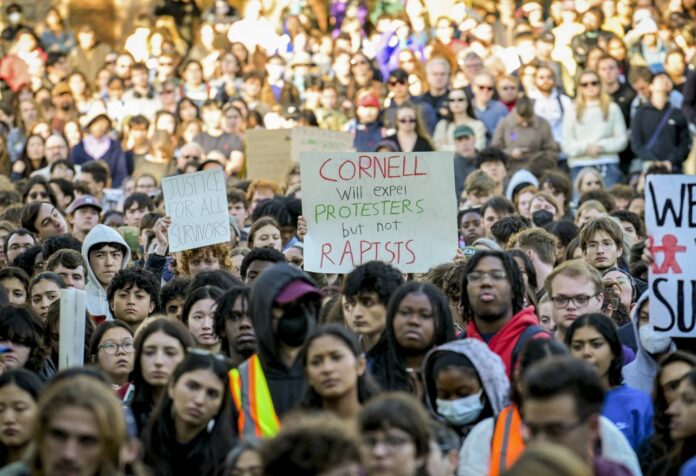
The account of Jane Doe has rapidly taken the country by storm, just weeks after she filed a lawsuit against Cornell University for the horrifying sexual assault she experienced as an undergraduate student there. Women all over the country clearly identify with all aspects of Doe’s experience, with thousands flooding social media with the hashtag #IAmJaneDoe.
Most of the fraternity members who took part in her orchestrated rape were disciplined with little more than a slap on the wrist. It has become painfully clear to a whole new layer of young people just how useless and incompetent, sometimes seemingly willfully, both campus and state police forces are, especially in cases of sexual violence. Protests have erupted in Cornell’s hometown of Ithaca, New York, and a national day of action has been called for October 8, which includes 100 events nationwide including many student walkouts.
These are the seeds of an important resurgence of feminist struggle after a years-long setback following its height in the 2010s with the #MeToo movement internationally, the Ni Una Menos movement in Latin America, feminist strikes across Europe, and more. Rebuilding a fighting feminist movement today is crucial for pushing back on the reactionary anti-feminist backlash, exemplified by Trump and his attacks on all oppressed people.
The Whole System Is Guilty
Tomkins County District Attorney Matthew Van Houten came increasingly under fire for his failure to pursue Doe’s case, declining to review more than a fraction of the evidence allegedly offered by the Cornell campus police. He has given conflicting stories about whether his office reviewed the fraternity’s straightforwardly incriminating group Snapchat messages, and he insisted that in her statements Doe described the events as consensual. Only days later, he was overwhelmingly contradicted by her interview transcript, which he then denied having seen in the first place. This stands as a stark example of a systematic failure to fully investigate rape cases.
All told, Cornell had thousands of pages of evidence surrounding Doe’s case, including police records, Title IX testimony, group chats, disciplinary findings, and the university’s own documentation. They’ve also repeatedly changed their story about what they provided to the DA’s office, which apparently declined comprehensive information from Cornell. If this is true, the university had a clear responsibility to push ahead and escalate the investigation, but instead tried to sweep it under the rug to avoid a scandal—a decision that is majorly backfiring under public scrutiny and protest.
Powerful universities like Cornell, which are funded by elite groups of billionaire men, are far more concerned with protecting their own prestige and endowments than their students, particularly women. Many of these elites can be found in Ivy League fraternities; one of the Cornell 7, Winston Lee, is highly speculated to be part of the most elite and powerful families in South Korea. It would not be surprising if this were a factor in why the case was never pursued in the criminal courts.
Cornell President Michael Kotlikoff released a tepid non-apology video, replete with trite platitudes and surface-level sympathy. Apparently his “heart aches” when he thinks of what Jane Doe experienced, but not enough to have pursued a criminal investigation based on her original, highly disturbing report. This is the same university president who backed his car into pro-Palestine protesters after a campus debate last spring. The true intention behind a video like this is to diffuse the situation and shut down struggle at any cost, but instead, the opposite is happening, with mounting calls for his resignation.
Protesters and administrators alike can see that struggles on campus and those in broader society are deeply connected, often one and the same. October 8 demonstrations held by the Women’s March are boldly calling for an end to sexual violence “from the frat house to the White House.” The ongoing protests in France around school conditions, where labor unions are joining students for their next day of action, also show how student protests can catalyze broader struggle, which neither school administrations nor the political elite can tolerate.
In an attempt to quell further struggle, New York Governor Kathy Hochul has assigned New York Attorney General Letitia James to take over the case from Van Houten. The movement can have no illusions in James—who has a record of letting killer cops walk free—to win justice for Jane Doe and protect future victims. Any progress toward justice surrounding this case has come and will continue to come from the explosion of public outrage. It will require a serious mass movement that shuts down business as usual to see any actual charges and convictions against the Cornell 7.
No Faith In The Courts Or Democrats—Escalate the Struggle!
The courts and the Democrats, who are tied to the wealthy and powerful, won’t save us. They’ve allowed countless attacks on women and bodily autonomy to go unchallenged, most notably the overturn of Roe v. Wade in 2022. The kind of fightback we need will be built from the ground up, starting with things like the October 8 day of action, which includes a call for student walkouts.
The struggle against sexual violence is hardly confined to the US. Over the last month, protests have erupted at Indian universities over rape cases and face the same kind of gaslighting and buck-passing as in the US. Both the feminist wave of the 2010s and the backlash against it were international and it will take an international movement against the entire sexist capitalist system to bring this violence to an end.
Students at Cornell have organized protests, as well as a seven-hour sit-in to mark the seven hours Jane Doe was tortured. This is a very important step, and the struggle needs to escalate further to include workplace actions such as campus union strikes. Workers and students throughout Ithaca should shut down Cornell until the seven perpetrators are charged and indicted. The labor movement has a key role in fighting oppression, a tool used to divide the working class, because it has the power to shut the system down.
We’ll never fully see justice while our education system is beholden to billionaires. That’s why the fight against campus sexual assault is entirely connected with the fight to end the whole profit-driven capitalist system, and the need to replace it with a socialist system that can finally see an end to all forms of oppression.