

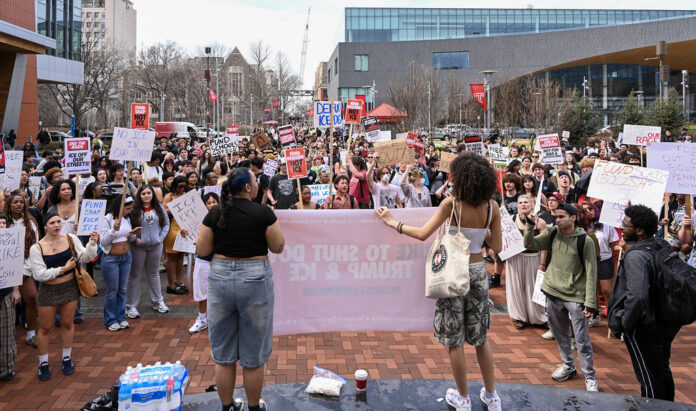
On March 11, over 500 Temple University students in Philadelphia walked out against ICE terror and to defend the right to protest. Students protested in solidarity with Jerome Richardson, a Temple student who was arrested on federal charges of conspiracy for protesting against ICE in St. Paul, Minnesota.
When Temple student Darryl heard about this egregious repression, they didn’t take it lying down. Inspired by the January 23 Minneapolis general strike and seeing student walkouts against ICE across the country, they fought back, alongside other students and Philadelphia Socialist Alternative. We spoke to Darryl and Rachel, a Temple alum and SAlt member, about exactly how they made it happen.
Socialist Alternative: What made you decide to organize this walkout and how did you get it off the ground?
Darryl: I’d seen the reports of what happened to Jerome and it really upset me. Also when I saw it on the news, it was just one paragraph. I was like, this is much bigger than one paragraph. And we couldn’t even talk about it in our classes. I thought, I could be targeted next if I protest against what Trump and ICE are doing. We had to do something.
The first step was meeting with people. You can’t do something like this by yourself, it’s impossible. So I sent you guys [Socialist Alternative] a DM on Instagram and said we should build a walkout, and Rachel was like, you can do that. And we just took it from there.
SAlt: How did you spread the word and get more people involved?
D: The first main tactic was first creating a flyer for a planning meeting, something people can see. It’s not just a flyer, it’s a tool—that’s how most of the word spread, seeing someone who can talk to you face to face about these issues.
We also went to other student orgs and invited them to our first planning meeting, where we discussed the reasons we were walking out and then talked more concretely about how to make it happen. We divided tasks between us and that made it a lot stronger, because we could each use our strengths uniquely and that elevated it to a different level. After that we had info sessions, art builds, safety trainings.
It was always very organized, everyone was welcome to share their ideas. A lot of campus organizing stuff I’d seen the fatal flaw was one person being in charge and they talked the majority of the time, but at these planning meetings, the reverse was the case. We had a person chairing, moderating and keeping it organized, and everybody had space to speak. At our first meeting, we decided on some of the demands we should fight for:
- No ICE on Temple’s campus and no collaboration or data sharing with ICE
- Drop the charges against Jerome
- Reverse all punitive measures taken against SJP, JVP, and all student activists
Rachel: Students volunteered to use their free printing to print thousands of flyers that we handed out every day leading up to the walkout and plastered around campus. We made announcements in classes encouraging peers to walk out and reached out to other student orgs. We also reached out to unions on campus and encouraged supportive teachers to email their union to support the walkout, since we know students and workers are stronger united.
SAlt: A little over a year ago, there were massively inspiring encampments at campuses across the country to protest the genocide in Gaza. These encampments faced brutal repression, from police and campus administrations. Was there any fear of this type of repression?
R: Definitely. Every official student org we reached out to was supportive of the walkout, but unwilling to sign on because they were afraid they would lose club status. SJP and JVP both faced repercussions for breaking the new student code of conduct that effectively bans protesting on campus as “disrupting educational processes.”
D: One question we dealt with was from international students who were afraid to protest because they were worried they’d be targeted. We understand that fear, but we argued that fear will only play into the hands of the ruling class, because if people are afraid to protest then protest won’t happen. They want us to be afraid and divided, so that our fightback is weaker.
SAlt: How did the walkout go? What were your main takeaways?
D: It was insanely successful. The beginning rally had 500 students, and then we drew in more as we marched on Broad Street. It shows just how frustrated the community is with ICE and the Trump regime.
Speakers talked about the inhumane tactics of ICE, the war in Iran, and how all these issues are interconnected, they’re all intertwined. It’s all part of a systemic issue.
R: The police tried to stop us from using megaphones. So we started our chants without the megaphone and pulled it out when our crowd was big enough, chanting “we will not be silenced!”
D: Then at the end we had an open mic which was really impactful because people got to share their point of view. It made people feel like they were part of something. This system can make people feel like they’re a cog in a machine, but here they felt like they had a voice.
SAlt: So what are the next steps?
D: Our immediate next step was building for a Students for a General Strike teach-in, to talk, and get people organized. It’s important for people to show up, but more powerful than people showing up for a protest is being willing to start a protest. So for that we need to get organized, and the first step to that is political education.
Coming out of the teach-in, we’re building for the day of action of “No work, No school, No shopping” on May Day. The walkout was great for getting students mobilized, but a general strike across the nation will unite us as the working class, and show that we have the power to fight the machinery, we have power to fight against the ruling class.