

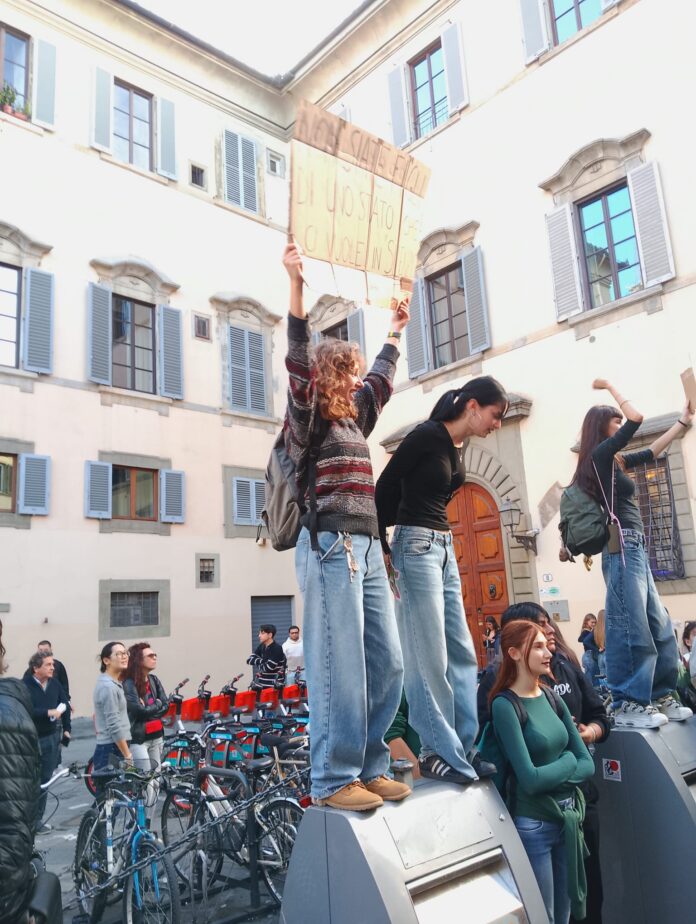
Over the past couple of months, the “Gen Z” protests have erupted once more. From Spain to France, Belgium to Germany, millions of youth and students have taken to the streets. While the triggers for each movement may be different (France: education, the Spanish state: housing), all have their roots in the crises of the capitalist system, as nation states prioritize increases in military spending, with cuts to education, healthcare, and the social care system more generally.
It is in this context that hundreds of thousands of school and university students across Italy have taken to the streets to oppose militarism and war, and to fight for a fully-funded education system.
This began on October 17, with massive protests in Roma, Milano, Firenze, Bologna, Pisa, and elsewhere. Some 400,000 students and youth came out onto the streets, in a positive and determined mood.
As in other protest movements across Europe, there has been a small minority of participants that have acted violently, smashing windows and shops, and the mainstream media have focused largely on this; portraying the movement as violent. The Italian state picked up on this immediately after October 17, granting police powers to 10,000 soldiers and not so subtly encouraging football “ultras” to come out and “defend the streets.” It is likely that at least some of those carrying out the violence are indeed agent provocateurs of the state, sent to deliberately give the movement a bad image.
ISA supporters were able to take part in one of the student protests on October 26 in Firenze. This particular protest was called in response to a visit to the city by the Minister of Education Giuseppe Valditara, who, alongside the Prime Minister Georgia Meloni, is a focal point of the protest movement.
The protest, organized by numerous student collectives, was joined by a contingent of teachers and university workers under the banner of the CGIL, the oldest and largest trade union confederation in Italy, representing some five million workers. Also joining the protest was a section of GKN workers, who have led the longest ever workplace occupation in Italy. These workers, under threat of redundancy, have produced a plan to run the factory themselves, producing socially useful and green items, such as cargo bikes and solar panels.
Unfortunately, as the protest marched towards Piazza Madonna degli Aldobrandini, they were met by several dozen members of DIGOS (the Italian police’ special operations division). These state forces physically held back the protesters from continuing their march, often roughly pushing people as young as 14. This was undoubtedly an attempt to antagonize the protesters and get a rise out of them, to give the Italian police, who had several vans and dozens more officers further up the road, the opportunity to then brutally attack the protest.
Despite these attempts by the state, the young protestors remained disciplined. They have already learned that to unnecessarily attack state forces is not the most productive strategy, and instead chants of “when the people are united, we will never be defeated” and renditions of Bella Ciao were sung to keep students’ morale up.
After an hour of this, the DIGOS forces backed down and the students were allowed to continue their protest. Speaking to Giulia, a local school student who said “these are the forces of the far right, they are the forces of Meloni. We face them every day and she wants to increase repression of protests. We cannot back down in the face of these attacks, but fight for our future,” speaks of the understanding of the current situation. She went on to say “we will be supporting the general strike on Friday, we have to unite the student movement with the workers movement to have a chance of victory.”
This instinctive solidarity shows the massive potential of the movement across Italy, and many students were excitedly discussing the Serbian elections, where only the day before, the “student list” had won an effective majority in the parliamentary elections. Aurora, a university student said, “It’s amazing that the students have been able to organize a political grouping like that, we need the same here!”
The lack of a mass workers’ party, bringing together the different elements of struggle in Italy today, points towards the necessity of building just that. The general strike this Friday could provide the next stepping stone, with students joining picket lines and protests across the Italian state. The trade unions have an integral role in this, they should be putting forward the call to bring together workers and students in struggle, to begin discussions on the next steps of the struggle. Beyond the streets, the working class needs to organize politically to take up the fight against Meloni, war and capitalism.