

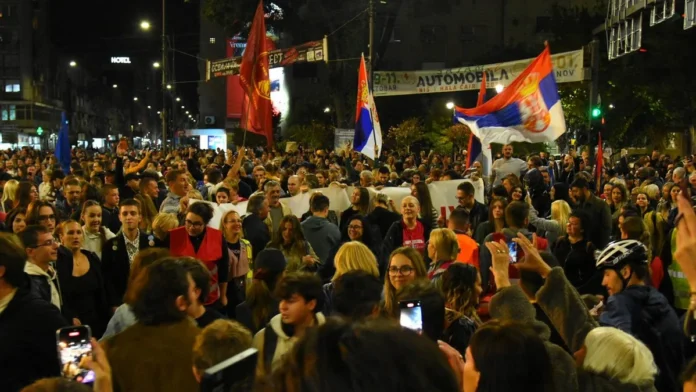
Sunday’s election in Serbia resulted in a victory for the movement and a crushing defeat for Aleksandar Vučić and his authoritarian, corrupt regime. The election was won by the newly formed Student List, which emerged from the mass movement that has transformed the country over the past nearly two years. At last, the struggle also succeeded in achieving one of its primary goals—ousting Vučić, who had ruled the country since 2014, first as Prime Minister and then as President. When the election results were confirmed, the streets were filled with jubilant people across Serbia.
This historic election victory inspires hope and raises expectations, whilst giving the struggle across the rest of Europe a new lease of life.
The Student List secured nearly 53% of the vote, compared with 39% for Vučić and his right-wing party, the SNS. Voter turnout was higher than it has been for a very long time—nearly 70%. This result means that, for the second time in the space of six months, an authoritarian right-wing regime led by a Trump admirer and Putin ally has been voted out; first, Viktor Orbán lost the election in Hungary in April after 16 years in power, and now Vučić, who stepped down as president before the election in order to try to remain in power as prime minister.
This was a maneuver reminiscent of the one Putin carried out in 2008, when he had himself appointed Prime Minister after stepping down as President because he was barred from standing in three consecutive elections. Putin then ensured his return as President in the rigged election of 2012, but in Serbia, the struggle and the public sentiment made it virtually impossible for Vučić to remain in power through electoral fraud. Had he attempted to do so, or had he been unwilling to concede defeat in the election, it would likely have provoked an immediate mass uprising. The fact that at least 150,000 people gathered in the capital, Belgrade (in a country with a population of around 6.6 million), three days before the election to show their support for the Student List, was a measure of the public mood and the desire for change.
The Students’ List candidates had been selected following extensive discussions at the universities and finalized following a decision by a special “election commission.” Despite its name, there are no students on the list; instead, it is dominated by professors and various experts. The list also includes a former central bank governor and several “celebrities.” It is headed by the cardiologist Ilija Srdanović, who is expected to become the new prime minister.
The Student List was supported by a number of smaller opposition parties and received backing from at least one of the central trade union organizations (the Alliance of Free Trade Unions). However, trade unions are weak in Serbia, and a few years ago it was estimated that two out of three trade unions were controlled by the state or employers.
With strong support from large sections of the population behind it, the politically diverse Student List has an opportunity to become a unifying force and, at least temporarily, fill the political vacuum created by the absence of strong, independent workers’ organizations and a socialist left.
The founders of the Student List firmly maintain that it is not, and will not become, a political party, and that it has no leader. However, the election victory has brought into focus how and in which forums the Student List’s policies are to be shaped, as well as, for example, the question of control over the parliamentary group. So far, it has been unclear what binds the candidates to the Student List after they have been elected and to which democratic bodies they are required to be accountable.
Continued organization is essential not only at faculty level but also in workplaces and within the local community to ensure both democracy and accountability, as well as to maintain awareness and readiness for struggle.
The struggle and the election victory raise, to an even greater extent, the question: what kind of organization and political program are required to move forward and resist the blackmail to which the representatives of the Student List will be subjected by the remnants of the old regime, the state and the domestic capitalists, as well as by all the imperialist powers vying for control over the country and its resources. Political independence requires collective organization based on the working class and democratic structures at all levels, combined with a conscious struggle to form a new revolutionary socialist party.
Two Years Of Mass Struggle
The protests that followed the collapse of the roof at the newly renovated railway station in Novi Sad, the country’s second-largest city, on November 1, 2024 marked the beginning of the end for Vučić’s rule. The roof collapse claimed the lives of 16 people. But when relatives and those who gathered for demonstrations to honor the victims demanded answers as to why the roof collapsed and who was responsible, they were met with a cover-up and repression.
Just a few days after the roof collapse, thousands marched through the streets of Novi Sad to hold those responsible to account for the fatal accident—which many described as murder—in what has been described as “the largest demonstration in the city for many years.” (BalkanInsight, November 5, 2024)
No official explanation has yet been given for the incident—the station construction was a key part of Chinese imperialist infrastructure project “One Belt One Road” in Europe—and no one in charge has been held to account or convicted.
The protests in Novi Sad in November two years ago quickly grew into one of the largest protest movements in Europe in decades. In March last year, for example, just over 300,000 people demonstrated in Belgrade—nearly 5% of the country’s population. Students were at the forefront of the protests, but they were not alone. The protest movement was backed, for example, by teachers’ strikes and blockades, and gained further momentum from the new mining protests held in 2024–2025, which forced the mining giant Rio Tinto to shelve its plans to open Europe’s largest lithium mine (the Jadar mine) in Serbia.
Initially, Vučić’s government calculated that a combination of repression and concessions—including the dismissal of a few ministers—would be enough to weaken the protests and that the movement would eventually run out of steam. However, unlike previous protest movements in Serbia, this one was considerably more persistent, better organized, and unwilling to give up its original demands—namely, to make public all documents relating to the renovation and redevelopment of the railway station; to identify and prosecute those who had attacked the students; to drop the charges against the arrested demonstrators; to increase funding for higher education by 20%—or the demand for new elections, which was increasingly coming to the fore. In short, the corrupt and authoritarian regime had to go.
In addition to the state’s security forces—the police, the army, and special forces—the regime also mobilized armed, fascist-like militias linked to the ruling SNS party against the protest movement. The movement defeated these attacks and, at the same time, spread to encompass over 400 towns and cities across Serbia. As the protests spread, the regime became increasingly weakened and isolated, and in September this year it was forced to call a snap election.
Vučić’s resignation as president was a maneuver designed, if possible, to keep the SNS-led right-wing coalition in power. The fact that the outgoing president became the governing bloc’s lead candidate for the post of prime minister confirmed that this was indeed the case.
Student List Contradictions
It immediately became clear that the election would be a choice between the old regime and the new Student List, which had emerged from the discussions and meetings held at universities during the spring of 2025. The Student List will also stand in the presidential election at the end of December.
The Student List’s 11-point political platform focuses on demands for greater democracy, such as a free press, transparency, a program aimed at combating systemic corruption, establishing the independence of the judiciary, scrutinizing public spending on infrastructure, and enforcing what is termed strict institutional accountability. Demands are made for the construction of affordable housing, particularly for those working in education and healthcare to prevent a “brain drain,” better conditions for temporary workers and improved healthcare, free schoolbooks and cheaper, state-subsidized medicines, as well as investment in rural areas.
According to the British newspaper The Independent on October 26, the Student List is also putting forward bold demands to break the monopolies of the food giants and to reduce food prices, “in combination with a tax reform that raises taxes for wealthy citizens and lowers them for low-income earners.” Furthermore, the Student List asserts that “Serbia must not be a source of cheap labour and natural resources that foreign companies can exploit.”
However, all these demands for necessary improvements and changes clash with the fact that the Student List simultaneously wishes to “build a competitive market economy” and is not prepared to take the necessary step of moving beyond the framework of capitalism, which is required if its program is to be realized.
As regards foreign policy, it remains unclear what stance the Student List and its MPs intend to adopt. The statements made so far suggest that they will attempt to continue the balancing act between the imperialist powers that characterized Vučić’s regime. The Student List has spoken out against Kosovo’s independence and, like the old regime, asserts the reactionary idea that “Kosovo is an integral part of Serbia” and “part of the Serbian national identity.”
The Student List has expressed its opposition to sanctions against Russia, which is Serbia’s largest supplier of natural gas. Furthermore, it has opened the door to deeper cooperation with China regarding high-tech investments. Serbia is Chinese imperialism’s most important foothold in the region, and China is the country’s second-largest trading partner; the largest is Germany.
European Imperialist Vultures Circling
Serbia has been a formal EU candidate country since 2012 and has been negotiating membership since 2014. Under Vučić, who was previously very much in favor of the EU, the negotiations have, however, largely stalled. Yet for a long time, the EU refused to condemn the regime’s violence against the protests. This silence did not, of course, go unnoticed by students and others in Serbia. That is why no EU flags were to be seen at the demonstrations.
Another major reason for the scepticism toward the EU is Western imperialism—led by Germany—and its efforts to turn Serbia into a lithium colony, through the “Jadar project” in western Serbia.
“The EU has made a strategic investment in Serbia’s lithium reserves to drive its ambitious transition to electric vehicles. What it ultimately received in return was dirty politics and an environmental backlash so severe that it is poisoning the Balkan country’s relations with Brussels and destroying its hopes of joining the Union. Serbia’s lithium deposit in Jadar is estimated to contain enough of the soft, white metal to power 1 million electric cars and meet up to 25 per cent of Europe’s demand, placing the continent’s largest lithium deposit at the heart of the EU’s efforts to secure supplies of critical raw materials. It is therefore no surprise that a project to mine the deposit, developed by global giant Rio Tinto, is on the verge of securing crucial support from Brussels under the Critical Raw Materials Act (CRMA), which aims to reduce the Union’s heavy dependence on China for key resources.” (politico.eu, April 18, 2025)
In June 2025, the European Commission decided that the Jadar lithium project would be classified as a “strategic project” under the CRMA.
Although the mining project has been halted by protests, plans to open a mine are continuing in secret. For the EU, lithium takes precedence over democracy. And if the Student List is to stand firm in its opposition to mining, it must break with the EU and all forms of imperialism, and seek support from workers and young people in the region and the rest of Europe.
A new chapter is now being written in Serbia’s history. The fact that a new government has come to power as a result of an unrivalled struggle has raised enormous expectations and put immense pressure on the new administration to start delivering results quickly. And if it is to start delivering and fulfilling its promises of change, new mass mobilizations and a conscious, organized struggle for a new socialist Serbia based on workers’ rule and a democratically planned economy are needed.