

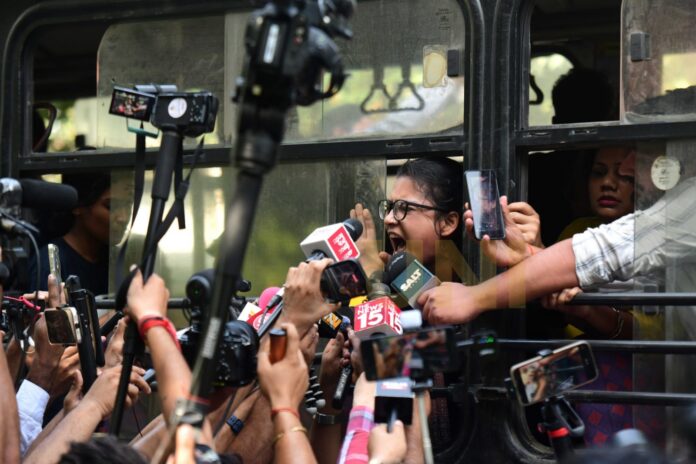
A wave of massive youth protests has rocked India in recent weeks, confronting the right-wing Narendra Modi regime with potentially its most significant political challenge since it came to power. Tens of thousands of people, overwhelmingly in their 20s and 30s, have flocked to demonstrations in New Delhi, calling for the resignation of Chief Election Commissioner Gyanesh Kumar, who oversaw the removal of over 130 million names from voter rolls. In response, the state has cracked down on protests with some of the most severe state repression India has seen in decades.
This voter purge, known as the “special intensive revision” (SIR), is widely seen as an effort to keep Modi’s Bharatiya Janata Party (BJP) in power, forcing nearly a billion people to produce documentation proving they have the right to vote. Drawing from the right-wing authoritarian playbook, Modi is pursuing a mass voter disenfranchisement campaign on a scale beyond Donald Trump’s wildest dreams. But this has now proven to be overreach, and the Modi government has limited room to maneuver.
These protests, spearheaded by the Cockroach Janta Party (CJP) and the movement around it, are the second major flare-up of India’s youth this year. The first round took place several months ago, sparked by unfairness in college entrance exams. Now, faced with evidence that “democracy” itself is rigged, a generation is further enraged that the system truly means to keep them trapped where they are. The legitimacy of Modi’s rule is fraying at the seams.
Assault On Democratic Rights
The “special intensive revision” was launched a year after the BJP lost 63 lower house seats, as well as its outright parliamentary majority, in the bruising 2024 election. The purge proceeded in state after state with some opposition, but the present wave of mass anger erupted in late September when The Indian Express broke the news that two election commissioners had registered objections to this revision over a dozen times.
Kumar has justified this revision with the need to clear dead and duplicate voters off of voter rolls, as well as “infiltrators” from neighboring countries like Bangladesh. In reality, millions of lifelong citizens have been cast off, many of them Muslims and ethnic minorities who are less likely to vote for the BJP, alongside poor, elderly, homeless, and otherwise itinerant and insecure voters. The process of reapplication is extremely burdensome, and in the most egregious cases, purged voters have been stripped of citizenship and deported, including people who have never lived in any other country.
Recent elections in the states of Bihar and West Bengal saw landslide victories for the BJP on the heels of the removal of millions of voters in those states. In West Bengal, whose population is over a quarter Muslim, Muslims account for 34% of names removed. Adding insult to injury, millions who have been removed may also lose access to public benefits.
Conceding to public opposition on this issue could be politically dangerous for the Modi regime, calling into question the legitimacy of these state election results, but also further accelerating the unraveling of Modi’s “aura of invincibility” that is already well underway.
Ahead of protests called by the CJP for the weekend of October 10-11, the Modi regime determined that a crackdown was in order. New Delhi was virtually locked down with upwards of 40,000 security personnel deployed, 45 metro stations shut down, hundreds of trains cancelled, and mobile internet service disabled across large sections of the city. Police boarded planes to arrest leading CJP activists as they touched down in the city, and student activists like Neha Bora of the All India Students’ Association were arrested multiple times. Protesters were dragged through the street and packed into buses. In all, over 7,500 were arrested including at least 30 journalists, several of whom reported sexual harassment by police.
Modi’s Regime In Crisis
Both the purging of the voter rolls as well as the brutal state crackdown are indicative of the deep fear Modi has of dissent and further erosion of his power. Behind his strongman image, the regime’s foundations are cracking under the pressure of inflation, energy shortages, and prolonged tensions with Trump.
Following its weekend of intense crackdown on the youth-led protests, which both inflamed the movement and drew criticism on the world stage, the government denotified the previously designated protest location of Jantar Mantar and permitted demonstrations to proceed at locations further away from parliament on October 12. At the head of this protest was the bourgeois opposition Congress Party’s Rahul Gandhi, who is working hard to seize the moment and capture the political momentum of the youth, and likely also to neutralize any potential political threat the CJP may present.
Cockroach Janta Party
The Cockroach Janta Party, named jokingly five months ago, has rapidly become a reflection of the anger and unrest at the system bottled up in India’s youth. Its name is a reference to derogatory remarks made by India’s chief justice, who called the nation’s unemployed youth “cockroaches” and “parasites.” Regardless of his attempts to walk back these comments, there is no erasing the contempt felt by young people from the wealthy capitalist class and their political representatives. More than half of India’s population—and almost a quarter of its electorate—is under 30. Youth unemployment reached 19% in September, with young women hit hardest at 26.6%. Among college graduates under 25, unemployment stands at 40%, undermining the idea that education can help young people achieve security.
The CJP’s founders readily admit they are accidental figures. Nonetheless, they have played important roles in pushing forward a movement that gave Modi one bloody nose and is poised to damage him further. Over the summer, the CJP and the movement around it organized mass demonstrations, sit-ins, and hunger strikes over a series of entrance exam-related scandals, and ultimately succeeded at forcing out Modi’s education minister Dharmendra Pradhan. Pradhan’s departure was the second resignation of a minister under public pressure under Modi’s rule (with the first being M. J. Akbar who faced the wrath of the #MeToo movement in 2018). The entire episode was a massive embarrassment for Modi.
Shortly after Pradhan’s resignation, however, the CJP called for an end to the weeks of protest—a premature decision that should not be made this time. What was needed then, and will be needed in the event of any concessions this time, is to consolidate and organize the youth movement into a fighting force, and to escalate the movement by linking up with organized workers and farmers, taking up their demands and going on the offensive with strike action. The combined force of such a movement has the power to take down the Modi regime, but his replacement with another representative of the capitalist class—like Rahul Gandhi of the opposition Congress Party—would not solve any of their problems.
The leaders of the CJP, inexperienced as they are, only stand for reforming the system. The party’s national convenor, Abhijeed Dipke, identifies as a follower of B. R. Ambedkar, a key architect of India’s constitution. Young people in India rightly see basic democratic rights as prerequisites to a dignified life, and they’re willing to fight fiercely for them. But democracy under capitalism is intentionally limited, unfair, and subject to interpretation and change by the class that’s in power and the political parties that represent it. Rebuilding Indian society to meet the needs of its workers, farmers, and youth will require taking the largest corporations, land, and resources out of the hands of the nation’s hundreds of billionaires and operating industry, with democratic control, in the interests of the masses. This task in turn requires an independent political organization that makes no alliances with the capitalist parties, but can only be born out of struggle. A revolutionary party to fight for this program is the urgent need of the hour.
Escalate The Struggle
There are signs that escalation involving broader layers of society are happening. Samyukt Kisan Morcha, a coalition of several hundred farmers’ unions born out of the 2020 anti-Modi mass farmers’ protests, has announced that farmers will march to Delhi on October 23 to demand Kumar’s resignation. Ashok Dhawale, a senior leader in the coalition, declared, “This is going to be one of the largest struggles against SIR.” While students and youth often do not have their hands on the levers of production in society, through their bold and often militant action, they have the power to spur workers and farmers into action.
“Gen Z revolts” have erupted in country after country over the last two years—from Nepal, to Madagascar, to Morocco, to France. These uprisings have been triggered by different issues, but all reflect the sense of existential dread and anger shared by youth worldwide that this system offers them no secure future. Achieving their aspirations will ultimately require toppling the rotten system of capitalism and rebuilding on new, socialist foundations. The seeds of such a revolution are contained within these revolts, but they will need to link up with the social power of the working class and to forge a leadership armed with the perspective that there is no solution without bringing down capitalism.
The youth movement in India has reclaimed the symbol of the cockroach to represent their resilience and the power they have in numbers. So long as the capitalists remain in power, the working class will continue to plague them. Or as the CJP tweeted more succinctly, “Cockroaches never die.”