

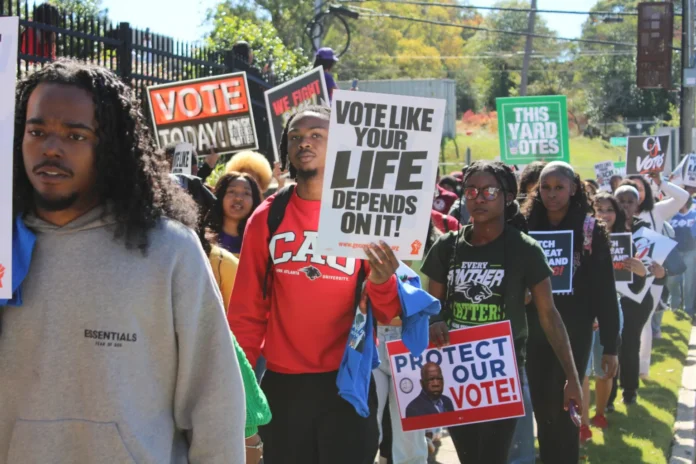
The “Blue Tsunami” of the 2026 midterm elections marked a seismic shift in US politics. Across the country, previously solid red states flipped blue, even in the deep South, a once reliable stronghold for the GOP. One of the most dramatic and unexpected victories was that of Democrat Scott Colom, the first Black man to win a US senate seat in Mississippi since the collapse of Reconstruction, 145 years ago. While Colom’s historic win was part of a nationwide realignment, it was ultimately made possible by an organized surge of Black voters in the South, now being called the “Blacklash.”
This surge was a direct response to the far-right GOP’s blatant attempt to disenfranchise Black voters with the gutting of the Voting Rights Act (VRA) earlier this year, and the subsequent gerrymandering that eliminated multiple majority-Black districts across the South. Get-out-the-vote campaigns such as “March to the Polls” mobilized thousands of students at historically Black colleges and universities (HBCUs) to polling stations. The success of these efforts is clear evidence that when organized, ordinary people have the power to change the outcome of political fights, even in spite of systemic oppression. But the Democrats can’t be relied on to take this fight to the finish, or to win significant gains for working people. Now, the question is how to build a sustained movement to fight racism and for meaningful change for workers and youth.
Beyond The Ballot Box
At its core, the mass turnout on election night was a referendum on Trumpism. Voters resoundingly rejected the cruel bigotry of the Republicans, which many rightfully recognized as a tool to divide and intimidate working people into accepting a declining standard of living, often a direct result of the GOP’s own actions like the disastrous war in Iran. In the South especially, the recent death of Mississippi teen Nolan Wells led to outrage and protests against state authorities for what many Black Southerners viewed as an inadequate investigation into his suspicious death, and a reminder of the state’s appalling history of turning a blind eye towards violence against Black people. In addition to the many Black voters who turned out to the polls to fight back against racism, many white working-class Southerners also showed up to vote blue, including former Trump supporters. But across the board, this shift was much less for the Democrats than a vote against Trump, his corrupt and racist regime, and the fiasco he’s made for working people. While many Southern voters are rightfully excited about defeating MAGA at the polls, many also recognize that simply getting Democrats into office will not be enough to solve all of their problems.
In the decade since Trump first got elected, establishment Democrats have consistently proven that they are incapable of adequately fighting back against his far-right agenda. There are very real limits as to what the Democrats, despite their populist rhetoric, are willing to fight for, because they are ultimately a party by and for their capitalist class donors. Those donors’ interests are often at odds with those of working and oppressed people facing legislative attacks on their rights at the hands of the GOP. A divide-and-rule strategy is fundamental to the ruling class’s ability to maintain their rule, and establishment Democrats are not going to challenge a system built and still reliant on anti-Black racism. This is how we got Trump 2.0: after Biden and the Democratic establishment refused to fight for the demands they ran on, many voters turned to the far right, which portrayed itself as an anti-establishment alternative.
In the South, establishment Democrats often justify their inaction with the supposed need to appeal to a more conservative voter base. Many Southern Democratic politicians use this excuse to support right-wing policies like oppressive laws against LGBTQ people and restrictions on abortion access. For example, Scott Colom has stated that he is “personally pro-life because I’m a Christian,” and when asked if he would vote to restore nationwide abortion rights, he did not commit to a blanket federal codification, saying he would “study what’s right for my values and for Mississippi.”
This falls short of what’s needed to fight for the interests of working-class Mississippians, especially Black workers, who are disproportionately affected by the overturn of Roe v. Wade, which was triggered by an abortion ban in their home state. In order to actually further the interests of Black and working-class Southerners, the movement against Trump must go much further than simply getting Democrats elected. While the mobilization of Black youth that unseated Republican incumbents in the midterms was largely organized by Democratic Party-aligned organizations, winning office is the furthest the Democrats are willing to go with such mobilizations. But it shows the potential that exists to build widespread organization and movements that last, based on the independent power of the working class and youth.
Lessons From The Struggle For Civil Rights
In fact, this movement-building approach was what originally won many of the historic victories that Trump and the Republicans have gutted. The gains of the 1960s were not granted by an enlightened Democratic Party—they were won through mass struggle from below. Black people, workers, and students waged a militant fight against oppressive Jim Crow policies. Groups like the Student Nonviolent Coordinating Committee (SNCC) led mass actions including voter registration drives across the South, while the Congress of Racial Equality (CORE) organized integrated Freedom Rides on interstate buses. However, many organizers recognized that neither major political party would genuinely fight for their interests, leading them to challenge the political establishment itself. As a result, some formed independent parties, such as Fannie Lou Hamer, who co-founded the Mississippi Freedom Democratic Party (MFDP) as an alternative to both racist Southern Democrats and Republicans unwilling to confront systemic anti-Black oppression. The MFDP was primarily aimed at gaining the official recognition of the Democratic Party rather than building an independent alternative. But it also showed that grassroots, independent organizing could mobilize tens of thousands of working-class Black people in Mississippi as a powerful force, with over 80,000 members at its peak. If the struggle had been carried forward on that basis, it had potential well beyond simply winning a seat at the Democratic Party’s table.
It was the titanic Civil Rights movement, and the immense pressure of escalating civil disobedience and sustained organization including the threat of this new political party, that forced Congress and President Lyndon Johnson to pass the Civil Rights Act and the Voting Rights Act, which reshaped the political landscape of the United States to this day. The political establishment would never have acted without a mass movement to force their hand.
Trump and the GOP’s attacks on civil rights and the gutting of the VRA show that all progress is temporary as long as the capitalist class remains in charge. Electing Democrats can’t be the final destination for organizing today. In order to win real change, the movement must ultimately take on the very system of capitalism that is deeply dependent on systemic racism. Our movements must take their cues from civil rights leaders like Fannie Lou Hamer and take up escalating actions based on class struggle methods. We must fully leverage the power of working people to not merely protect the gains of the previous century, but win even more, like democratic community control over the police, fully-funded education, free universal healthcare, and widely expanded social services.