

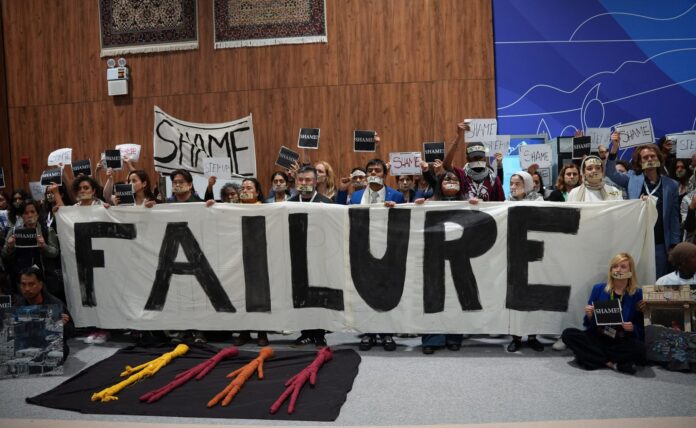
“The worst COP ever” and “a ghost COP” were some of the comments after this year’s climate summit in Antalya, Türkiye failed to cobble together a final statement, even after a long extension. This is a fair assessment, even if we shouldn’t have any expectations of these “circuses of greenwashing,” as activist Greta Thunberg calls them.
This was the first COP to take place since the UN’s acknowledgment that the world will pass the 1.5°C warming threshold set by the Paris Agreement. Yet while the stakes couldn’t be higher, COP31 was the first since 2009 that failed to even reach an agreement. After years of agreements that amounted to little more than words on a page, the outcome of COP31 reflects the new reality—even the illusion of a globally coordinated answer to the climate crisis from capitalist institutions and governments is off the table.
The collapse of the final “cover decision”—the main document of the summit, which was supposed to be known as the “Antalya Pact”—occurred because many countries were not ready to accept a text that failed to mention fossil fuels at all. Put forward by co-hosts Türkiye and Australia, the document instead included support for CCUS (Carbon Capture, Utilization, and Storage), which is rightly seen as an excuse to continue expanding the use of fossil fuels.
Attempts to deploy CCUS have proven to be very expensive and inefficient. According to Rachel Kennerley of the Center for International Environmental Law, 78% of CCUS projects have been canceled or paused.
At the same time, investments in fossil fuels continue at full speed. Over the last ten years, since the Paris Agreement, the 65 biggest banks in the world have injected USD 8.7 trillion into the fossil fuel industry, according to the report Banking on Climate Chaos – Fossil Fuel Finance Report 2026. Trump has withdrawn the US from the COP and no US delegation was sent to the event, but in practice his slogan, “Drill, baby, drill,” is what really reflects reality.
“Fossil fuel interests keep making a killing … while killing our planet… In the last quarter alone, the nine largest oil companies pocketed USD 95 billion in profits. Meanwhile, the Loss and Damage Fund [created at COP28 to pay for climate disaster losses] has received around USD 600 million. That is what these companies made in about 14 hours,” said António Guterres in his speech. Yet he can’t do much more than appeal to reason. The logic of these numbers cannot be challenged within the capitalist system. Profit is what drives the system.
This is also true for those countries and blocs that try to pose as more environmentally friendly and criticized the watered-down document as unacceptable, such as the European Union. There, companies and banks continue fossil fuel exploration and expansion while governments turbocharge military expenditure instead of investing in a real green transition.
According to Global Justice Now, mining and fossil fuel companies are also using so-called Investor-State Dispute Settlement (ISDS) mechanisms to extract compensation when governments act against their interests. These are private tribunals regulated by trade agreements that make it possible for private companies to sue governments.
“The UK was hit by a claim for £300 million after the High Court quashed planning permission for a coal mine in Whitehaven, Cumbria, [in 2024]. The amount is six times what the investor sunk in the project—a regular feature of ISDS tribunals, where investors can claim not simply for alleged lost costs but anticipated future profits. The case is ongoing,” writes Global Justice Now.
Data from UNCTAD (the UN trade body) shows that fossil fuel companies account for the largest share of these cases and have sued governments for a total compensation of USD 443.8 billion, of which USD 85.9 billion has been paid out so far.
Increasing Repression Against Protests
Earlier COP events have seen huge protests from climate activists, socialists, and trade unionists—mainly youth. However, several recent editions have taken place in countries where protests are banned, in addition to being heavily dependent on fossil fuels, such as Dubai in the United Arab Emirates and Baku in Azerbaijan. Türkiye is also still heavily dependent on fossil fuels. Türkiye’s emissions are rising, and its state-owned oil and natural gas company TPAO is expanding fossil fuel production. On November 14, there was a large march in Antalya with thousands participating, but the police cordoned off the entire route and attendees had to undergo two rounds of frisking and bag searches.
Defying a severe domestic crackdown on queer rights, Turkish LGBTQ+ activists joined the COP31 march. Organizers waited until the group was surrounded by international civil society delegates and foreign press before unfurling rainbow flags to shield participants from police intervention, according to The Guardian.
According to Amnesty International Türkiye, in September the Turkish authorities launched a nationwide operation targeting LGBTQ+ organizations, activists, and human rights defenders. Homes, venues, and offices were raided, more than 100 people were detained, and over 1,000 social media accounts were blocked or restricted. In October, the authorities raided and seized control of a major opposition television channel.
This follows a broader trend of increasing repression against protesters around the world, as we have seen against pro-Palestine demonstrations and in the heavy police repression recently directed against youth protesting in France and other European countries, as well as in India, Argentina, and Chile.
A Hotter Planet
The year 2026 is set to become the second hottest on record, according to Copernicus, though with a 20% chance of exceeding 2024 as the hottest ever as the effects of El Niño become more prominent. October was the warmest October on record globally, with an average surface temperature 1.75°C above pre-industrial levels. Climate scientists project that 2027 has roughly a 96% probability of becoming the warmest year on record.
According to the Emissions Gap Report 2026: The Point of Return, from the UN Environment Programme, if current policies continue, warming could reach 2.8°C within this century and continue rising thereafter.
This is fueling extreme weather events all around the world. This year, Europe had its hottest June-July period on record. This led to a severe drought, including record-low water levels on the Rhine that disrupted shipping in Germany and the Netherlands, while low levels on the Danube forced Hungary’s Paks Nuclear Power Plant to cut output. Europe also suffered its fourth-worst EU wildfire season on record, with over 300,000 people displaced in France and Spain, and more than 50,000 people dying due to the heat across the continent.
In Nepal, on August 26, a massive rock-ice avalanche killed 1,450 people and over 5,000 remain missing. Canada had hundreds of wildfires burning in July, with thick plumes of smoke drifting into the US. Extreme rain and flooding killed hundreds in Ethiopia, Kenya, Bangladesh, and other regions.
Now, with the effects of El Niño kicking in, droughts and floods are hitting other regions. In Brazil, the Amazon region is suffering from a lack of rain and wildfires, while the south of the country is being hit by heavy rains and tornadoes.
In Panama, a lack of rainfall has lowered the water levels of the Panama Canal, forcing authorities to cut daily ship transits. This is contributing to higher freight prices, which were already elevated due to disruptions in the Persian Gulf and Red Sea.
Eastern Africa and the Nile Basin are also suffering from drought, affecting Sudan, Kenya, and Ethiopia. The same is happening in parts of Central America, Papua New Guinea, and other regions already suffering from food insecurity.
This comes at a time when fertilizers are much more expensive due to the wars in Ukraine and Iran, forcing farmers in poorer countries to cut back on fertilizer or skip application altogether. In parts of Guatemala, for example, the combination of drought and unaffordable inputs contributed to projected losses of 70% to 100% in late-2026 subsistence maize and bean harvests.
All of this points to an increase in hunger and food prices in the coming year—but it doesn’t need to be that way. Taken as a whole, global food production is sufficient to feed everyone, yet control of the food supply is in the hands of a few giant corporations at the very same time that governments in the Global North, especially the US, are cutting back on global food programs.
Fight For A Socialist Alternative
It is possible to reverse this situation and reclaim our future. But it is necessary to fight to break the power of the “market,” by taking over banks and big companies that control the economy. Then we can put all the resources and technology that today are used to enrich a small elite and wage wars, to work for the benefit of humanity and the environment, through a democratic planned economy in a world free of oppression and exploitation.
There is a bright light in this situation. We have seen an increase in the level of struggle among youth and workers around the world at the same time as many are drawing the conclusion that the problem is the capitalist system itself. This is reflected in the way different issues are increasingly seen as connected: Palestinian activists taking part in protests for the environment; environmental activists protecting LGBTQ+ activists; workers striking for labor rights as well as against war and genocide; and youth going on strike against war, as well as for housing and education—all while protesting everywhere against the far right, racism, sexism, and increased repression. Yet protests alone are not enough: we must build a movement armed with a socialist program capable of leading the fight to its only possible conclusion—putting an end to a system that is killing our planet in the name of profit.