
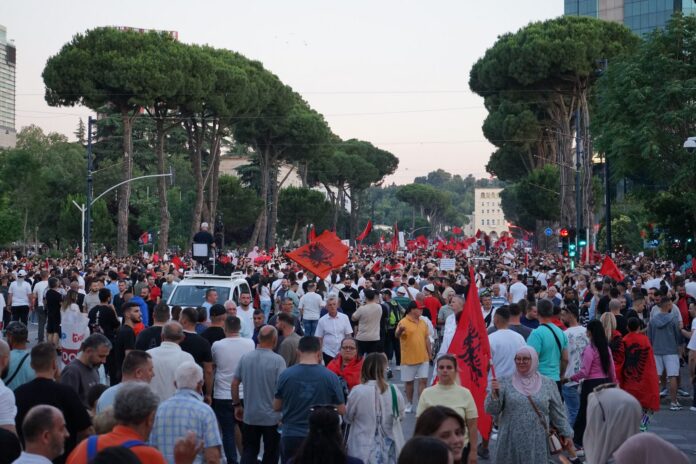
For half a year, Albania has been the scene of a protracted struggle. Dubbed the “Flamingo Revolution,” it began as a local environmental protest against a real estate development pushed by Donald Trump’s son-in-law Jared Kushner. It soon ballooned into a nationwide mass movement against the entrenched corruption in Albanian capitalism, personified by Prime Minister Edi Rama.
After months of mostly peaceful protest, the struggle took a turn on October 13 when police violently dispersed a student demonstration at the Ministry of Education in the capital city of Tirana. The protesters returned and beat back the cops with stones and firecrackers. Eventually, they stormed the Tirana Municipality building and set it on fire. The police responded with further violence, attacking protesters with water cannons, rubber bullets, and tear gas.
Over the next few days, street battles between protesters and police spread across the country. While the media highlights the violence, the escalation has also included a wave of student strikes, backed by prominent education unions. The Rama administration, meanwhile, has doubled down on repression and authoritarianism.
As Albania faces an emboldened movement facing off against an increasingly intransigent Edi Rama, one side or the other will have to give way.
Youth With No Future
The Flamingo Revolution may have begun with a local environmental protest, but the issues run deeper than protecting flamingo habitats. Alongside mass protests in Serbia and Bulgaria, this was part of a wave of “Gen Z” revolts in the Balkans directed against the corrupt ruling elites who have dominated the region since the collapse of Stalinism.
Since then, all of Europe has become engulfed in youth protest, with France, Spain, and Italy in the vanguard. In the wake of October 13, the plight of Albania’s youth and students has come to the fore. At issue in all these protests are the crises of the capitalist system, where politicians ramp up military spending and slash education funding, leaving the youth no future.
If European youth feel they have no future, that’s doubly so in Albania. A 2025 Eurostat survey of household incomes found Albania ranked second to last in Europe for young people aged 18-24, beaten only by North Macedonia. When those figures are adjusted for cost of living, Albania jumps to last place due to higher food prices.
One of the protesters, Bora Mema, active in the left-wing party Lëvizja Bashkë (Together Movement) summed up the situation facing Albanian youth: “Many of us have to migrate because the only development model that the government proposes is to clean the toilets of the rich and the mafia in luxurious resorts, like the one that Trump and Kushner and the national oligarchs and mafia in Albania are constructing.”
Much of the media focuses on violence carried out by protesters. This ignores the violence of the police and the criminal corruption of Albania’s ruling elite.
Another protester called out this hypocrisy, contrasting the treatment of protesters with the treatment of corrupt politicians. Citing the example of Belinda Balluku, Rama’s former Deputy Prime Minister who resigned over a corruption scandal, but was granted immunity to prevent her arrest, the protester argued “It is not a problem if 10 windows were broken; those 10 windows can be replaced with one of Belinda Balluku’s villas, even with gold.”
Government Response
As exciting and inspiring as the protests are, the key demands still haven’t been met. Under pressure from below, Rama made a few minor concessions, from a scholarship package to an increase in pensions. But the systemic demands about rooting out corruption remain unaddressed. Even the central practical demand, for Rama to resign, remains unfulfilled. Meanwhile, Rama has doubled down in lashing out against the protesters.
At the start of the Flamingo Revolution, Rama peddled conspiracy theories that the protests were part of an Iranian “hybrid warfare” campaign. Since then, he’s expanded that conspiracy theory to include Russia. Meanwhile, he’s copied and pasted the nonsense Trump uses to justify repression of anti-ICE and Palestine solidarity activists.
This was typified in an October 19 speech attacking the protesters as “young men and women who have been ideologized and radicalized under the pressure or inspiration of that dark and new force that has emerged in Europe and the United States, which the President of the United States has designated a terrorist organization: ANTIFA.”
The day after that deranged speech, Rama arranged a number of chairs in front of the Prime Ministers’ office with pieces of paper containing the word “dialogue.” When protesters tore down the chairs, Rama repeated the ploy again and again. The bourgeois press, in Albania and internationally, present Rama’s flagrant trolling as a sincere “offer of dialogue” that the protesters are callously rejecting.
Any question of Rama’s commitment to dialogue is made clear by his ramping up of state repression. His scholarship package is hard to take seriously when he’s also paying police a €2,500 bonus for cracking down on protesters. These are the same police who were caught physically assaulting journalists and beating up teenage protesters.
The repression ramped up at the end of October, when Rama announced a new wave of draconian anti-protest measures. This includes a fine of up to €5,000 per person (six times the average monthly salary in Albania) for “failure to comply with an order to disperse” at a protest. A “special electronic register” was established to track protesters. As teachers join the protests in solidarity, Rama is also instituting a new “code of ethics” for pre-university teachers to prevent them from walking out with their students.
So far, Rama’s crackdown has yet to blunt the protests. But it still represents a serious threat that the movement will need to be able to take on.
The Struggle Is International
The Flamingo Revolution isn’t an isolated phenomenon. It was sparked by opposition to a development project tied up with Donald Trump and his family. Internationally, it’s part of a wave of “Gen Z” revolts stretching from Nepal to Madagascar. At the time of the October escalations in Albania, the Serbian struggle played out in an election where corrupt president Aleksandar Vučić was ousted by an electoral list built from scratch by the protesters.
The latest escalations in Albania arrived alongside mass struggles across Europe, which also face state repression. Rama’s anti-protest legislation was inspired by similar legislation put forward by Italy’s far-right leader Giorgia Meloni the previous week.
The European ruling class clearly sees the connections between the protests in Albania and in their own countries. On October 18, the European Commission released a statement on the Albanian protests proclaiming that “violence has no place in a democratic society” but only mentioning the violence of the protesters. Meanwhile they praised “the Albanian authorities’ commitment that the right to protest will be protected.”
It’s through solidarity with the international struggles that the Flamingo Revolution will find its biggest strength. Protesters in Albania have taken inspiration from Vučić’s defeat in Serbia. The general strike in France can provide not only further inspiration but a concrete way to escalate the struggle. Young people across Europe are building for an International Youth Strike on November 20.
The recent U.S. midterms showed that Trump and his family are as unpopular in the U.S. as they are in Albania. Unfortunately, without an independent working-class party, the pro-capitalist Democratic Party was the main beneficiary of those elections. This also stresses the need for independent working-class organization in Albania.
“Rama In Prison, Berisha In Prison”
Like in the U.S., Albanian politics is dominated by two capitalist parties. Rama’s misnamed Socialist Party was historically associated with the Stalinist dictator Enver Hoxha but rapidly embraced capitalism in the 90s. The equally misnamed Democratic Party is headed by Sali Berisha, the former right-wing dictator who oversaw neoliberal “shock therapy” in the 90s and was ousted by mass protests in 1997.
Both Rama and Berisha are up to the hilt in corruption. Both have actively championed the Kushner-linked development projects that sparked the protests, and the chant “Rama in prison, Berisha in prison” has featured in the protests from the beginning.
This doesn’t mean Berisha and the Democratic Party aren’t trying to use the protests for their own ends. Early on, the youth wing of the Democratic Party attempted to join the protests, only to be correctly rejected by the protesters.
In response, Berisha did a 180, deciding that he actually opposed the Kushner developments. With the recent escalations in the protests, the Democratic Party has tried more forcefully to link themselves to the protests. Berisha called on supporters to join the mass demonstrations of October 24. On October 29, Democratic Party MPs set off flares and smoke bombs in the Albanian parliament.
The “Rama in prison, Berisha in prison” chant still features in the protests, but the danger of co-optation is real. The protesters recognize that Rama and Berisha represent the same corrupt system. But to definitively challenge that system, the movement needs independent, democratic, working-class structures.
Working-Class Organization
A feature across many of the “Gen Z” rebellions is their “leaderless” character which acts as a barrier to democratic control over the movements. This is a product of the long-term throwing back of working-class organization since the collapse of Stalinism. The phenomenon is exacerbated in Eastern Europe, where independent working-class organization was crushed by Stalinist totalitarianism decades prior.
While unions are weak in Albania, they do exist. Given the centrality of students in the protests, education unions have played an outsized role. The Union of University Workers of Albania organized a solidarity demonstration on October 20 and announced an indefinite teaching boycott the following day. Two more education unions, the Independent Education Union of Albania and the United Albanian Education Union, endorsed the mass demonstrations on October 24.
This is an important development, one that Rama is trying to stop with his “code of ethics.” Escalating further to a general strike can demonstrate the real power of the working class in a way that the Democratic Party’s flares and smoke bombs can’t.
This also raises the need for working-class political representation. In reaction to the Democratic Party’s attempts at co-optation, an anti-party mood has developed in the movement. However, not all parties are the same.
Unlike the Democratic Party, three smaller opposition parties have been more closely involved with the protests. Two of them, Shqipëria Bëhet (Albania Becomes) and Mundësia (Opportunity) are conservative pro-capitalist parties. They may be less tainted by the corruption of Rama and Berisha, but they fundamentally represent the same system. Lëvizja Bashkë, on the other hand, is a left-wing party that openly proclaims “social emancipation begins with the organization and struggle for the rights of the working class.”
Lëvizja Bashkë was built out of an earlier wave of student protests in 2018. In 2025, the party got Redi Muçi elected to parliament. They’ve actively organized unions of garment workers, call center workers, oil workers, and chromium miners. They’ve been targeted by the Rama government for their role in the protests. When Berisha put out a call earlier this month for all the smaller parties to line up behind him in an anti-Rama coalition they correctly rejected the offer.
At the same time, they have a very limited reformist program. They support workers’ rights, progressive taxation, and social services, but all within the framework of capitalism. When Rama justified his attacks under the guise of facilitating EU entry, Lëvizja Bashkë responded with a statement “In the EU Without Rama” where they hold up EU entry as “a catalyst for the country’s modernization, democratization and stability.” In reality, the experience of working-class people throughout Europe has demonstrated that the imperialist bosses’ club of the EU does not offer a way out of austerity, impoverishment or corruption.
Nonetheless, Lëvizja Bashkë is the strongest independent left-wing challenge in the country. Alongside the unions that have taken a lead in the protests, they should organize democratic bodies of struggle to build for a general strike to bring down Rama. The November 20 international day of action could be an important rallying point, linking the “Flamingo Revolution” with the other struggles internationally. Moreover, these bodies should build a mass working-class political force capable of challenging both Rama and Berisha, while rejecting the pro-capitalist politics of Shqipëria Bëhet and Mundësia. At the same time, it should open up debate around its programme and the way forward, not limiting itself to Lëvizja Bashkë’s reformist politics.
Right now, Rama is preparing to crush the movement and Berisha is preparing to derail it. But they’re faced with a mighty force that won’t give in easily. With mass, working-class struggle around a revolutionary program for workers’ rule and a democratically planned economy, Rama, Berisha, and the corrupt capitalist system they represent, can be swept aside.