


Matt McDonald is a unionized nurse in the town of Biddeford, Maine. On July 13, 25-year old Johan Sebastian Guerrero was shot and killed by ICE officers in Biddeford during a traffic stop while executing a search warrant unrelated to Guerrero. Eva Metz, a nurse and member of Socialist Alternative, spoke with Matt about the reaction in Biddeford and how Trump’s war on immigrants is affecting their access to healthcare.
Socialist Alternative: What has been the reaction of the community of Biddeford to ICE’s murder of Johan Sebastian Guerrero?
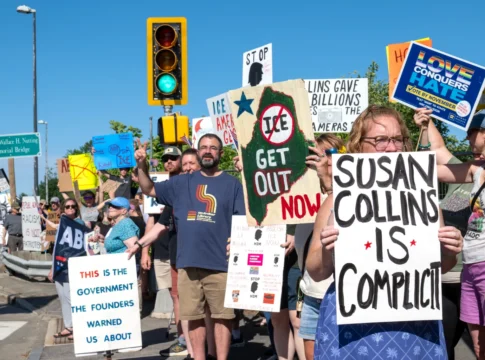
Matt: We had a very visceral, intense reaction. Within three hours, community organizers put together a protest. I remember getting there around noon. I looked around and there were maybe a dozen or so people there. About 20 minutes later, a couple of my friends arrived, and I remembered turning my head to look and seeing a sea of people. We were at a prominent intersection in town, and there was a constant stream of cars passing by, honking their horns. It was very clear that our community is very anti-ICE.
I think before this murder there was this idea that something like this couldn’t happen in small-town Biddeford. Biddeford is a town in southern Maine of around 20,000 people, originally a mill town that was built by immigrants. The murder provoked a response from people of “absolutely not in my town, not in my state,” and the movement took off from there. There have been regular protests in the weeks following.
SAlt: What has been the reaction of nurses at your workplace?
Matt: Amongst nurses there is this overarching belief that every human life matters, which shouldn’t be controversial, right? But I think nursing takes on a very specific role in this, because we believe that there is dignity and humanity that belongs to everybody, regardless of their circumstances. We don’t know who they are. We don’t know their immigration status. When somebody comes to my ICU, and they were in a car accident, and they’re fighting for their life, like, I’m not asking any of those questions. The only thing that I’m concerned about is, how do I support my patient and get them through? We take an oath to take care of anybody that walks through the door.
That means that anything that threatens the sanctity of our communities is a serious threat. I think that nurses all across the country are much more likely to be staunchly anti-ICE. I hear nurses say, “ICE out,” and “Abolish ICE, we’re not going to tolerate this.” It all boils down to one very common theme for nurses: we’re not going to let anybody—whether it’s ICE, whether it’s the Trump administration—hurt our community members, people who could be our patients or who are actively our patients.
SAlt: How have you seen Trump’s war against immigrants affect access to healthcare?
Matt: Many people already can’t afford healthcare, so they avoid getting it in the first place, right? So when “Operation Catch of the Day” [the disgusting name for ICE’s anti-immigrant surge in Maine] first happened here, we saw immigrants very hesitant to come to the hospital. What’s particularly dangerous about that is that fixable problems like high blood pressure or a stomach bug can become deadly. When you have secret police that don’t have body cameras, drive in unmarked cars, and kidnap people off the street, you’re going to have people who are very afraid to go to the doctor, or go to the pharmacy to pick up needed medication.
This compounds with the already challenging situation of our state being very rural. Once you get really far north, there’s not a whole lot, and access to healthcare is already really hard to come by. When you scare a whole community away from going to the doctor, when they already can’t afford it, and when they already have trouble accessing it, they’re going to do whatever they can to just try to power through medical issues. That’s how people die.
SAlt: Trump has said it’s “not possible” for the US to pay for Medicaid, Medicare, and day care. What do you think?
Matt: Well, I know that this is going to be a written article, but I just rolled my eyes into the back of my head, because that has got to be the most ass-backwards thing I’ve ever heard in my life. I find it really disingenuous when Trump says things like that. The US spends billions of dollars on ICE and billions more funding wars around the world. Your tax dollars are being used to bomb little girls in Iran. Obviously, the money is there. We know that universal healthcare would do so much more to benefit the average American that he claims to care about than sending out a group of masked, armed, secret police to kidnap innocent people off the street.
Trump said he’s going to arrest “the worst of the worst” and make sure we take care of all those “evil criminals.” That has not been the case. Johan Sebastian Guerrero was a family man. He was 25. He was actively doing things the “right” way. He was attending his immigration proceedings. He was working. He had a social security number. It was never about targeting people who are making this country unsafe. It had everything to do with scaring people. And it had everything to do with a distraction from the real issues.
They’re very quickly losing popularity among voters. People are starting to realize that our problems don’t stem from immigrants. Our problems stem from a very small group of billionaire donors and Donald Trump and his cronies who seek to benefit from all of the horrific things that they’re doing. So when I hear we don’t have enough money to pay for healthcare, all I hear is that the US government doesn’t want to prioritize paying for healthcare.
SAlt: How have you seen other recent policies, like the “Big, Beautiful Bill” and its cuts to Medicaid funding, affect health care?
Matt: Our hospital has been having conversations pretty frequently about what this is going to mean as far as the ability to provide care for our communities, and we are very concerned. A lot of people rely on Medicare and Medicaid services, elderly people, disabled people. There was recently a protest at Miles Hospital, which is a little bit farther north than Biddeford, because they are dangerously close to losing their labor and delivery services. People who live in that area are facing commutes of potentially 20 minutes or more for labor and delivery services. In healthcare every second counts, especially when it comes to a pregnancy. Even a minor complication can become very big if it’s not treated immediately.
We’re already seeing closures of departments like labor and delivery services at hospitals like Central Maine Medical Center, which just got acquired by Prime Healthcare. When these smaller hospitals start to go under and for-profit health care systems like Prime swoop in and buy them, they’re going to cut staff, they’re going to cut resources, they’re going to do everything they can to save a buck to pad their bottom line for their executive bonuses and compensation packages. That is going to have a downstream effect for the communities who rely on that care. The effect on healthcare is not just about closures of units and departments and small facilities, which is very important to talk about, but also the acquisition of small hospitals by large for-profit health care corporations.
SAlt: On January 23 in Minneapolis, 100,000+ workers in Minnesota went on strike against ICE as part of a day of “No Work, No School, No Shopping.” A week later, Trump wound up Operation Metro Surge. What do you think nurses’ unions, in particular, and the labor movement in general can do against ICE?
Matt: I think it is a lesson that the power lies with the people. It can be really hard right now to feel like it does. But I see what the people of Minneapolis did. I see the way that my neighbors organized and the pressure that we put on our elected officials. Something that happened here in Maine after Johan’s murder was Senator Collins, under pressure, got into contact with the DHS secretary, and they paused all vehicle stops. I think it was only for 24 hours until Trump overruled that. But it just goes to show that when we show up and we’re loud enough, they have to listen to us. We put them in power. We can take them out of power. We can hold them accountable.
I think nursing unions in particular, have an important role to play—we are already an organized body of people and have a special connection with our communities. We have this very intimate knowledge of what it’s like to take care of people and what happens when the government prioritizes corporate interests and profits over everyday people. The labor movement is in a unique position where we already have the numbers and the manpower and the people and we can start taking collective action.
SAlt: What demands have you seen coming out of the protests for Justice for Johan Guerrero and others murdered by ICE?
Matt: I think the top of the list is to hold the people who are committing these murders accountable. They need to go to jail. They need to be convicted. That’s the bare minimum. Beyond that, we’re seeing a lot of calls to abolish ICE. Take all of that money that they were given in that horrendous appropriations bill, the big, ugly bill, and put it towards working people to pay for education and healthcare. Those are the trillion dollars’ worth of cuts to Medicare and Medicaid. Put that money back where it belongs.
SAlt: What is next for the movement?
Matt: There are still protests all around the state planned—whether they’re anti-ICE events or protests against the Trump administration in general or whether they are gatherings to protest the closure of the maternity unit up at Miles—we need people to continue to show up. That energy hasn’t left. The other day it was pouring down rain and there were still people out on the street with signs. It’s not over. It’s never going to be over until we fight and get all of what we are demanding from our government accomplished for immigrants, for the everyday person.
We need to abolish ICE. We don’t want it here in Maine. It needs to leave. And we would be a lot better off if it was just gone through the whole country.
The murder of Johan Sebastian Guerrero is a terrible tragedy that shook the whole community. But seeing people show up in droves makes you feel like there’s definitely this feeling of solidarity here. This is not something we’re going to take lying down. I don’t know how many Mainers you know, but this was the wrong group of people to mess with.