

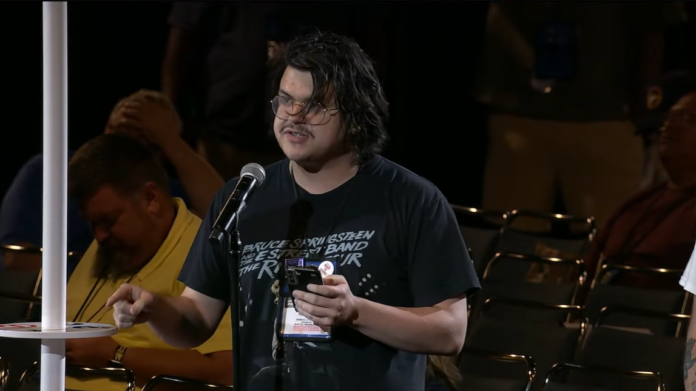
“Opposition to war is a union issue!” argued one Gen Z delegate at the National Association of Letter Carriers (NALC) National Convention in Los Angeles in August. The union’s outgoing national leadership had argued that the Iran War was not a postal workers’ issue, and therefore, the union should not take a position on the war. Another worker corrected things: “When there’s a war, it’s our sons and daughters that fight it, not the bosses or politicians’ kids!”
The gathering of over 3,000 delegates representing almost a quarter million workers who sort and deliver the mail was a week of excruciating calm followed by moments when the real world delivered contention into the heart of the discussions. Debates centered around a number of questions beyond the war, including union leaders’ pay and the critical question of the right to strike. Postal workers, like federal workers, are legally banned from striking!
The rank-and-file opposition grouping, Build a Fighting NALC (BFN), held an organizing meeting of a couple dozen delegates who support BFN, overwhelmingly young postal carriers. Together, they handed out 500 “Right to Strike” pins and a flyer on “5 Reasons Letter Carriers Should Fight for the Right to Strike.”
As one young delegate explained to widespread applause, “without the right to strike we are negotiating, not with one hand behind our backs but with two.” The convention made clear that a new generation of letter carriers has the potential to revitalize the union.
Inflation Means A 1% Raise Is A Pay Cut
Last year BFN played a critical role in mobilizing tens of thousands of postal carriers to vote “no” on a miserably poor 1% raise. This was only the second time in living memory that the union’s members rejected a tentative agreement proposed by its own leaders. This was a high water mark for rank-and-file union activity in NALC.
While the union leaders’ decision to go along with arbitration and effectively force a poor contract onto the members has dampened activity in the union, it has led many other workers to conclude that a different path forward now needs to be forged. The weakness of a union unable to strike is now a key lesson learned.
More often than not, high-paid union leaders have little reason to put their necks out and deliver on better contracts. This is why early on in the convention, delegates proposed an end to the super high salaries of the union’s leaders. One postal carrier, a BFN and Socialist Alternative member, asked, to wide applause, “Why should a leader make three, four or five times what our new members make?” This egalitarian idea of workers’ leaders only being paid a workers’ wage is an idea deeply embedded in the history of US labor and begs the question—are our unions independent workers’ organizations, or are we just mirroring the bosses’ organizations that we’re fighting?
Most of the rank-and-file opposition motions like this one were voted down by a 3-to-1 margin. However, almost 700 worker delegates sided with demands for a union that is fighting fit to meet a world dominated by people like Trump and the billionaires.
The Right To Strike: A Basic Democratic Right
In 1970, postal workers broke the law that forbade them from withdrawing their labor and organized a bottom-up strike. This was during the volatile era of the Vietnam War, the Civil Rights uprising, and a moment when bosses had begun again to try to smash unions. Sound familiar? This current moment is also a hugely unstable period for workers, with ICE on the streets, escalating wars, price inflation that destroys wages, and a federal government that has taken away union rights from a million federal workers.
The current union leaders pay themselves hundreds of thousands of dollars and see their job as keeping the peace and not rocking the boat with post office management. This is a failing strategy when postal managers and their masters are set on working postal workers to death with mandatory overtime and below inflation raises. The post office’s abusive managers create thousands of workplace grievances each year.
In the minds of many older and retired workers, this is how it is and how it will always be. However, the 1970 strike was an expression of how the anger from below cannot permanently be repressed and how the right to strike can never be struck from the instincts of workers, especially younger workers. A successful strike today would completely shift the balance of forces in the workplace.
Following the 1970 strike and a takeover of the union by opposition rank-and-filers, the right to strike was established as a demand of the union. However, that resolution has laid on a shelf, gathering dust for decades with successive union leaders putting the interests of postmasters ahead of the needs of union members.
Strike action in the US won huge wage hikes across industries in recent years during the post-pandemic spike in prices. Workers instinctively understand that the one thing the bosses care about is money and that strikes cost the bosses and get their attention. The NALC leaders, together with the wider labor movement, need to mobilize workers to force Congress to overturn the undemocratic ban on the right to strike. If the Democrats and Republicans vote against labor’s right to strike—which without an enormous amount of pressure from the working class nationwide we should fully expect—then that will only further underline another issue: workers need their own independent political party.
War Is A Workers’ Issue
The “Fund Services, Not War” resolution, which proposed the union take a real stance against the war in Iran, was passed by several NALC branches across the country in the buildup to reaching the convention floor. The lines to speak on it were long. In general, young workers lined up at the mics against the war, while older delegates, often union staffers, ex-staffers, or retired workers lined up to argue against the resolution. One delegate for the resolution argued that “there’s 1.5 trillion dollars for blowing up school girls in Iran and no money for healthcare, schools, or the post office here.” War and peace are union issues because they are issues that workers have to deal with. The same delegate explained that the war is pushing prices through the roof, saying, “I can’t do my job if I can’t afford to put food on my table.”
The anti-war resolution also called on the labor movement to take the helm of efforts to stop the bombing of Iran and all wars. As almost every government around the world embraces nationalism and war spending, the employers and governments are seeking to make the working class pay for this with cuts in public spending. The working class can only fight this by uniting around its common needs and fighting the billionaires and their parties.
Workers Need Our Own Political Party
The resolution for NALC to support independent candidates running on working-class programs where they exist and to go on record in favor of building a workers’ party did not reach the floor for a vote. However, the reverse side of the BFN “5 Reasons” flyer was headlined: “Who Delivers for Us? Why letter carriers should build towards a workers’ party.” The unions currently plough millions of dollars and hundreds of thousands of their members’ time into electoral campaigns for the Democratic Party. This has been union policy for decades, with little to no gains to show for it for unions or workers. The Democratic Party, like the Republican Party, is owned and controlled by the employers, and many workers understand this. Workers are hugely sympathetic to workers having their own party, but don’t see a path forward. The motion, like many other opposition resolutions, was intended to push the question to the front burner and remind members that the working class must have its own independent position on all the questions it faces.
Trump, in many ways, was elected because of the failure of the previous Biden administration to make any positive changes for working people. The current administration has broken collective bargaining with federal workers and has made favorable comments about both privatization and wage cuts for public sector workers. The NALC and other public sector union leaders need to organize a wide fightback. Union leaders will need to change or step aside. This convention confirmed that many workers, especially younger workers, see the return of union militancy as an absolutely urgent task if the unions are to grow and become the force they need to be to change society.