Three months ago, Donald Trump declared he would have “the honor of taking Cuba.” This came as new US-imposed oil sanctions shrouded the island nation in a total power shutdown.
In the ensuing months, the Trump regime has mounted a campaign of “maximum pressure” on Cuba, imposing oppressive oil and trade embargos, instituting travel and financial bans, and precipitating a humanitarian crisis. They’ve threatened former President Raúl Castro with a federal indictment and amassed an immense military presence in the Caribbean, surrounding Cuba with warships, aircraft, and thousands of troops.
Why Is Trump Assaulting Cuba?
This affront follows a series of imperialist adventures by the Trump regime. The US orchestrated the state kidnapping of Nicolas Maduro in January, overtaking the Venezuelan regime and bullying it to enact his will. Trump’s hubris then led him into a humiliating quagmire in the Middle East, deeply damaging the global prestige of US imperialism. Now he is looking for what he sees as an easy win, and the weakened Cuban regime of Miguel Díaz-Canel is a prime target.
The assault on Cuba is part of the US’ push to assert dominance in the Western Hemisphere, both through invasions, like in Venezuela, and the support of new right-wing governments, like that of Abelardo de la Espriella in Colombia. Cuba is also a long sought-after prize for US imperialism: laying in the US’s “backyard” and one of the few remaining nominally “socialist” states, knocking out this historically defiant enemy would ideologically strengthen a world capitalist system in crisis.
Can The US Take Over Cuba?
Cuba’s military is weaker than Iran’s, and it doesn’t have economic leverage like the Islamic Republic’s control over the Strait of Hormuz. But Trump still cannot simply “take” it as he has vainly stated. Cuba’s ideologically hardened military will certainly fight, and its “War of all people” doctrine threatens to involve much of its population in resistance. At home, US workers have little appetite for a needless bloodbath. Provoking a deeper and uncontrolled humanitarian crisis, resulting in enormous instability in the region, including a likely migration surge, would make for an untenable situation.
Crucially, imperialism needs a puppet in order to be the puppeteer. But while Cuba has seen a two-year historic wave of mass demonstrations against its continued food shortages and power outages, there is no organized opposition ready or able to take power that the US could exploit. None of this means military action is off the table—the overreach-prone Trump regime would like to achieve a Venezuela-like situation, but its options are fraught with difficulty.
Can Cuba Be Saved By Restoring Capitalism?
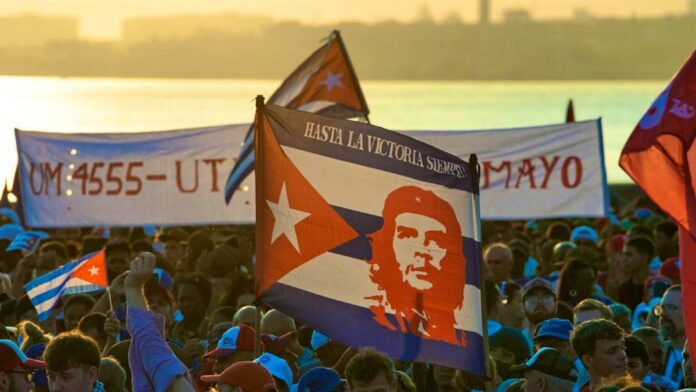
Capitalism was overthrown in Cuba in 1959. While the lack of workers playing a central role led to a bureaucratic regime that never achieved socialism, the planned economy still provided many important social gains for working people, such as widely expanded literacy and access to healthcare and education. However, in recent decades the so-called communist government, under pressure from imperialist forces, has implemented growing market reforms.
This has now culminated in its greatest push toward capitalist restoration, with sweeping reforms reprivatizing major industries, authorizing private banks, and opening its economy to investment by Cuban capitalists abroad—a desperate attempt to satisfy US imperialism. But Trump has dismissed these reforms as “superficial smoke signals,” clearly aiming at deeper economic and political concessions.
Some on the left may support Cuba’s market reforms—inspired by Chinese capitalist restoration—as pragmatically necessary to ensure the regime’s survival. But this only demonstrates to Trump a willingness to liquidate the remaining gains of the revolution. The Cuban Revolution inspired left-wing movements throughout Latin America, which challenged imperialism. This—the spread of anti-imperialist mass movements and revolution—is the best defense.
How Do We Fight Back?
The fate of the working class at home is inexorably linked to that of workers throughout the world. The military aggression in the Caribbean is just another form of the ICE offensive nationwide and the myriad attacks on working people domestically. We must build an international working-class movement across the Americas and globally, against Trumpism, all imperialism, and all capitalist exploitation. Just as the heroic Italian working class organized multiple general strikes against the genocide of Palestine in Gaza, and just as Minnesotan workers organized the first citywide general strike in the United States in decades to push back ICE, so too can the workers of the world unite to defend Cuba by organizing against the embargos and arms shipments.
Meanwhile, the Cuban working class cannot rely on its own ruling regime, with its capitalist betrayals, to struggle against US imperialism. It must express its interests through a new, truly socialist, mass organization, rooted in working-class democracy and internationalism, that fights to restore the gains of the revolution, not reverse them. This could electrify workers internationally and deal a blow to US imperialism.
The movement against the rising tide of capitalism and right-wing authoritarianism is already underway in Bolivia, Chile, and Argentina. The US working class must stand shoulder-to-shoulder with these movements and against the siege of Cuba, as part of a common struggle for liberation from imperialism and repression.