

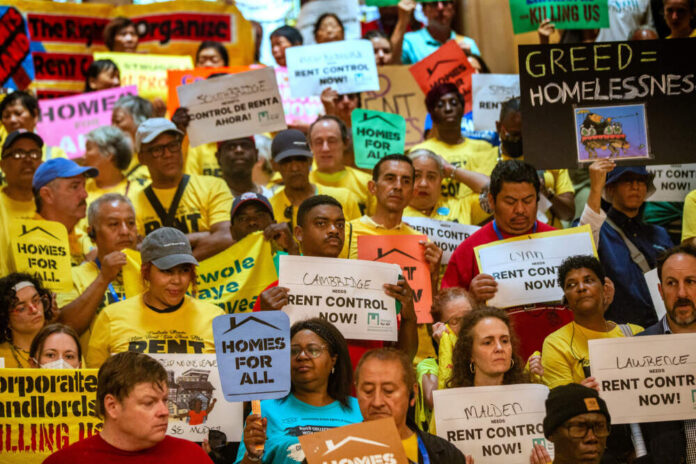
The turbulent trajectory of a state-wide Massachusetts rent control ballot initiative—from an immensely popular demand to address the severe housing affordability crisis to a legal disqualification based on a minor technicality—offers critical lessons for housing activists, socialists, and working people everywhere. The fight for rent control in Massachusetts was not simply a matter of housing policy; it was a test of the strength of the grassroots tenants’ rights movement and a stark demonstration of how the ruling class uses the state apparatus to crush working-class demands. It is a story not only of corporate landlord lobbyists and legal loopholes, but of a strategic betrayal by NGO leadership that kneecapped the initiative, deferring to the very Democratic establishment that ultimately facilitated its defeat.
Origins & Popular Support
Before 1994, rent control measures were in effect in Boston, Cambridge, and Brookline. But after an expensive propaganda misinformation campaign that year by corporate landlords, voters narrowly approved a ballot initiative prohibiting most local rent control laws statewide. In the 32 years since, communities across Massachusetts have experienced huge increases in rents and rapid gentrification—disproportionately affecting historically Black and Latino neighborhoods, pushing out immigrants and families, and leading to the decline of Boston Public Schools enrollment. The housing affordability crisis also disproportionately affects LGBTQ+ youth who experience high rates of homelessness, as well as transgender adults who are overrepresented in the renter pool.
The 2026 ballot initiative began as a response to an escalating crisis that has made Massachusetts one of the most unaffordable places to live in the country. The average rent for a one-bedroom apartment in Boston is $3,635 per month—119% higher than the national average of $1,662 per month. Ongoing failure to act by state legislators led tenant advocacy groups to launch Keep Massachusetts Home, a campaign for a ballot initiative that would have established rent control across the entire state, limiting annual rent increases to the cost of living (as measured by change in the Consumer Price Index) or 5%, whichever is lower.
The process of getting a question onto the ballot is intentionally difficult, designed to filter out working-class demands before they even reach the public. It requires a gauntlet of approvals, including review by the Attorney General and the collection of a massive number of signatures in a short timeframe. Despite a lengthy qualification process, activists successfully gathered over 150,000 signatures to place the measure on the November 2026 ballot, a testament to its popular support. Public opinion was clearly on the side of the initiative. Working-class people, burdened by soaring rents, saw the ballot question as a direct mechanism to push back against corporate landlords and the housing affordability crisis.
Compromises & Betrayal
Facing the reality that they could not win on the merits of their real argument—that rent control would cut into their profits—the landlord lobby, backed by billions in real estate capital, unleashed a tidal wave of advertisements rife with misinformation, insisting that rent control would worsen the housing crisis. The measure was painted as a “housing killer,” with the opposition claiming it would deter investment from housing developers—despite the ballot initiative’s inclusion of a ten-year exemption for new construction. Not to mention the fact that these new, primarily “luxury” housing projects are absolutely unaffordable to most renters in the first place—a real solution to the affordability crisis would require building new affordable housing units on a massive scale rather than accommodating for-profit developers.
Unfortunately, Keep Massachusetts Home’s original proposal included this unnecessary, preemptive concession to the corporate real estate lobby, along with an exemption for owner-occupied properties with four units or less. We must recognize that the interests of corporate landlords and working-class people are fundamentally opposed, and watering down our demands only reduces possible victories. It also weakens our ability to mobilize the widest section of renters. Those in newly constructed units or the relatively small number of owner-occupied buildings that exist would not benefit directly from the proposal, making them much more difficult to convince to participate in the fight. There is no advantage to watering down demands in an attempt to appease the ruling class—a better deal for them is always a worse deal for us and they will fight tooth and nail even the smallest infringements on their profits.
The housing lobby’s most effective weapon yet was not their propaganda but the Massachusetts Democratic Party establishment. Thoroughly corporate governor Maura Healey opposed the measure outright, while the nominally progressive mayor Michelle Wu spearheaded a “compromise” legislative bill. This bill was designed as a trap, with significant input from groups prioritizing landlord interests. It was weak and riddled with loopholes, allowing unlimited increases during tenant turnover and capping increases at 10% per year—allowing rents to double over a decade. Worse, it made provisions completely optional, requiring municipalities to “opt in,” gutting its statewide application. The existence of this compromise, along with the relatively low profile of the ballot initiative, led many to confuse the two or believe their only option was Wu’s sell-out compromise.
Then came the most devastating blow. Keep Massachusetts Home voluntarily agreed to withdraw the ballot question if this weak bill passed. This was an act of profound betrayal. By agreeing to this backroom deal, the leadership traded 150,000 signatures and campaign momentum for a bill that would do little to nothing to improve the crisis. They disregarded the will of the renters they claimed to champion and resisted input from tenant organizations that had worked alongside them. They prioritized a legislative “win”—mediated by the same Democrats who take money from big real estate developers and corporate landlords—over the leverage of a direct popular vote. It handed landlords their victory: They didn’t need to kill the question in court if movement leaders would kill it themselves.
The initiative’s leaders, like those of many NGOs, saw Democratic officials as allies and wanted to stay in their good graces; but the role of the Democrats is to disrupt and co-opt workers’ struggle, giving enough appearance of progress that the working class does not organize independently and continues to look to Democrats for capitalism’s barest offerings. For this campaign to succeed, it needed to be built totally independent from Democratic officials and rely solely on the strength of our movement. Even while the coalition was prepared to give up their ballot question—already containing huge concessions—to agree to this defanged bill, the housing lobby was still negotiating for even fewer renter protections to be included.
State Supreme Court Deals The Final Blow
While Keep Massachusetts Home refocused its efforts on pressuring the legislature to pass the “compromise” bill, the landlord lobby doubled down on advancing legal challenges. Filing with the Massachusetts Supreme Judicial Court, they argued the ballot proposal’s language violated the state constitution, which prohibits any “…measure that relates to religion, religious practices or religious institutions.” The court struck down the question on a minor technicality: an exemption for “buildings used primarily for religious services”—language already approved by the Attorney General.
This ruling highlights the courts’ role in protecting capitalist interests. While courts seed illusions of fairness, they issue rulings that protect capitalist interests; victories for the working class that seem to come from courts are really the result of powerful movements exerting enough pressure to force concessions. When the threat of winning rent control became too real—despite the massive capitulation already promised—the judiciary stepped in to throw out the ballot question on a small detail unrelated to its intent. This reminds us that the legal system under capitalism will always defend property rights over human rights.
Keep Massachusetts Home’s response to the defeat was to instruct people to call their legislators to urge passing the weak “compromise,” ignoring that they had just lost their only leverage. They had no new strategy, appealing to the same Democrats who had refused to approve the measure when it came before the state senate with 75,000 signatures. What we needed was a massive presence inside court hearings and huge protests outside—a wave of pressure so intense that judges would feel the political cost of throwing it out.
Lessons For The Renters’ Rights Movement
1. The danger of NGO-ization
The coalition behind Keep Massachusetts Home proved more interested in preserving its relationship with the Democratic Party establishment than winning a genuine victory for renters. Deference to Healey and Wu—both receiving huge donations from the housing lobby—leads to demobilization; when officials inevitably betray the movement, the working class is left demoralized instead of galvanized. The Democrats are not our allies; they are managers of a capitalist state hostile to working-class interests. We cannot allow unaccountable leaders to trade away the leverage our movements build. Keep Massachusetts Home agreed to the compromise legislation in a backroom deal, entirely separate from actual renters who would have fervently opposed it. This betrayal arose from the flawed political strategy of the campaign’s leadership since the beginning: reliance on the Democratic Party instead of the power of our movement—in brief, class collaboration instead of class struggle.
2. Renters must be the engine
The campaign failed to deeply integrate the mass of renters into its movement. Hours for signature sheet pickup and drop-off were limited to the middle of the workday—thereby preventing the vast majority of everyday renters from participating directly in collecting signatures. There was a disconnect between the campaign’s leaders and the renters who would benefit. A successful campaign must be rooted in direct participation and leadership of the working class in its own struggles. If Keep Massachusetts Home had democratic structures with mass working-class participation, the base itself could have pushed back when leadership tried to capitulate to the Democratic establishment.
3. Escalating the struggle
We must learn to anticipate the tactics of the ruling class: pouring money into misinformation, co-optation in the legislature, and judicial sabotage. We cannot rely on the politicians or the courts to save us. We must be prepared to mobilize the masses in the face of opposition and build a movement that calls out betrayals and puts no faith in the Democrats or their “compromises.” In order to win, the struggle needs to combine rent strikes, tenant unions, and mass meetings where demands and tactics are democratically debated and decided.
What’s Next?
This defeat does not mean the fight for rent control is over. We must redouble our efforts to organize renters into a militant force capable of mass action. Capitalist courts and the current two-party system stifle any attempt at working-class democracy. No candidate who runs for office on rent control can win these demands alone, but only with a mass organized movement. Ultimately, we need a new independent workers’ party capable of building and maintaining an organized movement to win rent control and even bolder demands generated by and fought for by workers.
As we have seen in Seattle and elsewhere, victories for working people are won through mass struggle, not legislative chambers or courts. We need rent control that works—not watered-down, opt-in loopholes. As the struggle continues, we must rebuild on a stronger, independent, and more militant foundation. The housing crisis remains, and the lessons are clear: Only a working-class movement that relies on its own power, not the courts or the Democratic Party, and that attacks capitalism at its root can win us the affordable housing we deserve.