

- Attacks are a consequence of the betrayal of the ANC.
- Capitalism is the monster that must be confronted and defeated
- For a new mass workers’ party to lead the struggle against capitalist rot
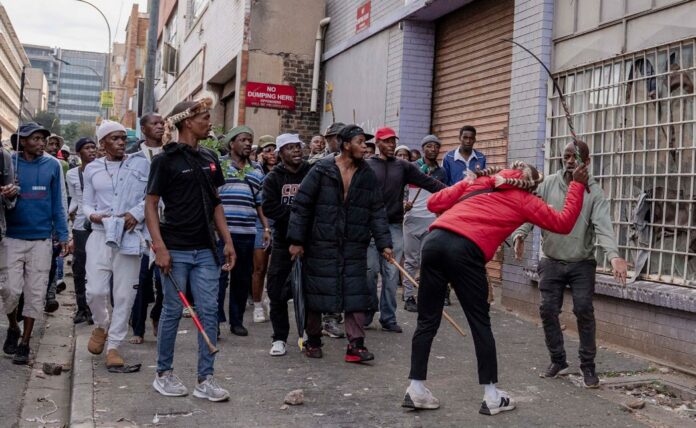
During the just-concluded World Cup, South Africa in its first match came up against Mexico. All over the African continent there was an immediate shift of support by football fans on the side of Mexico, who eventually won the match. The idea of African support for African teams, a form of solidarity which is the norm at such tournaments, was nowhere to be found. And this is not disconnected from the xenophobic movements and attacks on African immigrants in South Africa. These attacks have brought untold damage in the form of mass displacement, loss of livelihoods and properties for immigrants, and even death directly and indirectly. Far right groups like Operation Dudula and March for March have called for African immigrants to get out or be dealt with. Millions have had their lives suddenly plagued with uncertainties. And at the same time, hundreds of thousands have had to flee from South Africa back to their countries, fearing for their lives.
The mood outside of South Africa—from Nigeria, Ghana in West Africa to Zimbabwe, Malawi, Mozambique in Southern Africa it is one of rage and a huge sense of betrayal of trust, given the decades of unending support by the African masses for Black South Africans in the struggle against Apartheid.
What Is Responsible For The Anger On The Street?
The first thing to acknowledge about South Africa today is the fever of mass discontentment on the street by the working masses. Unemployment figures currently stand at 40%, with youth unemployment at an alarming 70%. Close to 70% of its 63 million person population live below the “upper-income poverty line.” GDP growth is at a weak figure of 1.1%, and public debt stands at 75% of GDP. 20% of government revenue is spent on debt servicing, taking funds out from the treasury that could be used to meet the economic and social needs of the working masses. South Africa is also top on the World Bank’s ranking of 164 countries with regards to inequality, with the top 10% of its population appropriating 86% of the wealth and resources of the country, while a mere 5% is what is left to the bottom half of the population.
It is this economic meltdown that drives the anger on the street that has provided the oxygen fueling the xenophobic bitterness and attacks. However this anger is misguided by forces that put forward the idea that immigrants are to blame for taking jobs away and for the high rate of crimes in the country. In reality it is the African National Congress (ANC) that has led the country to a dead end, with mass unemployment and poverty, a consequence of implementing capitalist neoliberal policies, attacking the living conditions of the working class, with no fundamental step taken in the direction of reversing the economic arrangements put in place by Apartheid South Africa, since coming to power in 1994.
The Betrayal Of The Expectations Of The Working Masses By The ANC
The end of Apartheid was supposed to be the beginning of a reversal of fortunes for Black South Africans, and the opportunity to build a new homeland of paradise on the African continent. It was the most developed and industrialized society south of the Sahara. This was the idea that drove the wave of African immigrants down to South Africa, fleeing from the failures of the ruling class in their various African countries—failures rooted in capitalism and private ownership of the collective wealth and resources by members of the billionaire and millionaire class. There was a hope that these failures would not be repeated in South Africa, under the rule of the iconic Nelson Mandela and the ANC.
The facts speak for themselves. This betrayal cannot be rooted in the racial coloration of Black leadership, despite its complete failure to address the roots of impoverishment and misery, which have remained intact since the ending of white Boer apartheid rule. Capitalism was only able to develop the means of production to the level it did in South Africa on the basis of an exploitative apartheid system that legislated into existence a denial of access to basic necessities, which imposed mass deprivation on the Black population, making cheap unrewarded labor possible to enable the accumulation of capital at one pole for the minority white population.
To sustain that level of development and lift millions of Black population out of poverty demanded a break from capitalism, demanded that the ANC must go ahead to nationalize the commanding heights of the economy, nationalize the mines, the banks, electricity, the key industries, and land as well made available for use with the full support of the resources of society to meet both the agricultural, industrial and housing needs of all citizens whether white or Black, carry out a program of expropriation, with compensation only on the basis genuine proven needs.
This was the spirit of the “Freedom Charter,” which constituted the backbone of the liberation struggle for the ANC before it came to power. The principle that “the people shall share in the country’s wealth” and “land shall be shared among those who work it” has been dumped. Mandela’s historic compromise and agreement to not take South Africa through the process of nationalization and to keep the Apartheid state structure intact has seen regime after regime move toward a full embrace of neoliberal capitalism, implemented across all key sectors of the economy. Today the ANC has become a billionaire club with key figures like Cyril Ramaphosa, Patrice Motsope, Saki Macosoma, Vusi Khanyile, Tokyo Sexwale taking advantage of the party’s hold on power to not just become business moguls, but to at the same time preside over the inherited Apartheid state structure.
This is a repeat of what happened in the independent African countries in the 1960s, with the so-called “wind of change” translating to nothing more than opening the door to African nationals taking over a state structure not organized to meet the interests of the vast majority of the population. The modern “African states” were colonial contraptions put in place by European colonialism to help facilitate the exploitation of the resources and wealth of their conquered territories—and at the same time crush any resistance against its imposed law and order. Independence or “Black rule” as is the case in South Africa simply meant an arrangement that grants a small layer of Black ruling elites a ticket to enrich themselves. In return they rationalize and maintain the continued existence of the neocolonial arrangement, at the expense of the wellbeing of the working masses.
This is the exact same scenario that set in motion the inevitable betrayal of the expectations of the vast numbers of the Black majority and the working masses in South Africa.
Ramaphosa Plays The Trump Card
The Municipal election, fixed for November 2027, is one reason why the main political parties are particularly ensuring that they are not seen to be opposed to the xenophobic movements. Nearly all the main political parties are all acting to leverage it for support in the coming polls. The ANC having lost its parliamentary majority in the last general elections, reduced to 40%, is cautious to not hurt its electoral fortunes.
The Ramaphosa regime has not deemed it right to clamp down on Operation Dudula and March for March for their role in the xenophobic attacks on immigrants. Ramaphosa’s broadcast to the nation on the subject in June, explaining that the country is opposed to violence and xenophobia, is mere soundbite, given his reassurance to South Africans that his government will now directly take charge of the movement with all the necessary tough measures and stated actions against immigrants. According to him, the government “will intensify the process of identifying and deporting undocumented foreign nationals residing illegally in South Africa.” It was tough talk all through against immigrants, rolling out measures against immigrant employers, corrupt immigrant officials and as well as strengthening border security. This is direct support for the movement on the street. The police that previously turned blind eyes to the attacks on immigrants have now put their right foot forward, joining the attacks on immigrants.
Not a word was said on the worsening economic situation in the country or any indication given that it intends to reverse its neoliberal capitalist policy framework that is at the very root of the widening gap between the rich and poor in South Africa. It must be pointed out that Ramaphosa is here drawing from Donald Trump’s playbook of pinning the blame for government mismanagement of the economy on immigrants, instead of taking responsibility for not providing the necessary public funds to expand and improve on existing health, housing, educational facilities, create jobs to guarantee access to these social needs by all to counter the feelings on the streets that foreigners are not just accessing, but competing and denying South Africans their rights to these essential needs.
The governments in other African countries cannot here also be left off the hook, indeed it is the squandering of the aspirations of the working masses of their various countries that left them with no other choice than for them to seek greener pastures outside their own borders. The blame is therefore not on Ramaphosa alone, but the ruling classes on the whole of the African continent, whose rule over their countries piles up misery on their citizens.
The Way Forward
Unfortunately the trade unions and their federations seem to be completely helpless. In reality, they have the organizational structure and capacity with which to counter the xenophobia campaign groups and redirect the anger of the working masses against the ruling elites in the ANC. Indeed the struggle against Apartheid was not possible without the role and effort of the working class. This is the same exact role that is required of the working class today—to come frontally into the arena of struggle against the ANC and to overthrow capitalism.
But no, the Congress of South African Trade Unions (COSATU) with its claimed 2.2 million members is painfully stuck in its so-called “Tripartite alliance” with the ANC. It’s unwilling to come fully out against the ANC, it refuses to acknowledge that its policy of “seek a good relationship with the ANC in order to influence it” has failed to achieve its purpose. All it does is hold the working class down, while successive ANC governments run roughshod over the lives and wellbeing of the working masses, with COSATU completely unwilling to provide leadership for the anger of the working masses.
As a matter of urgency, workers must call out the leadership of COSATU under Zingiswa Losi and Solly Phetoe to step down from office, if they remain unwilling to end the compromised agreement with the ANC, given the historical betrayals of the gains and struggle for liberation and for its failure to improve the wellbeing of the working masses. COSATU must be reclaimed by workers to defend the interest of the working class and the place to begin is to break with the ANC and commence an independent political action for the working class to organize and boot Ramaphosa and the ANC out of power.
While the other trades unions cannot be directly accused of being glove in hand with the ANC, and take pride in their political independence from them, the fact remains that they have continued to shy away from directly taking up the challenge of providing the needed leadership for the working masses to take on the government directly.
The Federation of Unions of South Africa (FEDUSA), largely composed of white workers, is dominated by the right wing and its non-affiliation with the ANC amounts to nothing at the end of the day, given its support for neoliberal capitalist programs of the ANC. The National Council of Trade Unions (NACTU) is at the opposite ends of FEDUSA with its pan-African and Black workers-based membership cutting itself from white workers.
The South African Federation of Trade Unions (SAFTU) on the other hand comes out against the ANC, calling for an end to “austerity, elite based empowerment and corruption” and that without embracing “a workers-led socialist transformation grounded in redistribution and dignity for all, South Africa will remain the world’s capital of poverty.”
This is beautiful, but not enough. SAFTU must step up its act to provide the needed leadership for the whole of the trade unions movement and the whole of the working masses in South Africa. The ANC having done away with its own “Freedom Charter” cannot and will not embrace socialism. The working class must seize the initiative and bring itself onstage to organize and provide the leadership for the whole of the working masses, and commence the process for the formation of a working people’s political party that will bid to unseat the ANC and capitalism at the same time.
To refrain from doing so will mean that the xenophobia campaign groups and other far-right groups will become bolder and seek to transform themselves into political groups that will contend for power in the near future—either by organizing to take control of the ANC like Trump did with the Republican Party in the US, or with a new far-right political organization. This will be an even worse turn of events for the working masses, given the fact that they do not oppose the capitalist system that really lies behind their economic woes, instead blaming immigrants. These immigrants themselves are victims fleeing from the mass misery that the capitalist policies of deregulation and privatization had imposed on them in their own countries. The same immigrants who serve as cheap labor and work their asses to hell to keep up the profit margins of the bosses of industries. Rather than stand by as immigrant workers are attacked, killed and forced out, the trade unions should have stepped in to have them all organized and to respond collectively, together with strength and force of the whole working class in South Africa to take on the bosses for a living wage and improved working conditions. No to dividing the working masses against themselves.
Only the united action of the working class movement under a revolutionary leadership, posing the question of power, can ultimately win the mass of South African workers and poor peasants from the reactionary backlash of xenophobia, and turn its anger against capitalism and imperialism. South Africa can draw from its rich history and legacy of struggle against Apartheid to provide the lead and example for the whole of the working masses in Africa by coming into the arena of struggle against the ruling elites contending for power for its own class with the goal of abolishing capitalism and mass misery. This is the general position that is needed all over the continent.