Tyler is a member of the National Association of Letter Carriers, Branch 9 (personal capacity).
On April 1, Donald Trump said, “We’re fighting wars. We can’t take care of daycare,” arguing that it is “not possible” for the federal government to fund Medicare, Medicaid, and childcare. Meanwhile, he has proposed a Pentagon budget of $1.5 trillion and has spent hundreds of billions on war abroad and his anti-immigrant offensive at home. It’s clear that this funding will continue to come at the expense of funding for schools, hospitals, housing, childcare, and other social services like the United States Postal Service (USPS), which is in a decades-long financial deficit.
The US-Israeli war on Iran is creating a humanitarian crisis in the region, unleashing economic chaos worldwide and causing the price of oil and other goods to skyrocket. An anti-war movement on a mass scale is needed. The labor movement needs to step up and build this movement by putting forward a working-class program, including linking the fight to end the war to the fight to fully fund social services.
Fund Services, Not War
US workers are already feeling the impact of increased inflation, with gas prices nearly doubling since the start of the war. Increased gas prices not only impact consumers, but will put an extra burden on the entire logistics sector. Every increase in gas prices costs USPS and other delivery companies millions of dollars, which is why USPS announced a first-ever 8% “fuel surcharge” on packages. Additionally, the postmaster general announced intentions to raise first class stamps to 90-95 cents, as well as a host of cost-cutting measures that would negatively impact working conditions and the service.
The over 200,000 city letter carriers at USPS are represented by the National Association of Letter Carriers (NALC), and in Minneapolis, we’re fighting back. NALC Branch 9 in Minneapolis passed an anti-war resolution, “Fund Services, Not War,” with overwhelming support at our April General Membership Meeting. Our anti-war resolution will be brought to the floor of the NALC National Convention this August, and we’re using it to force a debate within the union about the role the labor movement needs to play to fight back against this war. The resolution draws the connection between the government funding the war while the postal service—as well as schools and hospitals like Minneapolis Public Schools and Hennepin County Medical Center—are in financial crisis. But the resolution doesn’t stop there—it calls for our union to publicly oppose the war in Iran and for the need to fund social services.
Since then, several other NALC branches have also passed the resolution, including Allentown/Lehigh Valley Branch 274 and Seattle Branch 79. These resolutions concretize growing opposition to the war felt among letter carriers and working-class people across the country, as well as steps our unions should take to fight back. Our anti-war resolution will be brought to the floor of the NALC National Convention this August, and we’re using it to force a debate within the union about the role the labor movement needs to play to fight back against this war.
The “Fund Services, Not War” resolution was put forward by NALC members who are a part of Build a Fighting NALC (BFN), a reform caucus in the union that was built around the fight for open bargaining in 2024. Since then, in addition to pushing our union to take a strong stance against the Iran war, we have organized against the ICE occupation of Minneapolis this winter, and are fighting for the right to strike. From the beginning, BFN has advocated for linking a program addressing postal-specific workplace issues like a $30/hour starting wage, an end to mandatory overtime, an all-career workforce, and more, to the key political and social questions that exist for NALC members and the working class as a whole.
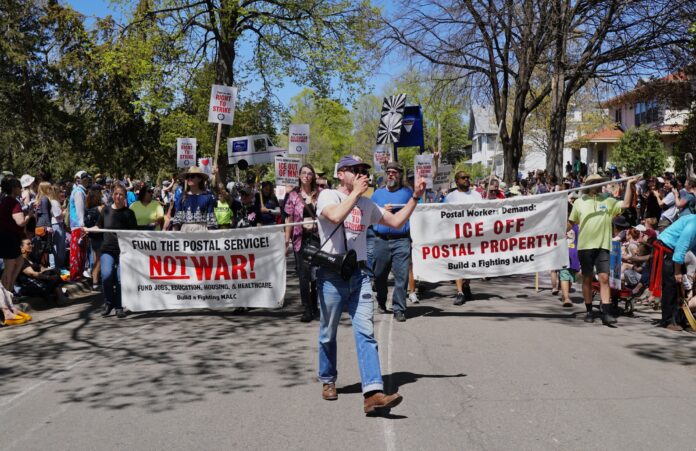
BFN and NALC Branch 9 members organized a contingent at the Minneapolis Mayday Parade, which takes place every year in South Minneapolis, the epicenter of the anti-ICE struggle. On May 3, we marched with banners stating “ICE Off Postal Property!” and “Fund the Postal Service, NOT War!”, chanting “ICE out, shut it down, every city, every town!” The crowd enthusiastically joined in the chants and cheered so loudly in support that at times it drowned out the postal worker contingent. This is just one small example of the potential public support that exists if the labor movement takes the lead in organizing opposition to broader attacks on the working class, such as the war.
Why The Labor Movement Needs To Be Anti-War
The labor movement should not limit itself to making statements opposed to the war, but should also actively mobilize its members as contingents to anti-war demonstrations, and even organize our own union-led protests where possible. These demonstrations should link opposition to the war to a working-class program, including slashing the military budget and taxing the rich to fund services like the postal service, healthcare, childcare, housing, and more.
As the war escalates, the labor movement will need to go even further to disrupt the billionaires’ flow of profits, as workers in Minneapolis did on January 23 by striking against ICE. Workers are the ones with the power to disrupt the flow of military equipment, from production to distribution. In 2025, Italian dockworkers went on strike in opposition to sending military equipment for the Israeli state’s genocidal war on Gaza, giving the international working class an example of the kinds of actions needed to stop the war machine.
When BFN members organize around broader societal issues—like opposition to ICE or the war in Iran—we often hear the question, “What does this have to do with our union?” Our response is that these broader societal issues impact the working class as a whole, and unions are fighting organizationsorganized forces of our class. We are not separate from our communities—workers don’t cease to exist the moment they clock out of their shift. This is especially true for public sector workers, like postal workers, teachers, or other social service workers.
“An injury to one is an injury to all” is an old labor movement slogan that gets to the heart of what solidarity means in practice. Unions taking up broader working-class struggles strengthens those movements, and in turn the labor movement grows stronger. This happens through giving union members experience in organizing and actively building the solidarity needed to take the fight in the streets back into the workplace around issues of wages and working conditions.
For too long, labor leadership has narrowed the scope of what unions should fight for exclusively to the “bread and butter” issues of wages and working conditions, but it wasn’t always this way. At the height of the labor movement in the ‘30s and ‘40s, unions regularly took on broader political questions and other issues that impacted the entire working class. In 1946, the United Auto Workers fought for a raise for its members without a rise in the price of cars, as a way to build public sympathy for autoworkers who had suffered from rising inflation during the war.
Other unions also played key roles in bringing the fight for justice from the workplace and into the streets, including the packinghouse workers who played a key role in fighting against segregation in Chicago and garment workers who fought for rent control and social housing in New York City. The fights for “bread and butter issues” and broader social issues, go hand in hand.
This war has made it clear that the US government can always find the money to fund their programs, but that money will not go into the services that benefit the working class unless we get organized and fight for it. This is why the labor movement needs to get organized now and help lead a mass anti-war movement, one that draws in the entire working class behind a program to end this disastrous war and fund the services working-class people need.