
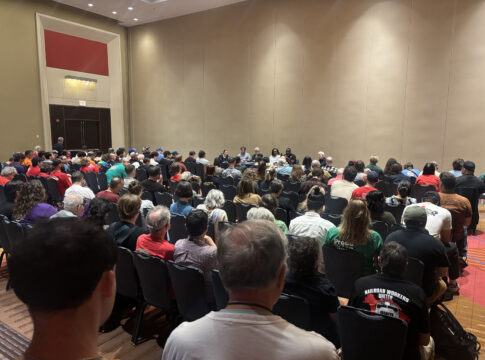
From June 12-14, around 4700 workers packed the Hyatt Regency O’Hare for the largest Labor Notes Conference to date. In addition to strong representation from sectors like healthcare and education, 220 Amazon workers and more building trades workers than in any previous year were in attendance. Many federal workers arrived a day early to hold a Federal Unionist Network (FUN) summit, with a renewed commitment towards fighting Trump’s attacks on federal workers.
This is a critical moment for the labor movement, which has suffered a slew of union-busting, anti-worker schemes from the Trump administration, as part of its broader right-wing agenda. As a result of this hostile political landscape, the conference offered many sessions that looked beyond the confines of workplace struggles, with sessions such as “Dismantling the War Machine,” “Resisting AI,” and “Forcing Corporations to Drop ICE.”
Several sessions took up the question of political strike action, including one titled “Can Political Strikes Restore Labor’s Power?” The Minneapolis general strike on January 23 forced Trump to take a step back from his violent ICE-driven offensive in the Twin Cities, but since then, more decisive action from the labor movement against Trump has yet to be seen. All in all, this Labor Notes Conference took up many key questions facing the labor movement today, from battling the bosses to defeating Trump.
Strikes Are On The Table
The real hunger to fight echoed amongst rank-and-file workers throughout the conference, often expressing a desire to go beyond what their union leadership was willing to do. Offensive strikes were a major discussion topic at the K-12 Educators meetup. This past March, both faculty and staff unions at Portland Community College went on strike together against an insulting 0.35% pay raise. Shamefully, the leadership of the staff union pressured their members to settle early. But because the faculty rank and file held out until the end, both unions won a raise, which scared the administration at another community college outside the PCC system to preemptively offer their staff a real raise.
In January of this year, 15,000 New York City nurses organized in NYSNA struck for 41 days for better pay and staffing. Nurses in the “Lessons from Health Care and Hospital Strikes” session explained how winning a stronger contract took not just overcoming the hospital’s blatant union busting, but also the undemocratic maneuvers by their own statewide union leadership. The importance of open bargaining was also stressed. In the case of NYSNA, opening the bargaining sessions up to the rank and file via Zoom engaged the membership and built the necessary pressure on the bosses to give concessions.
Striking is far from straightforward, as it takes openly defying anti-union no-strike clauses enshrined in many union contracts—especially challenging in the public sector, where penalties are generally harsher. But the militant history of the labor movement shows that illegal strikes are necessary to take on the fight against the bosses and billionaires, who won’t hesitate to use illegal measures themselves to crush workers and protect their own power. It is no coincidence that the session on “How to Break Your No-Strike Clause” was standing room only. While the session focused primarily on contractual workarounds, the political question of what it will take to fight Trump and fight for better workplaces couldn’t be avoided, and will need to continue to be a topic of discussion and debate.
The Political Strike & The Decisive Role Of Labor
The highest profile strike of the weekend was of course the historic Minneapolis general strike that took place on January 23 of this year. There were several sessions dedicated to this day of “No Work, No School, No Shopping,” featuring panelists who spoke to how struggle was built in the Twin Cities to end Operation Metro Surge.
In addition to the 100,000-person-strong movement in the streets, the closing of 800 businesses, and the shutting down of schools, more impacts were revealed, including 67% of SEIU airport workers not going to work, which grounded Delta flights for 24 hours. While the community-wide activism in rapid response groups and the movement in the streets served as crucial catalysts for mass struggle, Twin Cities labor leaders explained how decisive the role of organized labor was in forcing all these shutdowns on January 23.
The unions that led the way spent years working together: aligning contracts, working with community organizations, and cultivating an alliance. All of this made for a strong foundation upon which a general strike could be built. Some labor leaders are drawing the conclusion that militant political strike action cannot be achieved without following the “Minneapolis model,” i.e. patiently preparing for years before any action can be taken. But in a session explaining this model in great detail, SEIU Local 26 president Greg Nammacher emphasized that, especially with the pace of attacks today, the labor movement should not be held back by aiming for perfect preparation. Indeed, taking the idea of drawn-out preparation too far can overlook how, especially when the political moment makes it urgent, struggle can inspire more struggle. Worse, it can serve as an excuse for the labor bureaucracy to put a brake on struggle rather than push it forward.
Arguably, January 23 has already laid groundwork for other political strikes to take place elsewhere, such as the statewide strike and march on the state capitol on May Day called by North Carolina educators. Political strikes also can spur more organizing of the unorganized. Five Minneapolis workplaces that organized action on January 23 have since launched organizing drives, with one workplace, a brewery, already winning union recognition. Studying and replicating the blueprint of January 23 is an urgent task for the entire labor movement in taking on the Trump regime.
Billionaires Have Two Parties—Workers Need Our Own
Another major topic of discussion at Labor Notes was labor’s relationship with the Democrats. While much of the labor bureaucracy is tied to the Democratic Party establishment, funneling millions of dollars of union dues every year into electing more corporate Democrats, rank-and-file union members are increasingly distrustful of the party. With the Democrats currently at an even lower approval rating than the authoritarian in power, putting up no fight against the right and offering no way out for workers, the question of breaking with the Democrats could not be ignored.
Socialist Alternative gathered hundreds of petition signatures throughout the weekend in support of a call on union leaders to break with the Democrats and for the labor movement to help launch a new workers’ party. This was met with immense enthusiasm, with many workers agreeing that we can no longer kick this can down the road and need a new party now.
This topic was addressed head-on in a session titled, “How Is Labor Building Political Independence from the Democratic Party?” The answer from panelists was that we should run independent candidates, but only in elections where no Democrat is running to avoid the “spoiler effect.” This may sound smart, but in practice it places limits on the power we can build and protects often rotten Democratic politicians. In “Running Labor Candidates for Public Office,” the moderator shamefully told the audience to refrain from asking any questions about independent runs and third parties.
Union leaders need to seriously take up the task of building a new party, and, as a step toward this goal, run and support pro-worker, independent candidates who actually challenge the right and expose the empty promises of Democrats. We need a new party that isn’t tied to corporations and the billionaires, that serves as a vehicle to build the fighting movements we need.
Some labor leaders agree we need a break with the Democrats, but not before the labor movement is stronger, given that union density is only 10% right now. But this overlooks how a break with the Democrats and founding of a new political party can be a boon for organizing the unorganized, and for building militant struggle instead of putting energy into electing Democrats. A new poll shows that 43% of voters are dissatisfied with both political parties and 45% consider themselves politically independent. If not now, when?
One session discussed progressive Democrat Zohran Mamdani and his political platform. As we have explained, to win Mamdani’s program, it will take a mass movement of the ordinary people who elected him and a clean break with the Democratic establishment, which will otherwise serve to undercut him every step of the way. As one NYC public sector worker put it, “Zohran won’t support a wildcat strike, but I want to build one anyway,” and connected this idea to the need for a new political party.
(Almost) Everyone Hates AI
From its impact on jobs, workflow, energy costs, the environment, and more, AI has rapidly found its way into every corner of our lives. Several sessions were dedicated specifically to the discussion of AI, such as “Resisting AI.” But discussion about AI as it relates to workplace issues and contract battles came up in sessions throughout the weekend.
On balance, union members expressed negative views towards AI—educators shared concern about the rise of AI use in school, which is negatively impacting learning, and designers expressed fear of being forced to use AI and sacrifice their creativity. Workers across sectors discussed the threat of job replacement, from voice actors to hospital workers to tech workers.
In “Data Centers and Union Power,” union leaders in IBEW (electrical workers) provided a different point of view—they described the positive impact data centers, the water-guzzling factories needed to power AI, have had on job security and on building their unions. They described how, for the first time, they can send their kids to college, and how instead of traveling constantly for work they can work on one project for years. They went on to explain how these projects, which are longer term than typical construction jobs, allow them to deepen relationships on the job site to build their union. Their union memberships have doubled and diversified, no longer looking like the “white boys club.”
At the same time, the detriments of data centers are nearly endless. Noise, high electric bills, and terrible impacts on the environment are driving workers across the country to oppose their construction, including in many rural communities. This opposition reflects not only a rejection of AI, but a rejection of the billionaires who have recklessly unleashed the technology without weighing up the consequences, and who are using their power to buy up our communities.
While the session unfortunately sought to draw up a narrative that workers in the building trades and community members have opposing interests, this is far from the truth. Together, workers everywhere, including in the building trades, must oppose the rule of the AI billionaires and their quest for profit. While union leaders paint a rosy picture of the security that data center jobs provide now, they have no answer for what happens when the AI bubble bursts and data center jobs dry up. This is because their program is limited to following the lead of the capitalists and whatever the market wants them to build.
What workers really need is to fight for a new green jobs program, which includes a plan for retooling polluting industries into socially useful work and publicly financed construction jobs building new green infrastructure—all without loss of pay or benefits and paid for by taxing the rich. A real program for a just transition also means taking the top 100 polluting industries into public ownership and moving toward 100% renewable energy.
Rebuild A Fighting Labor Movement
With more attacks on unions and marginalized people, the rising cost of living, the hottest summer on record on the way, a fragile peace deal in the Middle East, and now a crackdown on Minnesotan protesters, there is reason for fear, anger, and uncertainty. At the same time, there is far more reason to fight back to win the world working people deserve. The labor movement has a crucial role to play in this battle. The huge turnout of rank-and-file workers at Labor Notes, with whispers of the conference moving to an even larger venue next year, is a welcome sign. But much more is needed to revive the militant traditions of the past, including a decisive break with the corporate, strike-breaking Democratic Party.
Defeating Trump is an uphill battle, but one that the labor movement must boldly take up. Such a battle is one step in the wider war against the billionaires and the system that produces them, and toward a better world.