

Trump’s war on Iran has dragged the world into a roller coaster. One minute, Trump is threatening that “A whole civilization will die tonight, never to be brought back again.” The next minute, he’s announcing a ceasefire and declaring the war over. At the time of writing, the original two-week ceasefire deal has been extended, but without any clear indication of a long-term solution. Still, the Strait of Hormuz remains blocked, Israel has continued attacks on Gaza and Lebanon, and the threat of deeper escalations hangs over everyone’s head. The situation is begging for a mass anti-war movement.
Historically, the onset of war is accompanied by a patriotic propaganda offensive that temporarily gains an echo, only for the mood to reverse when the reality of war sets in. George W. Bush’s approval ratings dropped from 90% right after 9/11 to 25% at the end of his term. The protests against the Vietnam War were tiny in the early 1960s before ballooning into the biggest anti-war movement in US history.
The good news is, compared to past wars, the usual patriotic drumbeats aren’t working. Even without a mass movement, Trump’s war has been deeply unpopular right from the start, with 59% of Americans opposing the bombing. You would think that this would translate to mass anti-war protests, but thus far they’ve generally been small.
Many factors have held back the development of a more sustained anti-war movement. It’s dizzying to keep up with Trump’s erratic military adventures, which raise questions of whether he’ll continue the war or turn his guns elsewhere, and whether protesting in the streets can move the needle anyway. But US society has been far from quiet under the Trump regime. The last year has seen the largest protests in US history, and the working class decisively pushed back Trump’s deportation machine when they went on strike in Minneapolis. The labor movement has yet to take a clear lead against war abroad.
Even if Trump does back out, conflict in the region will be far from over, and an anti-war movement is still necessary. But further, Iran isn’t an isolated war. Trump’s military adventures are symptomatic of the period we’re in—a period defined by war and militarism—where imperialist powers, chief among them the US and China, compete for global dominance and drag the rest of the world into conflicts. The global trend is towards more conflict, not less. One thing’s for sure: imperialist war is in the interests of the ruling class and does not benefit workers.
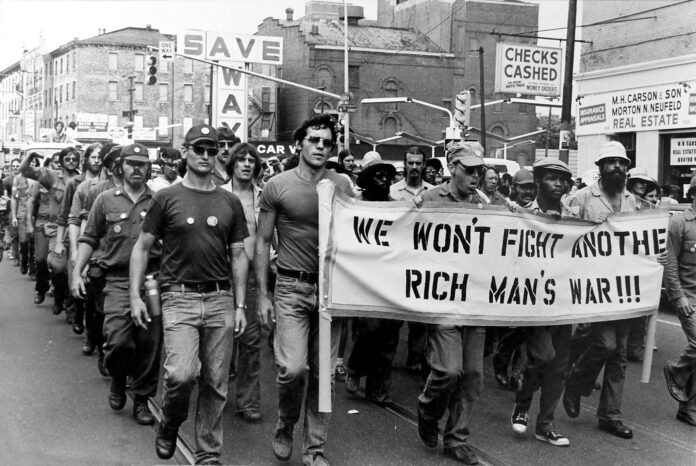
To see how a mass anti-war movement can be built, it’s useful to look to past examples, from the historical lessons of the movement against World War I to the recent memory of the Gaza encampments. As horrifying as the world’s slide into war may be, we need to learn the lessons of the past and apply them as we build the anti-war, working-class fightback that’s so urgently needed.
Lessons From The Gaza Encampments
The Gaza solidarity movement in 2024 was the largest anti-war movement in decades. Although smaller in numbers than the movement against Bush’s war on Iraq, the Gaza solidarity protests were more militant and confrontational. The encampments on college campuses faced off against intense police repression, responding with mass demonstrations and limited but important strike action.
These are the types of militant mass actions a revived anti-war movement would need to build on. The movement had an enormous impact on public opinion. After decades where popular support for Israel was taken for granted in the US, the movement solidified a shift in public sympathy with the Palestinian people.
But ultimately, it failed to win any concrete gains in stopping Israel’s genocidal onslaught or US imperialism’s backing of it. At best, it pressured the US government to give marginally less brazen support to Israel than usual. The changes in public consciousness are important, but the question still remains: why didn’t it go further?
The most immediate answer is the intense repression foisted on the movement by the state and campus authorities. Protesters were beaten, arrested, expelled, and deported. Groups like Students for Justice in Palestine had their campus chapters suspended in universities across the country. The repression reached its highest prominence in 2025 when ICE kidnapped Mahmoud Khalil, one of the organizers of the Columbia encampment. Khalil still faces the threat of deportation, fueled by Secretary of State Marco Rubio’s insistence that Khalil’s beliefs are “in conflict” with US foreign policy.
Repression alone can’t explain why the movement didn’t go further however. The immigrant rights movement has also faced severe repression, with the Trump administration laying siege to one city after another. However, following the murder of activist Renee Good, the Twin Cities responded with a general strike on January 23, 2026. Although ICE wasn’t decisively defeated once and for all, they were forced to make a significant retreat and detention numbers dropped nationwide in the aftermath.
With the Gaza movement, at least in the US, there wasn’t a similar escalation in the labor movement. This left the encampments isolated in the face of campus repression, and many leaders of individual encampments accepted bad deals with university authorities to disband the encampments. By the time of the 2024 elections, with both Trump and Harris backing Israel’s genocidal war, the liberal left abandoned the Gaza solidarity movement as an obstacle to getting Harris elected. All this helped weaken the movement and make it more vulnerable to repression.
The Gaza solidarity movement was a hugely formative political experience for a whole generation, but its retreat was also a setback for the anti-war movement. We need to learn the right lessons from the encampments. Had the wider workers’ movement stepped in and the struggle escalated, the movement could have gone further and won real gains. To understand this, we can look elsewhere in history, to a time when workers actually did manage to stop a war.
World War I: When Workers Stopped A War
In its time, World War I was the greatest mass slaughter known to history, killing 9.7 million soldiers and 6.8 million civilians. You wouldn’t know it from a typical high school history class, but World War I ended because of mass working-class action. This reached the level of general strikes and mutinies and beyond, resulting in two revolutions in Russia in 1917 and one in Germany in 1918.
At first anti-war voices were a minority, even in the socialist movement. Still, dissent developed, from the Christmas truce in 1914 to a wave of mutinies in the French army in 1917. But the decisive turning point came in Russia.
In February 1917, the first of two revolutions that year in Russia brought to power a Provisional Government that ended the rule of the Tsar but deliberately refused to go beyond the bounds of capitalism. The Provisional Government continued Russia’s involvement on the Allied side in the war despite massive casualties, terrible conditions for soldiers, and widespread desertion among the Russian troops.
At the same time, the Russian workers set up democratic councils (called “soviets” in Russian) as organizing bodies of the revolution. This gave space for anti-war agitation. Within the Russian socialist movement, the revolutionary wing, called the Bolsheviks, had remained firm in their opposition to the war from the start. The Bolsheviks opposed the Provisional Government and called for “bread, peace, and land.” Over the course of 1917, the Bolsheviks were able to win majority support in the soviets on this basis and, following the second revolution in October, brought the soviets to power.
Unlike politicians, the Bolsheviks kept their word. They immediately halted cooperation with the Allies and repudiated debts to the other bloodsucking powers. For good measure, they published the secret treaties whereby the Allied powers were preparing to divide the spoils at the end of the war and redraw maps in their interests.
The example of the Russian working class in 1917 inspired millions. In Germany, developments were heading to a breaking point in 1918. The sailors in the German High Seas Fleet, based in Kiel on the Baltic Sea, mutinied on November 3, refusing the order to head out for one more battle with the British fleet. This signaled the end of the war on the Western Front and the beginning of the German Revolution.
The revolutionary upheavals of Russia and Germany can seem far away compared to the small protests today against Trump’s war on Iran. But they provide important lessons for how to stop a war. An anti-war movement needs to aim its fire at the capitalists who benefit from it through imperialist plunder. It needs to take up militant workplace action and strikes. And while this may be sufficient to stop an individual war, the wider drive towards war won’t stop under capitalism. Ultimately, revolution is needed.
That can seem like a tall order, but it has been done and can be done again. The question is: how do we get there?
How An Anti-War Movement Can Form Today
War in general, is incredibly unpopular in the US today. The US defeat in Vietnam, and the mass anti-war movement of the time, initiated a decades-long “Vietnam Syndrome” in public consciousness, an instinctive aversion to getting the US bogged down in foreign wars. Following 9/11, there was a concerted effort to use the “War on Terror” to reverse “Vietnam Syndrome.” But, as the wars in Iraq and Afghanistan developed into quagmires of their own, opposition developed in society: a continuation of “Vietnam Syndrome” as “Iraq/Afghanistan Syndrome.” This featured into Trump’s election, as he campaigned on a disingenuous promise to take the US out of “forever wars.”
Beyond “Iraq/Afghanistan Syndrome” people can clearly see the costs of the war. Rising fuel prices have fueled international protests from Ireland to the Philippines. In the US, the sight of rising gas prices with nothing to gain from it provides little reason to line up behind Trump.
Afraid of mass movements and aware of the way “boots on the ground” would have an explosive impact in society today, the Trump administration has focused on short, splashy attacks followed by increasingly unconvincing attempts to spin whatever results as Trump’s intent the whole time. But the logic of the global inter-imperialist conflict means US imperialism will eventually need to put “boots on the ground.”
This doesn’t mean that “boots on the ground” is a necessary precondition to revive a mass anti-war movement. The Gaza protests were spurred by horror at the genocide in Gaza and US imperialism’s complicity in it. The first large-scale protests against the war in Iraq began before the war even started.
There are already rumblings within the US military. Since the start of the war on Iran there’s been a spike in soldiers applying for conscientious objector status or finding other ways to end their enlistment. A key impetus for the spike was the bombing of a girls’ school in Iran. On April 20, these rumblings translated into open struggle when dozens of veterans occupied the Cannon House Office Building in Washington DC to protest the war. The government responded by arresting 62 protesters. These are the types of escalatory struggles that can transform the anti-war movement into something big.
It’s crucial that the movement take up the types of demands that can bring the working class into struggle. Military recruitment ramped up during the post-pandemic inflation that defined the Biden administration. A resurgence of inflation will increase the weight of the “poverty draft” where workers and poor are pressured into joining the military for economic security. At the same time, anger at how Trump’s war is fueling that inflation can detonate strike action and increase opposition to militarism and war. A demand of “Money for jobs and education, not war!” can tap into that anger while cutting across the “poverty draft.” The labor movement should play a leading role in coordinating these kinds of anti-war slogans.
Such a movement can’t give in to lesser evilism around the midterms. The Democrats may oppose Trump’s refusal to seek congressional approval for his wars, but they still fund obscene defense budgets and they still stand for the global dominance of US imperialism. Without an independent working-class voice against the war, the right will fill the vacuum. When the main alternative to Trump was a warhawk like Harris, his disingenuous anti-war messaging was able to do just that. While Trump has now exposed himself as a warmonger, we can’t allow far-right figures like Marjorie Taylor Greene and Tucker Carlson to become the leading anti-war voices. Truly, we need a left-wing, working-class, anti-war party.
Trump’s terror abroad can’t be disconnected from his terror in US society. While the anti-war movement has been small, the anti-ICE movement has been at the forefront of the class struggle in the US. The Minneapolis general strike against Trump’s deportation machine is exactly the kind of struggle that’s needed to push back his war machine. What’s needed is a movement against Trump, the right, and the billionaire class that brings struggle against war, oppression, and the bosses into one united fight.
Finally, an anti-war struggle needs to be international. The Italian general strike in solidarity with the Sumud Flotilla and the anti-conscription struggles in Germany are some of the biggest recent inspiration for anti-war activism. The drive to war is part of an international capitalist and imperialist system and requires international class struggle to defeat. Socialist Alternative is part of International Socialist Alternative, who are fighting around the world for just that. Join us!