

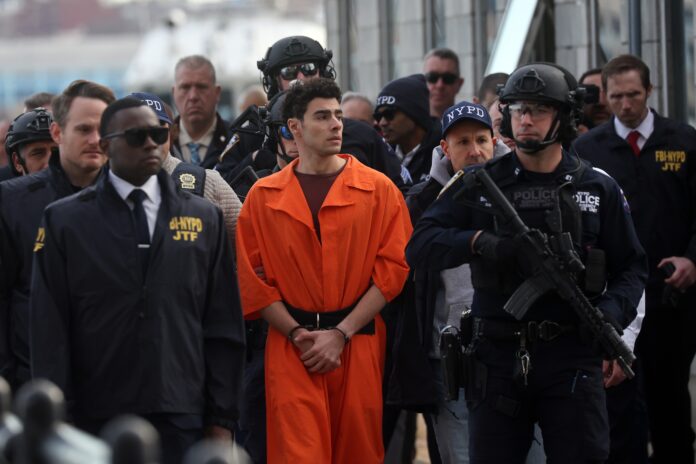
On December 4, 2024, the words “Deny, Defend, Depose” spiked in Google searches, as millions of people watched the video footage of UnitedHealthcare CEO Brian Thompson being shot at gunpoint. The words inscribed on the bullet casings allegedly came from 26-year-old Luigi Mangione, who was spotted and arrested a few days after the shooting. Mangione quickly became an internet phenomenon, with ordinary people coming forward with their stories of being denied coverage from the healthcare company with a net worth of over $250 billion. An Emerson College poll found that nearly 41% of people under the age of 30 said the killing was somewhat or completely acceptable, and over 28,000 people have donated to his legal defense. Nine months later, the question is posed: was it worth it? Mangione now may face the death penalty, the UnitedHealthcare CEO has been replaced, the US still has the most expensive healthcare in the world, and the whole ordeal has been caricatured into Luigi: the Musical.
Political Violence on the Rise
Mangione is emblematic of the rising trend over the last year of political violence as a means to effect change. Two failed assassination attempts were made on Trump. After one of these, Trump claimed he was “chosen by God to make America great again.” Two Israeli Embassy staffers were shot and killed outside the Capital Jewish Museum by a young man chanting “Free, free Palestine!” as he was apprehended. Most recently, a group of eleven have been arrested in Houston for attempted murder of an ICE officer. Right-wing political violence has increased too, as seen with the assassinations of two Democratic Minnesota lawmakers at the hands of a far-right anti-abortionist and the shots fired by an anti-vaxxer at the CDC headquarters.
All of these examples reflect a deepening political polarization in society and a desperation to put an end to the horrors fueled by capitalism. From the genocide and forced starvation in Gaza to the tearing apart of immigrant families, ordinary people are justifiably outraged and terrified. 73% of Americans see political violence as a major problem. At the same time, online resources for making DIY weapons like 3-D printed guns have grown in popularity. While the majority of young and working people are not looking to pick up a gun and plot an assassination attempt, for many there is a question of how to stop Trump and the far right, and if it is even possible.
Earlier this summer, anti-ICE protests erupted in Los Angeles and spread like wildfire across the country. On June 14th, 10 million people took to the streets on “No Kings” day, looking to get involved in the movement. Unfortunately, the lack of a sustained mass movement with a left working-class leadership to show the next steps to fight back means that millions of ordinary people are not sure what comes next, or what their role should be. Some will see individual acts, such as violence, rather than collective action as the only viable way forward. But for socialists, individual terrorism is a dead end, and history shows us what kind of tactics actually point towards the struggle for a better world.
The Narodniks and Individual Terrorism
In 1917, a monumental step forward in history erupted in Russia, when the working class overthrew capitalism and established the only workers’ state in human history—a state run through the active democratic participation of workers. What began as an uprising of 100,000 textile workers on International Women’s Day to overthrow the Tsar in February, sharpened into a socialist revolution by October, with the revolutionary party of the Bolsheviks at the tip of the spear. Workers’ control was established through the Soviets (democratically-elected councils of workers). With this came the outlawing of landlordism, the liberation of the workers and peasants, free education and healthcare, free childcare and abortion rights, and even access to the first gender-affirming surgeries. The capitalist mode of production was replaced with a planned economy, in which production is democratically decided according to need, not profit. Although many of these gains were thrown back by Stalin’s bureaucratic counterrevolution, the Russian Revolution remains the definitive example of the workers taking power into their own hands.
The preparation for this revolution did not drop from the sky, but was forged through many decades of struggle and failure, through testing a wide range of political ideas and tactics, and through the construction of a revolutionary organization to point the way towards socialism as the only way to break the chains of the working class. The path leading up to the revolution that was charted by Marxists is rich with lessons for today, including which methods work and which don’t.
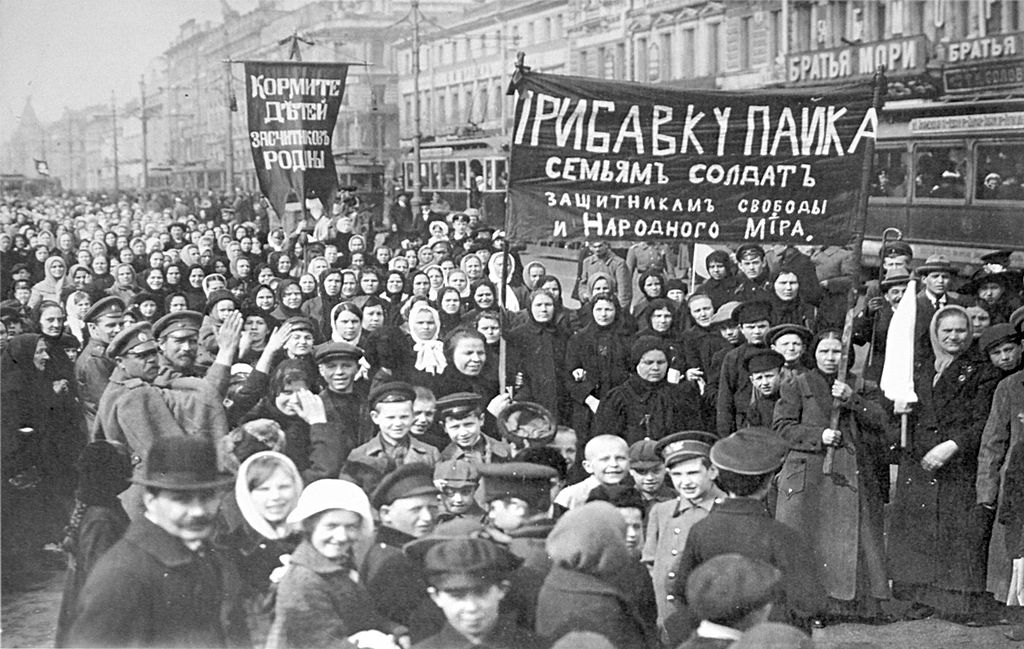
The seeds for the Russian Revolution were planted over half a century before 1917, when struggles against the near thousand-year old form of Russian monarchism began to develop. One tactic that arose out of the harsh and repressive conditions of 19th-century Russia was the individual terrorism of the Narodniks. The Narodniks, composed primarily of the young intelligentsia, renounced their privileged backgrounds to dedicate their lives to the struggle against tsardom. Police surveillance and a stifling education system combined with a Polish uprising that was bloodily crushed in 1863 gave way to a revolutionary student movement looking for a way out. Under the slogan, “V Narod!” (To the people!), they correctly realized that the brutal and authoritarian tsar had to be overthrown, and that early capitalism offered no way forward for the masses of Russia.
Unfortunately, there were many factors during this period that made building a revolutionary struggle extremely challenging. The authoritarian state brutally cracked down on any dissent, meaning that groups like the Narodniks were forced to operate illegally. The writings of Marx and other socialist theorists were banned, meaning the youth lacked access to the much-needed ideas about the development of capitalism and the role the working class must play to overthrow it. Additionally, 19th-century Russia had over 100 different ethnic groups, a wide range of spoken languages, a high illiteracy rate, a small working class and large rural society, all spread out across an enormous mass of land. These conditions, along with the Narodniks’ own middle to upper-middle class backgrounds, shaped their approach to struggle, an approach that ultimately failed.
The young Narodniks were radicalized by the writings of Russian anarchist Mikhail Bakunin, who saw “the people” (particularly the peasantry) as inherently socialist and revolutionary. And so, in 1874 the Narodniks dressed themselves in ragged clothes and headed towards the countryside, looking to rouse the revolutionary spirit of the peasants. It wasn’t long until this failed completely, the outsiders being met with skepticism and sometimes outright hostility from the villagers. In reality, they, with their academic backgrounds, had little in common with the land toilers they idolized. They returned to the towns exhausted and demoralized, and the movement was split in two—between the educators and the insurrectionists.
The Narodnik secret terrorist organization, Narodnaya Volya, became popular to the youth who were gaining no ground in appealing to the peasants. Now, their aim became to spark a revolutionary movement amongst the masses by using “propaganda of the deed.” In other words, they believed individual acts of violence would inspire others to jump into action. But in fact, the opposite became true, as the group succeeded in assassinating a number of high ranking tsarist officials. The masses they hoped to rouse were reduced to passive spectators of struggle, and a generation of revolutionary youth perished under the endless cycle of repression-terrorism-repression.
The Makings of Revolution
At first, the ideas of Marxism, and its denouncement of individual terrorism in Russia, lacked appeal for the revolutionary youth. But the course of events proved the correctness of Marx’s theory on the centrality of the working class: that only the working class could lead a socialist revolution because of its unique relation to capitalist production and profit. This meant that Narodnism was not a step towards working-class revolution, but actually a step in the opposite direction. The growth of Russian Marxism was only possible through a struggle against the old ideas, a turn towards the labor movement, and a political program to point the way towards socialism.
Marxists critiqued the ideas of Narodniks, whose methods pointed away from the central role of the working class to be able to change society. Vladimir Lenin, while having respect for the youthful vigor of the Narodniks, characterized them as “liberals with bombs.” Essentially, beneath the revolutionary facade of the actions of the Narodniks laid a method that relied on enlightened individuals rather than the mass action of the working class to bring about change. Leon Trotsky, one of the leaders of the Russian Revolution, described the process that would follow the Narodnik assassinations of autocrats:
The successor of the murdered minister makes his appearance, life again settles into the old rut, the wheel of capitalist exploitation turns as before; only the police repression grows more savage and brazen. And as a result, in place of the kindled hopes and artificially aroused excitement comes disillusionment and apathy.
Leon Trotsky, Why Marxists Oppose Individual Terrorism
In 1883, Marxists formed the Group for the Emancipation of Russian Labor, preparing the groundwork for an active orientation towards labor and trade unions as more factories developed. While semi-feudal society still existed, the Russian Industrial Revolution established the Russian workers as a class. 1896, 1902, 1903, and the revolution of 1905 saw significant strike waves against poverty and repression, and the ideas of Marx and class struggle grew. These mass struggles that consolidated working-class power as a fighting force posed far more of a threat to the ruling class and their profits than individual assassinations. This period of struggle gave way to the founding of the Russian Social Democratic Labour Party in 1898, which based itself on the idea that workers needed to overthrow the autocracy and take control. Though relatively small, this party contained the seed of the future revolutionary Bolsheviks that would grow to 200,000 members in September 1917 and lead the working class to victory in October 1917.
While the path to revolution was far from straightforward, containing debate, fractures, setbacks, and counter-revolutionary pressure, the ideas around the central role of the working class and the power they hold when organized with a revolutionary leadership prevailed. It is only in this way that achieving a socialist state was possible. In fact, the degeneration of the Soviet Union under the bureaucratic misleadership of Stalin was in large part due to the working class being relegated to play less and less of a role in protecting and building the workers’ state they had fought for. The isolation of the Russian Revolution and the Civil War left the working class in a weakened position, hollowing out the worker’s democracy that was won during the October Revolution.
What Way Forward Today?
Of course, there are many differences between 19th-century Russia and the highly developed global superpower that is the US today. But useful comparisons can be drawn. While there is no monarchy in the US and there is a bourgeois democracy that allows for some democratic rights like voting, Trump is consolidating an increasingly authoritative regime. While capitalism today is far more developed, there are still broadly two opposing classes—today, an oppressor class of capitalists, and an oppressed class of workers. The working class is subject to the violence of the capitalist state, whether that be through physical violence like police brutality and ICE raids, or the violence of being deprived basic human rights like healthcare or housing. Furthermore, this period of history teaches us lessons on how to take on an authoritarian regime when there is no sustained mass movement, and what role socialists should play.
History shows that real progress is made not by individual acts of violence, but through mass working-class struggle. The united working class that creates the wealth for the rich and keeps the world running is the most powerful and progressive force in the world. Individual acts of violence today don’t go unpunished, but it is working people, socialists, and the oppressed who pay the price. Trump is using this political violence to justify attacks on basic democratic rights like the right to protest, the repression of unions and higher education, and an increase of police militarization. Now, the Department of Homeland Security is urging law enforcement to crack down on protestors further, categorizing common protest activities like livestreaming as a violent crime. These acts aren’t only punished and weaponized, but they set our movement back.
Only the working class, with methods like strikes, civil disobedience, and mass social movements can bring down Trump, and capitalism as a whole. There are numerous examples of progress developing this way, from the Civil Rights Movement and the women’s movement of the ‘60s and ‘70s, to the West Virginia teachers’ wildcat strikes that reignited the labor movement in 2017. We can’t rely on a hero to come and save us—we need to build a multigender, multiracial, multinational movement. It is through mass movements that we build real power as a class.
Defeating Trump
While mass movements rooted in the working class are what is needed, the working class is in a challenging position today. Decades of neoliberal privatizations from the 1980s through the 2010s seriously weakened the labor movement and unions, with union jobs now making up less than 10% of the US workforce. The labor movement has begun to rebuild over the last decade but is still nowhere near its previous high points. The failure of the George Floyd Rebellion to win concrete gains and rebuild new organizations of the working class has opened up a political vacuum for the far right to grow. The strategy of Bernie Sanders and “the Squad” to work within the dead-end Democratic Party has left working people out to dry, and has been proven again and again to be a failing strategy. The increasingly authoritarian Trump administration has piled on even more setbacks, with attacks on federal workers, repression against protestors, and the weaponization of the police and National Guard against ordinary people (to name only a few features). The road ahead is not an easy one. In this context, it’s understandable why some, out of desperation, could think individual terrorism is the only way out.
However, there is no use in waiting around for the situation to change, or hoping that someone will come to the fore to save us. Socialists must play a role in developing roots in our class (the working class), building struggles when they do erupt (which they will), and developing a broad program that speaks to the needs of working people. This means holding community meetings to discuss and debate how to build the anti-Trump movement, and actively participating in struggle, from protests to picket lines, to bring more workers into the movement. It means taking up initiatives in our communities that ordinary people care about and are willing to fight for, such as kicking ICE off our streets. It means bringing the anti-Trump movement into workplaces, for example, by building support to strike against Trump’s attacks on immigrant communities. Historically, students and young people have served as catalysts for mass struggle, such as the Gaza encampments that spread to universities around the world, or the #EndBadGovernance youth protests in Nigeria. What is needed though to truly strike a blow to Trump and the far right is for youth movements and the anti-Trump movement more broadly to leveragethe full power of the working class.
To truly build a wider struggle will require a left leadership separate from the Democrats that is rooted in the working class. We need a leadership that builds our movements, unlike the Democrats who cut across or co-opt them for electoral gain. A new workers’ party in the US that allows for the fullest participation of members and is directly accountable to the movement would be an enormous step forward. The new pro-worker, pro-Palestinian party in the UK, launched by Jeremy Corbyn and Zarah Sultana got over 700,000 sign-ups in just a few days, is a shining example of what is possible in the US if such a party were launched, though it is still in a very early stage.
Most of all, we need workers and young people to get organized. Individualistic ideas like “everyone doing their part” cannot be a substitute for collective action, nor will it build the kind of power that can take down Trump, and ultimately, capitalism. Socialists can’t be a group of individuals that each work on separate projects towards separate goals. We need to work collectively on common projects with a common strategy. This requires studying the lessons of revolutionary and labor history, learning which tactics work and which don’t, and democratically deciding the way forward.
Join the Socialists!
The pace of events in the Trump era is rapid, disorienting, and scary for many working people. This makes it all the more necessary to reject individual methods, including individual terrorism, and work together. Building the kind of working-class organizations that can take on Trump is an urgent task. While there will likely continue to be ebbs and flow in the anti-Trump struggle, each struggle is an opportunity to build the confidence of workers to recognize their collective power, test out tactics, and bring more people looking to fight back into the movement. Moreover, our fight against Trump also needs to be a fight for socialism, the only path that can put an end to war, climate catastrophe, poverty, and oppression. The time to get organized is now—join us!
For further reading:
- “The Bankruptcy of Individual Terrorism” by Leon Trotsky, 1909
- “Why Marxists Oppose Individual Terrorism” by Leon Trotsky, 1911
- The Mass Strike the Political Party, and the Trade Unions by Rosa Luxemburg, 1906
- “Marx’s Theory of Class Struggle: The Working Class and Revolution” by Socialist Alternative
- “Largest Day of Protest Takes Aim at Trump and ICE: What Now?” by Socialist Alternative
- “Attempted Assassination Helps the Right: We Need Mass Struggle Against the Threat of Trump 2.0” by Socialist Alternative