This article was produced as part of the work of Socialist Alternative’s Black Caucus. Follow us on Instagram for more analysis on the fight for racial justice and against capitalism!
One year of Trump 2.0 has been disastrous for working people. ICE is invading working-class communities and ripping families apart. Unemployment is increasing, prices are skyrocketing, and the mega-rich continue to rake in billions in profits.
Landmark civil rights legislation, such as the Voting Rights Act of 1965, is being slashed to bits. Repealing Roe v. Wade, defanging affirmative action policies, destroying environmental protections, smashing queer rights and disability rights—the Trump regime is attacking all of the societal gains won through mass struggle in the 60s and 70s. Trump has made it clear that he and his gang of ghouls see a need to uproot these victories to reshape society for their aims of war and plunder.
Trump has declared war on Black History Month and everything it stands for. They are afraid of working people, activists, and socialists learning lessons on how to struggle on a mass scale. This Black History Month, we must rush to learn the lessons of this profound movement, to revive the best tactics of it, and to finish the job of destroying oppression and exploitation.
The Towering Civil Rights Movement
The height of the Civil Rights Movement was reached at a time of gigantic upheaval around the globe. US imperialism was locked in an existential conflict with the Soviet Union. The Vietnam War was raging alongside US imperialism’s assaults against the anti-colonial movements in Africa and Asia, all on behalf of the supposed “free world.” Meanwhile, Black Americans were forced to live in a regime of racial dehumanization, known as Jim/Jane Crow. This obvious contradiction fueled immense anger and determination to struggle among Black working people.
The Black liberation struggle started long before the Civil Rights Movement officially kicked off. A mass movement of Black folks took part in fighting back against lynchings during the infamous Red Summer of 1919 and created self-defense organizations against racist violent mobs and KKK attacks. Communists and socialists organized and recruited among the Black working class during significant campaigns like the Scottsboro Boys, where nine young Black men were falsely accused of rape in the US South.
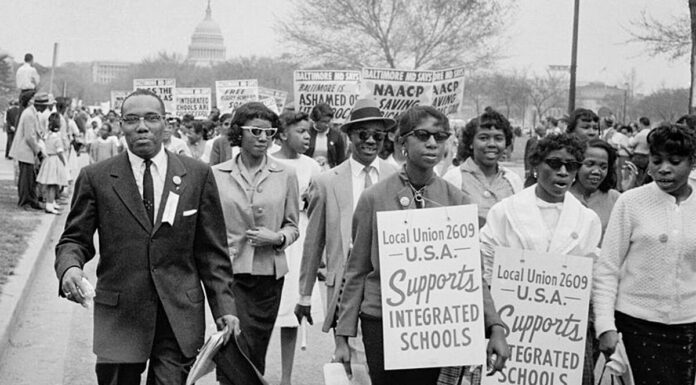
This was the foundation for the towering movement that emerged in the 50s and 60s, built by Black activists, socialists, union organizers, and working people. Black communities organized massive rallies and marches with clear demands, strategy, and shared lessons with other organizers. Black women in particular—like Rosa Parks, Fannie Lou Hamer, and others—played a key role in building the movement.
Massive battles were waged like the Montgomery Bus Boycott in 1955-56, a 391-day boycott! Another was the Greensboro sit-ins in 1960, where four Black college students occupied a segregated lunch counter, sparking solidarity student protests nationwide. These battles were both demanding desegregation in public life, including the workplace, as well as fighting for raising the living standards of Black America.
Role Of Students And Workers
Students also played a key role during this time by launching bold and dynamic initiatives against Jim/Jane Crow: actions like the Freedom Rides, where Black and white students traveled on an integrated bus throughout the Jim/Jane Crow south, in defiance against racist violence from both the police and the KKK.
One spectacular example was the Children’s Crusade of 1963 in Birmingham, Alabama. Over a thousand Black students organized a walkout and confronted racist police under the leadership of Bull Connor, a man so vile that he could make Trump blush out of admiration. These children were arrested, beaten, hosed down, and dogs were allowed to rip through their flesh. The resulting outrage finally forced John F. Kennedy to publicly support the Civil Rights Act, a victory that further emboldened the civil rights struggle for years.
The Student Non-Coordinating Committee (SNCC), a national organization of students organized against racial oppression, led militant voter drives in rural Black communities in defiance of the political establishment of both Democrats and Republicans. They often organized independent ballot lines like the Lowndes County Freedom Party (precursor to the Black Panther Party for Self Defense).
Black workers, inspired by the struggle happening around them, fought also in the workplace against racist discrimination, unfair wages, and for union representation. Black workers in Detroit fought for unions against capitalist titan Henry Ford, and they won by organizing a multi-racial working-class struggle linked with fighting back racial oppression. Black unionists also played leading roles in the Civil Rights Movement—like A. Philip Randolph, founder of the first Black union (Brotherhood of Sleeping Car Porters), who also co-organized the March on Washington for Jobs and Freedom.
Co-optation & Repression
A wing of the ruling elite, represented by figures like Lyndon B. Johnson and Northern Democrats, sought to grant concessions in order to pacify the movement, and to co-opt the leadership away from radical, socialist conclusions that flow from the struggle against racial oppression.
This strategy was unfortunately effective. Many Black civil rights leaders became a core factor in the Democratic Party’s control over the Black vote. But the Democratic Party, antithetical to struggle, could never be relied on to safeguard the gains of the Civil Rights Movement. At the same time, the US government orchestrated COINTELPRO, a massive covert operation against Black socialists and radicals such as the Black Panther Party, Fred Hampton, Assata Shakur, Martin Luther King Jr., and the list goes on.
The downfall of the Civil Rights Movement doesn’t mean that its strategies were flawed. On the contrary, it was so effective that the US ruling class was forced to change its strategy. What was lacking was both broader, nationwide, independent working-class organizations and revolutionary socialist organizations pointing the way toward class struggle methods and socialist transformation.
The Empire Strikes Back—Push it Back!
Trump’s regime is aiming to reshape US society to be more ideologically militaristic and racist, to prepare a struggle against its imperialist rivals, namely China. Working people are paying the price. If Trump is victorious in these attacks, it would deal a serious setback to struggle and further pave the way for this new era of capitalist hellscape.
Capitalism requires exploitation of the most marginalized groups to keep the entire working class down. Trump’s divide-and-rule tactics, that further oppress Black and other marginalized workers, serve as a brake on class unity and collective liberation. The regime’s counter-revolution against the victories of the Civil Rights Movement is not only a rollback of the gains that were won, but an offensive against the multi-racial mass struggle our class needs to win.
To take down Trump we need to build a movement on the scale of the Civil Rights Movement. We need to organize walkouts, strikes, and occupations, on a mass scale. Workers across communities and workplaces will need to unite, just like before, to fuel the struggle against Trump and reaction, for the long haul. This type of movement has begun to take root in the fight against ICE, and we need to link the Black liberation movement to the fight against all oppression. Crucially too, we need a new workers’ party that organizes struggle in the streets, workplaces, and the halls of power.
Earth-shaking, era-defining reforms for working people can be won through mass struggle. Black History Month is a vindication of that. At the same time, capitalism will always claw back any concession it can as it embarks on new adventures of war, profit, and terror, and only socialism can make these gains permanent. There is a desperate need to build a socialist movement capable of bringing down capitalism here in the US, and around the world.