

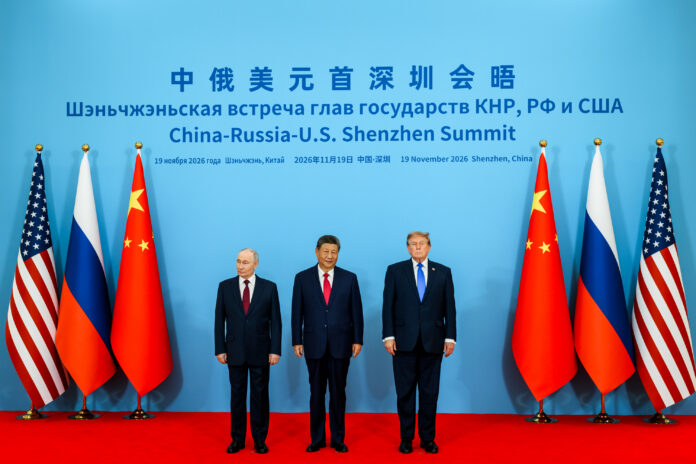
The unprecedented trilateral summit between Trump, Xi Jinping, and Putin on the fringes of the APEC (Asia-Pacific Economic Cooperation) gathering in Shenzhen was a fitting start to the Christmas pantomime season. Nothing concrete was achieved, apart from the stroking of egos and a handful of politically useful images for domestic and global audiences. All three leaders and the regimes they head are in serious trouble. They shared a common interest in staging an 80-minute meeting, which they could each use to shift the focus away from crises and promote themselves as irreplaceable.
No one should be fooled. This is not the beginning of a “great power concert”—in fact all major processes today point in the polar opposite direction. More illustrative of the real direction of travel of capitalism and imperialism is the collapse of the COP31 charade in Turkey last weekend.
None of the deep and burning crises which dominate the real world, and are about to get a lot worse, seem to have even made it onto the agenda in Shenzhen. Historical comparisons drawn by some news media with the Yalta Conference of 1945 (Churchill, Roosevelt, and Stalin) are absurd. If anyone even remembers, history will record this “great” meeting as a pathetic spectacle—three “strongmen” fiddling while the world burned.
The four-point joint “peace statement” issued afterwards is truly farcical. True to its name, it did not even mention the massive military quagmires over which two of the three assembled despots are currently presiding over (with the third active in both)!
Nor, apparently, did they get around to discussing the colossal crisis of AI, over which US and Chinese imperialism are locked in a ferocious conflict. On the very same day that they met, there was a further acceleration of the bursting of Asia’s AI bubble. Stocks recording their worst week since the 2020 COVID shutdowns, just as new US restrictions on Chinese AI were announced.
Propaganda Value
Of the three, the propaganda value of the gathering was of the greatest importance to Xi Jinping. He is desperate to assert his strength in the context of an ongoing internal CCP power struggle, rooted in the deep crisis of Chinese imperialism’s state capitalist model.
In all official pictures of the trio, Xi was carefully positioned at the center. This builds on the propaganda value of Xi’s two recent summits with Trump, the content of which was equally vacuous, but which offered him the opportunity to bask in China’s status as one of the “G2” great powers. Ultimately though, no amount of convenient photographs or readouts will bail Xi’s regime out of the deep structural crisis facing Chinese imperialism.
Trump & Putin’s “Friendship”
It was also a propaganda win for Putin. The very idea that Russia, whose GDP is around the size of Italy’s but whose army and fossil fuel reserves are among the world’s largest, somehow belongs at the top table of world powers is in itself remarkable. This speaks to the centrality of militarism and the struggle for natural resources in this new era, a sharp departure from the era of neoliberal globalization.
Trump made a major show of his “friendship” with Putin, but his admiration for the Russian dictator is nothing new. However, the symbolism of Putin’s seat at the table is a powerful illustration of how much he has benefited from Trump 2.0’s “regime change” in Washington. Trump has upended years of Western imperialist policy, which sought to isolate and weaken Russian imperialism. This pivot has gathered impetus under the impact of Trump’s disastrous Iran war debacle, despite Iran being allied with both Russia and China.
This was most graphically illustrated in the October US/Russia diesel deal. Under intense pressure from sustained high oil prices (which have hit the diesel market especially hard), Trump has flipped the US’s Russian sanctions policy completely on its head. After almost five years of waging economic warfare to cripple Moscow’s energy industry, Trump’s interests now lie in propping it up, to mitigate the pain provoked by his own imperialist aggression in the Middle East! This was the point in the “peace statement” which Trump cares most about: “The three countries plan to increase the production and supply of refined petroleum products for the benefit of all nations. They reaffirmed the importance of stable energy flows.”
This has led to a sharp resurgence of tensions between Washington and Kyiv, whose campaign of attacks on Russian refineries has been at the center of its growing momentum in the war. It is undoubtedly this which lies behind the sporadic withdrawal of vital US intelligence provision to Ukraine, and the restrictions placed on its use of Elon Musk’s Starshield service.
Trump’s boasting posts on Truth social about his “friend” Putin are yet another two fingers being held up not only to Kyiv but to US “allies” in Europe whose interests in the conflict with Russia he is charging against. To add insult to injury, one of the four points of the summit readout is clearly a personal gift to Putin, scolding the toothless International Criminal Court for its temerity in charging him with war crimes. For the Chinese regime this point also vindicates its aggressive stance in the South China Sea conflict (against the Philippines, a US treaty ally), despite a 2016 international court ruling against its territorial claims.
Is The US/China “Busan Truce” Coming To An End?
Much more misleading were the friendly gestures between Xi and Trump. Behind the scenes, the fragile “truce” between the contending superpowers, established in Busan last year which stabilized the tariff war escalation which followed Trump’s 2025 “Liberation Day,” was creaking at the seams.
While Xi greeted Trump with a red carpet airport welcome and even hugged the warmonger, reciprocating the reception granted to him in Washington, the US administration was in the process of rolling out fresh restrictions on the Chinese AI sector. These focus on attempting to undermine Beijing’s ability to work around existing restrictions on access to advanced chips, by preventing Chinese firms from using overseas data centers. This directly affects the computing power which reportedly sustains up to 30% of China’s AI industry.
Trump was initially forced into this new escalation amid the ousting of his close crony, Nvidia CEO Jensen Huang. This followed the exposure of the latter’s tight business and personal relationship with an alleged CCP agent, Alice Huang. She is herself formerly the CEO of a firm suspected of facilitating Beijing’s access to at least US$7.5 billion of embargoed Nvidia chips (The Information, Nov 10, 2026). The New York Times reported “a web of relationships, most of them indirect, linking Ms. Huang’s family and companies that acquired Nvidia chips to Chinese state-owned defense contractors that supply the People’s Liberation Army.”
This crisis is one of many factors which triggered the latest sharp decline in tech stock indexes, which saw Nvidia’s value fall by almost 50% compared to its October peak. The midterm elections, which showed growing opposition against the tech billionaires and their data centers, added further momentum to the crisis.
Then the Trump administration, sharply divided on the issue of how rigorously to enforce its chip sanctions against China, made another u-turn. Jensen Huang was reinstated by the firm following “input from senior levels of the US government.” This underlines the role of Nvidia as central for the tech sector and therefore the US economy. Nvidia, totally dominated by Jensen Huang, has been the backbone for the stock market, including acting as a de facto bank for other tech companies.
Beyond declarations denouncing Washington’s “economic coercion,” China has yet to respond to the latest measures. The CCP regime, which is no less “all in” on the AI race than the US, is undoubtedly fearful of triggering an even sharper collapse of its own tech bubble. For the same reason, China and several other East Asian governments have recently deployed some of the biggest stock market bailout measures since the 2008 crisis.
Nuclear Non-Proliferation Smokescreen
Most of Trump’s absurd attempts to claim the summit as an historic success revolve around the vague language contained in the fourth clause of its “peace statement,” which states: “The three countries will engage in dialogue on reducing nuclear risks and preventing nuclear proliferation.”
This language, which is itself likely Made in China, is at complete odds with reality. Equally absurd is the Xi Jinping quote which sycophants of the CCP regime have been eagerly spreading, stating that nuclear weapons should be “comprehensively banned and thoroughly destroyed”! Such statements hold as much weight as Beijing’s occasional mentions of “socialism.” In truth, Chinese imperialism is engaged in one of the most rapid nuclear arms build ups in history. It has tripled its stockpile since 2019 from around 200 to 600 warheads, and has laid out plans to reach 1,000 by 2030 and 1,500 by 2035.
This presents major problems for US imperialism, whose strategists are being forced to contend with the theoretical possibility of simultaneous nuclear war against Russia and China, both with stockpiles rivalling its own. The Chinese imperialists will surely be licking their lips at the prospect of being able to conduct such a major nuclear buildup while simultaneously being allowed to pose as advocates of nuclear nonproliferation, with the direct complicity of their main rival!
For International Working-Class Struggle To End Imperialist Conflict
Of course, it cannot be ruled out that temporary arrangements, truces and agreements will be reached between imperialist powers at given moments. This can include steps towards some formal regulation of AI’s development, or of its extension into military systems, etc. But the general trajectory of world events is squarely in the opposite direction.
The growing tendency towards imperialist conflict is not rooted in personalities but in the fundamental crises and contradictions of the capitalist system. It spells disaster, in the form of wars, climate breakdown, and mass immiseration. The only social force which can decisively push it back is the international working class, whose existence and fundamental interests are international in nature.
This must be harnessed in international power, struggle, and organization. It is the trend towards international struggle, evidenced by events in Europe and beyond at the time of writing, upon which hopes for an alternative path must be founded. A program of revolutionary opposition to all imperialism, based on international socialist transformation, must be placed at the head of the struggles to come. ISA organizes on an international level to pursue this goal.