

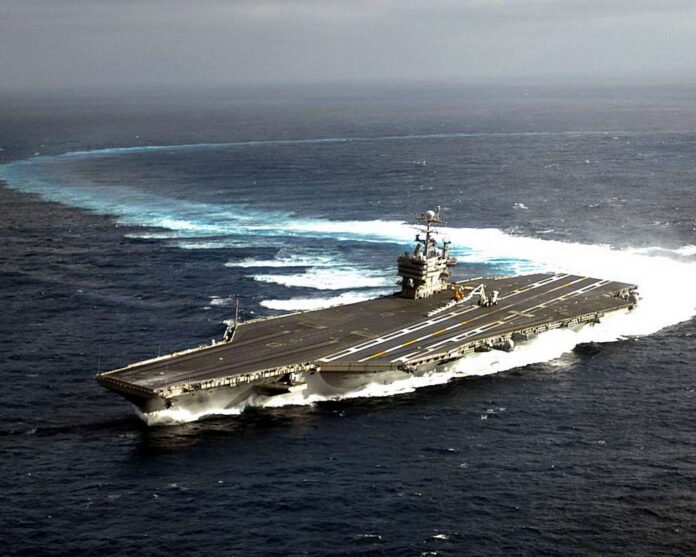
When the USS Abraham Lincoln set sail in November 2025, the sailors on board had orders for a six-month, peacetime mission around the Pacific Ocean. Over nine months later, they are leaving a war zone in the Middle East and nightmarish conditions on the ship that have led several sailors to attempt to jump overboard, with one now facing disciplinary action for the suicide attempt.
Imagine this: At age 19, you and 5,000 others are crammed into a ship the length of three football fields for over 270 days. You are at work 24/7 in a windowless, steel room on an endless rotation of six hours on, six hours off. A port call, the only opportunity to take a break on dry land, never comes, but the deployment extensions do: six months slowly turns into seven, eight, nine months. Without a deep cleaning, showers and toilets accumulate mildew and grime. The soap stops arriving, and body odor abounds. Fresh food is scarce; meals shrink and come straight from a can. The care package sent by your family? Lost in the mail.
In a war zone, sleeplessness, hunger, or depression translate to mistakes that can cost your life.
This was the situation on the USS Abraham Lincoln, where a crisis of the Trump administration’s own making has driven morale to a new low and further exposed the crisis in the US military.
Morale In Short Supply
Of all the resources needed for war, undoubtedly the most important is morale. Humans are capable of great sacrifice if they believe in a cause, but for many of the young people on board the Lincoln, the United States has been at war in the Middle East longer than they’ve been alive. There is a widespread perception even among the enlisted, that the US entered the Iran war at Netanyahu’s behest and as a means to distract from Trump’s involvement in the Epstein files. So when the orders come to bomb fishermen in Venezuela or school girls in Iran, soldiers are beginning to question their moral and legal limits, fueling a six-fold increase in applications for conscientious objector status.
The US ruling class is keen to avoid “Vietnam Syndrome,” the widespread public aversion to bloody and expensive foreign wars. But, whether by hubris or desperation or both, Trump has plunged the US into a war that can’t be won. As the scale of their mistakes becomes apparent, the administration has responded in typical fashion by lying and denying reality, claiming conditions on the Lincoln were “fake news” and that extended deployments were “not nearly long enough.” The entire situation is rapidly eroding trust in the chain of command, and the longer and wider the war grows, the greater the public opposition and likelihood that soldiers begin refusing orders.
Roadmap To Chaos
Within the military there is a saying that “amateurs talk strategies, while professionals talk logistics” because the provisioning of food, fuel, munitions and other supplies are an essential part of any military operation. Logistics becomes all the more complex, however, when you are waging various undeclared wars in Iran, Iraq, Nigeria, Somalia, Syria, Venezuela, and Yemen (all countries the US has bombed in the last year), not to mention military aid to Ukraine and maneuvers against China.
Like a small island in the middle of the ocean, an aircraft carrier relies on constant resupply shipments. When, on the first day of the war, Iran responded to US strikes by destroying a key naval resupply base in Bahrain, the writing was on the wall. With similar bases crippled, and the aircraft carrier unable to dock within range of enemy missiles, shipments have to be rerouted thousands of miles further through the Navy base Diego Garcia resulting in delays. So the military is running out not only of bombs but also of all kinds of necessities and comforts.
For decades top military brass have warned that, under threat, Iran would respond by closing the Strait of Hormuz and crippling logistics hubs. Unfortunately for sailors on the Lincoln, Pete “War is Hell”’ Hegseth actively purged senior commanders who warned against entering an endless war with limited resources, simply because they weren’t ready to be Trump’s yes men, or didn’t share his skin color or gender. Similar to other branches of government, the anti-DEI crusade in the Department of War has been used as cover to complete a reckless concentration of power. Although chaotic, the capitalist class was prepared to allow it in an attempt to arrest the decline of US imperialism by, for example, breaking Iran’s influence over the region.
US Imperialism Buckling
It’s not just soldiers feeling the strain, however. The Iran war is stretching US imperialism to its breaking point. Trump’s threats against NATO allies has left the US fighting alone on many fronts, partly explaining why he has turned to bluffing and wider economic sanctions. In a tacit acknowledgement of the unsustainable situation, the Trump administration ordered the Lincoln be replaced by the USS George Washington. While this no doubt came as a huge relief to sailors onboard the Lincoln, this move betrays the depth of the administration’s dilemma. By removing the USS Washington from its station in Japan, the US military will be without an aircraft carrier in the Indo-Pacific for the first time since 1943!
The presence of an aircraft carrier-class ship in the Indo-Pacific not only projects air and sea power and reassures allies that the US will come to their aid, but also serves as a deterrent against Chinese operations in Taiwan or the South China Sea. In vacating the region, the US is not deescalating tensions with China but doubling down on war with a Chinese ally in Iran, risking even further escalation globally.
For An International Anti-War Movement
While we shed no tears over this historic blow to US imperialist interests, socialists abhor the impacts of war on regular working people including civilian deaths, the acceleration of the cost-of-living crisis and the hardships imposed on soldiers and sailors who are largely drawn from poor, working class communities.
In the final analysis, working people are the only force capable of stopping the descent into further war. Through our role in the system, workers against war can freeze arms shipments while soldiers can organize amongst their unit to refuse orders. The end of World War I was precipitated in large part because of the mutinies of soldiers and sailors against their own governments, most clearly seen and carried to its political conclusion in the October revolution in Russia.
As socialists we organize for a world without imperialism and war, and for a society where everyone is guaranteed healthcare, education, housing, and job security. The approximately $1 trillion spent on the US military each year comes at the direct expense of universal healthcare, childcare, and education. Young people drawn to the military for the benefits should instead be guaranteed free public education and a job in the public interest to create armies of teachers, healthcare workers, and tradespeople building a green economy. Together we can and must build an anti-war movement that brings together soldiers, sailors, veterans and working people of all nationalities to fight for a world worth living in.