

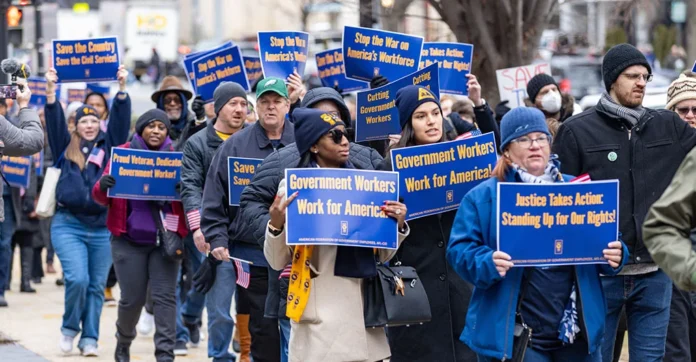
On March 27th, Donald Trump unveiled an executive order that would strip over a million federal workers of the ability to engage in union bargaining with government agencies, under the guise of “national security” concerns. For a few months, the order was tied up in the courts (though of course DOGE’s war on federal workers was already in swing)—but on August 1st, the Ninth Circuit Court of Appeals lifted the block on the order. Since then, hundreds of thousands of federal workers have received notice that their union contracts are now terminated.
These voided contracts dictated standards for things such as sick leave, evaluations and raises, overtime pay, and pensions, and now these workers have no legal right to bargain for new ones. So federal unions still “exist”—they’re just now stripped of what little power they did have.
We can’t mince words: this is the most significant attack on the labor movement in decades. The way has been cleared for Trump’s original order to be fully unleashed over the coming months. Without a fightback, the bosses will be encouraged to escalate their anti-worker offensive.
Kneecapping Federal Workers
Slashing workers’ rights has been part of the right-wing playbook for years. In 2011, then-Wisconsin governor Scott Walker signed Act 10 into law, which eradicated collective bargaining rights for municipal employees, severely limited their ability to raise money, and mandated annual recertification votes for the unions to continue as bargaining agents. This resulted in a near halving of Wisconsin’s union membership in the following decade, and served as a certain model for Trump’s attacks today.
Project 2025, the Heritage Project’s blueprint for Trump’s presidency, claims that “union representation in the federal government [is] incompatible with democracy.” But this was never actually about democracy, or national security, or trimming a budget. Trump’s interest in DOGE was not primarily to save money (as the “Big Beautiful Bill” shows, he will readily spend money on his agenda), but to slash elements of the federal bureaucracy that stood in the way of his aims to reshape the state, and to weaken the workers’ movement while doing it. Federal unions have posed an obstacle—so by stripping them of their authority, Trump can clear the way for as much restructuring as he wants.
Mass Struggle is Desperately Needed
There has never been a more urgent time to build a fightback, yet the federal union leaderships are in retreat, with no idea where to turn beyond continuing to rely on the same court system that has already failed them. Critically, union leaders have not led a fightback using organized labor’s most powerful methods, like collective workplace action. Federal workers don’t have the legal right to strike, which complicates the situation—but workers throughout history have overcome this obstacle.
In 1970, postal workers defied the same anti-union law to win what many federal workers have now lost: the right to collectively bargain. But it took a rank-and-file movement to lead this strike, over the heads of their leadership who refused to take a militant approach. Today, the growing rank-and-file group Build a Fighting NALC is organizing a movement within the letter carriers’ union to fight for the right to strike.
We can also draw lessons from the recent victory of Air Canada flight attendants, who were on strike for less than 12 hours when the Canadian government ordered them back to work under Section 107, an anti-union provision of Canada’s Labour Code. But the union stood firm and stayed on strike, in defiance of the law. In doing so, they forced Air Canada back to the bargaining table and reached a tentative agreement hours later. Besides achieving significant gains for the workers, this strike also won big for all Canadian workers by dealing a potentially fatal blow to Section 107.
Federal unions realistically have two options: fight or die. By not seriously showing a fighting way forward, the union leadership are failing their members.
Not Just Federal Workers’ Fight
We need to see this for what it is: an attack on the entire working class, and the rest of the labor movement needs to be part of the fight. The federal unions, barred from striking, and employed by Trump’s government were an easy target—but they won’t be the last.
AFGE (American Federation of Government Employees) has organized some rallies, but this needs to be part of an escalation plan that draws a broad base of workers into active participation and builds towards collective workplace action—not just to boost morale while waiting on the courts. To bring this fightback into the work day, AFGE and other federal workers’ unions could begin organizing mass lunchtime rallies in every city, with maximum mobilization by other public and private sector unions.
Out of this momentum, AFGE could name a date for a mass walkout/sickout. If the union leadership won’t take the lead on escalation, workers should initiate discussions and organize meetings to cohere this kind of active movement that can fight back and win. Rank-and-file organization Federal Unionists Network could play a role in this.
We Need Our Own Party
But in order to do so most effectively, our unions need to break with the Democrats, who’d rather redraw districts than fight back against Trump’s anti-worker agenda, and who have a history of union-busting themselves.
The labor movement is in dire need of an independent party of the working class that could serve as an avenue for mass struggle against Trump’s attacks, like cuts to Medicaid and food stamps, ICE raids, and his attacks on the unions.
The organized labor movement would need to be a key component of building a viable alternative to the two-party system—but these union leaderships remain willfully chained to the Democrats. So in many cases, this is going to require rebuilding the unions as combative organizations of the working class, with leaders who are prepared to fight alongside their members against Trump’s attacks with tactics that include breaking the law and going on strike when necessary.
The situation may feel dire, but it doesn’t have to be. Workers have fought for collective bargaining rights before, and with collective worker action and a leadership willing to fight, we can win again.