

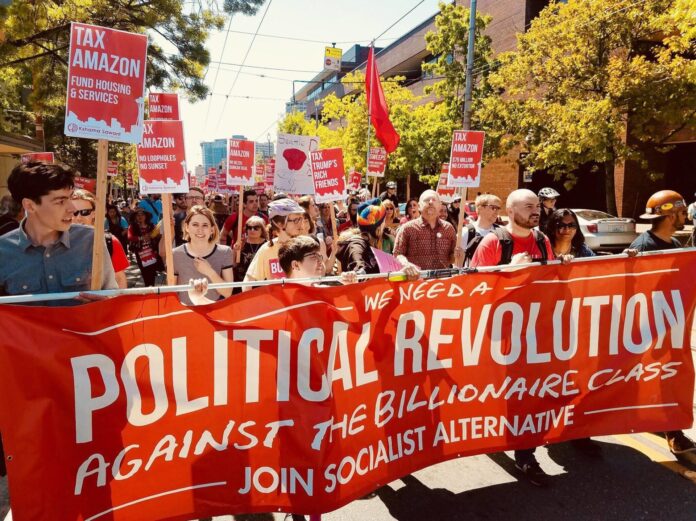
Following the surprise victory of Zohran Mamdani, a member of Democratic Socialists of America (DSA), in NYC’s Democratic mayoral primary, many on the left are thrilled. If implemented, Mamdani’s bold platform, which includes demands like a $30 minimum wage, free childcare, and free buses, would represent a historic win for working people. But what will it take to make these demands reality? And what pressures can we expect Mamdani to face from the Democratic Party and the billionaire class if elected mayor of the financial capital of the world? To help understand what lies ahead, we can draw lessons from Seattle’s recent history, where for a decade Kshama Sawant served as the lone socialist on the City Council.
Entering the Lion’s’ Den
Socialist Alternative (SA) first ran Kshama Sawant for Seattle City Council in 2013 on a bold working-class platform of rent control, taxing the rich, and a $15 minimum wage. Soon after taking office, Kshama was approached by two Democratic councilmembers who told her, “you may have rabble-roused your way in here, but we call the shots in city hall, and you won’t win a new minimum wage or anything else unless it’s on our terms.” While it won’t always come in the form of such crude bullying, this example illustrates the kind of pressures that await any working-class representative upon entering elected office.
The Democratic establishment will try to defang anyone who poses a genuine threat to the interests of their capitalist donors, and if they can’t outright co-opt you, they will seek to isolate and demoralize you. AOC even alluded to this when she suggested that if she defied the Democratic leadership, she would face “relational harm.” Unfortunately, AOC’s strategy of reforming the Democrats from within while avoiding open conflict with the leadership has failed to drag the party to the left on popular demands like Medicare for All, free college, or a Green New Deal. Instead, the Democratic establishment has pulled AOC toward the center.
During her tenure as the lone socialist on Seattle City Council, Kshama faced constant “relational harm” and repeated attempts at political isolation by the Democrats (there were no Republicans on the Council). This is the unavoidable reality for any elected representative willing to side consistently with workers against the bosses and their politicians.
These obstacles can be overcome, however. By using Kshama’s elected position not simply as a means of casting votes inside city hall, but as a vehicle for organizing working people in their communities and in the streets, Kshama and SA were able to play a leading role in building the movements that won historic victories like the first $15 minimum wage of any major city, taxing Amazon to build social housing, and a series of landmark renters’ rights.
How We Won the Amazon Tax
In 2018, the first coalition of socialists and housing activists organized to pressure the Seattle City Council to tax Amazon and big business to fund desperately-needed affordable housing. Kshama used her City Council seat early on to introduce a bill taxing big business, but it was voted down. This came as no surprise, as the movement was not yet large enough to be seen as a viable threat by the Democrats on City Council.
In the following months, the Tax Amazon movement escalated the struggle through a combination of rallies, marches, a #TaxAmazon Town Hall, and by packing City Council chambers demanding the passage of a strong tax. The movement faced resistance on multiple fronts, including attempts by Democratic Mayor Jenny Durkan to water down the legislation, as well as threats from Amazon that they would cancel construction on a new office tower if the tax passed, effectively holding 7,000 construction jobs hostage.
In response, SA used Kshama’s bully pulpit to call out and expose every attempt by Democrats to undermine the bill behind closed doors, and to patiently explain how Amazon’s threats were a cynical attempt to pit workers against each other.
After the movement finally succeeded in pressuring the Council to pass the tax, big business launched an immediate counter-offensive, dumping hundreds of thousands of dollars into a ballot referendum to repeal the bill, and even recruiting members of the far-right group Patriot Prayer to collect signatures, many of whom told blatant lies to voters about the details of the tax.
In response, Kshama and SA began immediately gearing up to wage an all-out struggle to counter the right-wing misinformation campaign and defend the tax in the fall elections. But we were swiftly robbed of this fight: in an unprecedented sell-out of working people, Democrats caved to the threats of big business and called a special session of the City Council where all but one Democrat voted to repeal the tax they had unanimously passed just weeks prior. Why did they do this?
As socialists, we understand that all politicians who attempt to work within the framework of capitalist democracy, whether they consider themselves progressive or proudly pro-business, are keenly aware that if they arouse the ire of the billionaires, they risk going up against an onslaught of corporate ads and PAC money in their next election, among other threats. Any movement that seeks to overcome this dynamic therefore needs to be large enough that politicians fear angering the movement more than they fear big business.
The 2018 Amazon Tax betrayal clearly demonstrated the limitations of electing well-meaning Democrats into office and appealing to them to “do the right thing.” What was needed was a stronger movement.
In 2019, Amazon and big business spent over $4 million in an attempt to elect a more “pro-business” City Council, with Kshama being their primary target for removal. Rather than watering down our politics in the wake of these attacks, SA once again built a fighting election campaign around bold demands, including bringing back the Amazon Tax.
After winning reelection, we used Kshama’s victory rally as a springboard to launch a series of Tax Amazon Action Conferences, where working people from across the city democratically debated and voted on next steps, including preparations to launch a ballot initiative if the City Council failed to act. Once again, our movement had to overcome all manner of attempts by the Democrats to water down or outright block the tax.
Sensing that some sort of bill was likely to pass in Seattle, Democrats in the state legislature began maneuvering to “preempt” individual cities from enacting corporate taxes. In response, we organized a rally at the State Capitol and successfully pressured a number of house Democrats to come out publicly against preemption. After weathering weeks of COVID lockdowns, our movement eventually collected tens of thousands of signatures for a ballot initiative—in large part thanks to the support of thousands of George Floyd protesters who drew the connection between the fights against racist policing and racist gentrification.
Fearing that they couldn’t stop the Amazon Tax from passing at the ballot box in November, the Democratic Establishment moved quickly to pass a watered-down version of the tax (generically named “JumpStart”) to try to paint the narrative that it was friendly collaboration between liberal Democrats and corporations that got results—not the combative, rabble-rousing approach of the Tax Amazon movement.
The truth, of course, was that the Democrats would never have proposed any legislation to tax big business if they hadn’t been forced to by our movement. Workers packed city hall on the day of the vote, and were able to pressure the Council to adopt several of Kshama’s amendments to strengthen the bill. Ultimately, the Democrats were forced to pass a historic tax on big business that went on to raise nearly $250 million for affordable housing in its first year alone.
Lessons for NYC
The fight to tax Amazon was just one of countless struggles in Seattle where the same dynamics consistently played out. In every instance, the question of victory or defeat came down to the question of how strong of an independent working-class movement we were able to build.
One demand that we never succeeded in winning was rent control, despite campaigning for it over multiple years and the demand enjoying huge popular support. After collecting over 13,000 signatures supporting a rent control bill sponsored by Kshama, and after packing city hall, the most we were able to win was forcing a public vote on the bill in which all Democrats present voted against it.
In order to actually win rent control in Seattle, which represented a much larger threat to the capitalist class than the Amazon Tax, it would have required workers getting organized to build a qualitatively larger movement. This should serve as a lesson to Zohran Mamdani and his supporters as they aim to fight to make NYC a city that’s actually affordable for working people. Making the city truly affordable will require a historic transfer of wealth from big business to ordinary people—this will not happen without a titanic struggle in which Wall Street and the Democratic establishment will undoubtedly use every tool in their arsenal to defend their profits.
The role of a working-class party also cannot be overstated—the reason Kshama was able to weather the enormous pressures of elected office was because she had Socialist Alternative, a revolutionary socialist organization, to help her strategize and to hold her accountable. As a member of SA, Kshama took home only the average workers’ wage while in office, donating the rest of her salary to a fund to help build movements. Unfortunately, DSA has not had a strong record of holding their elected officials accountable in office. This is very connected to DSA’s refusal to clearly break with the Democratic Party, and it should urgently become a topic of discussion within the organization.
For his part, Mamdani will need to firmly pick a side in the class war, and shed any illusions that he can deliver wins through closed-door negotiations or seeking to maintain friendly working relations with corporate politicians. He will need to use his elected office to actively build movements in the streets, and be willing to publicly expose the Democrats when they act to undermine the movement behind the scenes.
To turn the tide against the right wing and win even bigger victories than we won in Seattle, workers and socialists in NYC and across the country need to urgently break from the Democrats to build a new party, rooted in the working class and the labor movement, which can run similar candidates nationwide and hold them accountable to a party program.
But inevitably, any party that fights for reforms under capitalism will run up against the limitations of the system, and will have to choose between fully breaking with capitalism or selling out working people. Throughout all of our campaigns in Seattle, we were always clear to point out that none of our victories can be permanent under capitalism, and that if we want to truly end exploitation and oppression, we need to fight for a socialist transformation of society.