

On October 4, the Brazilian far right won its most decisive triumph since the country’s military dictatorship in 1988. Jair Bolsonaro’s Liberal Party (PL) has won a plurality of seats in the Senate and the Chamber of Deputies. The PL also won six governor positions, which is the highest number ever won by a single party in the first round. Now, at least 20 governors out of all 27 openly identify with Bolsonaro’s camp. In the Chamber of Deputies, the PL caucus alone—which will grow from 98 to 121 deputies—will reach nearly the size of the entire caucus typically considered left-wing or center-left in the Chamber. This reactionary wave is a grave threat to the working class and poor in Brazil.
The result of the first round presidential election was a narrow win for Flavio Bolsonaro, son of the widely hated former far-right president, Jair Bolsonaro, who is a close ally of Trump and led Brazil through one of the deadliest and most disastrous Covid pandemic responses in the world. Flavio Bolsonaro was running against incumbent Luiz Ignacio Lula da Silva, known commonly as Lula, of the Worker’s Party (PT). None of the candidates received enough of a majority to win outright, so the election will proceed to a run-off second round on October 25 between Flavio Bolsonaro and Lula. Unless the situation shifts significantly, Flavio Bolsonaro is poised to win. The next three presidential candidates with the highest number of votes were from right-wing parties, with nearly nine million votes that are likely to shift to Bolsonaro.
Hanging in the balance of these elections is also the fate of the Amazon rainforest, of which Brazil controls the vast majority. Flavio Bolsonaro—who, like Trump and many far-right leaders, does not believe climate change is caused by humans—plans to open up protected Amazon lands to the whims of the voracious mining and agriculture industries. This is part of why stock markets surged when Bolsonaro pulled ahead in the first round, as the billion-dollar agribusiness and mining industries prepare for a deforestation free-for-all.
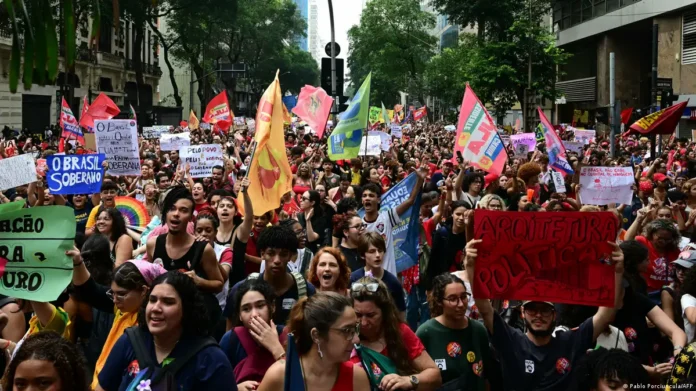
But the fight is far from over—after the first round results, millions of Brazilian students and workers took to the streets in nearly every major city in the country to protest the possibility of another Bolsonaro presidency. Protests have continued this week, with enormous mobilizations in Rio de Janeiro and elsewhere.
How Did We Get Here?
Today, millions of working-class and poor Brazilians are suffering from high interest rates and an economic slowdown, household debt, rising prices for basic food items, precarious working conditions, and little hope for the future.
Lula himself was quoted in major news outlets as being completely surprised at the first round result, revealing just how profoundly out of touch he and the liberal establishment are from the lives of working-class people in the country they currently run. Lula’s campaign tried and failed to convince voters that the situation in Brazil was actually great, thanks to him—not so unlike Biden’s infamous 2024 campaign in the US where he bragged about superficial economic “stability” despite a deep cost-of-living crisis for workers and young people.
Liberation, Socialism, and Revolution (LSR), the Brazilian section of International Socialist Alternative, wrote after the first round, “The mistakes of the election campaign are nothing more than a continuation of the limitations of Lula’s administration—an administration that avoided popular mobilization, relied on backroom deals with sectors of the business community and the right, was hamstrung by its austerity policies, and failed to deliver on its campaign promises.”
Corruption also became a key issue after the Banco Master scandal broke last year, uncovering one of Brazil’s largest ever financial frauds. The scandal confirmed vividly for millions what they already suspected to be true—that corruption runs in the veins of the Brazilian political system and the ruling class it serves. It exposed the rampant corruption of politicians across the political spectrum, but it was seen by many to be most clearly connected to the head Supreme Court justice and by extension, Lula.
But even if his allies had not been directly implicated in the corruption scandal, Lula and the PT have billed themselves as defenders of this decaying, crisis-ridden system—one in which shameless corruption and outright violence by the ruling class often goes uninvestigated and unpunished. The first round results were in large part a rejection of this status quo, even though the right wing has clearly also grown and consolidated during Lula’s austerity-ridden term.
The Need For Independent Left Politics
A key explanation for these election results, however, is rooted in the failures of the organized left in Brazil, especially one of the largest and most important left parties, the Party for Socialism and Freedom (PSOL). Formed in 2004 as a left-wing split from Lula’s PT that was moving to the right, PSOL has historically put forward an independent left candidate in the first round of presidential elections, in opposition to both the PT and the right wing. Since the 2022 election, however, they have refused to stand a candidate against Lula, claiming that uniting behind him is the only way to defeat Bolsonarism and the far right. But this strategy of allying with center and center-right political parties has clearly only served to strengthen the far right and weaken the left.
In this context, it’s easy to see why a record number of voters felt there was no one worth voting for. More than 33 million people stayed home on election day—the highest number of non-voters in a first round election since the end of Brazil’s military dictatorship. This is especially notable in a country where voting is compulsory, and declining to vote requires documented justification in each election. Rates of non-voting have only increased in Brazil since 2006, when Lula won his second-ever presidential term.
This alone shows the space there was for an independent, genuine left candidate to stand against austerity politics and mobilize millions on the basis of a militant fight against the wealthy for the things working-class and poor Brazilians really need. Such a stand would also have assisted in mobilizing more voters to defeat Bolsonaro in the second round. The Brazilian left will continue to find itself in crisis until it gains the clarity that we can only rely upon the power of the working class and mass movements, independent of the political establishment.
As our sister section LSR also wrote, “We need a movement that is not afraid of what the ‘market’ and ‘Faria Lima’ [Brazil’s Wall Street] will think of measures such as ending the fiscal straightjacket, significantly raising the minimum wage, ending the 6-day work week, implementing free public transportation, reversing privatizations and counter-reforms, taxing the super-rich, and putting an end to the speculative casino of public debt.”
In the second round, LSR is calling for a critical vote for Lula to block the path to a disastrous second Bolsonaro (family) administration. They make it clear, however, that the only way forward is building an organized mass movement out of the current demonstrations, one that does not wait for the PT or Lula. These massive protests have shown that the Brazilian working class, in their millions, are capable of waging a historic collective struggle that can not only defeat the far right, but win radical improvements for workers and young people. One 19-year-old university student at last week’s protests was quoted as saying, “We’re fighting for Brazil, not for Lula.”
Below are demands from a leaflet used by LSR, the Brazilian section of International Socialist Alternative, in the current protests:
Vote Lula & Stay In The Streets!
- End the six-day work week! Repeal the labor counter-reform—defend the right to strike and to unionize! Towards a 30-hour work week with no loss of pay!
- Repeal the Social Security counter-reform!
- 100% public and free health care and education!
- Re-nationalize privatized companies! End privatization!
- Zero fares! Free, high-quality public transportation!
- End police violence and the genocide against the Black population! Demilitarize the police and place them under social control!
- No to lowering the age of criminal responsibility!
- Combat violence against women and LGBT+ people! For the right to legal, safe abortion and through the public health system!
- Defend the environment and the territories of Indigenous peoples!
- End the Fiscal Framework! Tax the rich! Let the super-rich foot the bill!
- No to handing over our natural resources to imperialism! Trump, keep your hands off Latin America!
- Build a socialist workers’ government in Brazil!