

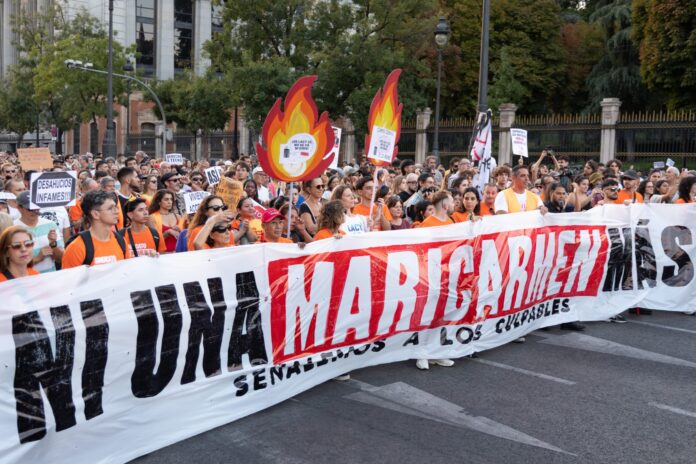
A mass movement, triggered by an intense housing crisis, has erupted in the Spanish state. On October 1, a million people took to the streets in over 50 cities—up to 500,000 in Madrid alone—demanding a general strike and radical action against spiraling housing costs, evictions, and the “vulture funds” that have bought up housing stock for profit.
For years, Spain has been on the sharp end of a housing crisis that has been growing across Europe. The average person spends 50% of their income on rent—as high as 70% in urbanized areas like Madrid and Catalonia. Over the past year, housing prices have increased 6.9%, while wages are up barely 1%. No wonder then that half of young adults still live with their parents. Swathes of housing stock have been bought up by housing corporations and private equity firms, who ramp up prices to make a profit.
That is why the eviction of Maricarmen Abascal, an 87-year-old disabled woman, became the spark that set a mass movement ablaze across the Spanish state. After her rent-controlled apartment was bought by corporate hedge fund Urbagestión, they put the rent up from 500 euros to 2,650 euros—more than double her pension. When she was unable to pay, they moved to throw her out onto the street. In the face of community resistance, 50 police vans and 200 agents were mobilized to force her out, using teargas and leaving her unconscious as she was taken on a stretcher to hospital. With the rest of the country groaning under the strain of unaffordable housing costs, this outrageous eviction triggered a massive outpouring of solidarity and anger.
Encampments At Puerta Del Sol
The next day, an encampment sprang up in Madrid’s Puerta Del Sol . In scenes reminiscent of the historic “indignados” protests in 2011 (known in the Spanish state as “15M”), Spanish workers and youth transformed the center of Madrid into a space of protest, as well as discussion and debate on the way forward, conducted in mass assemblies. Similar protest encampments were set up in towns and cities across the Spanish state in the following days.
Previous waves of housing struggle won real victories in the Spanish state, including stopping thousands of evictions in 2012. These struggles laid the basis for the birth of new left forces such as Podemos in the coming years, as well as a powerful tenants’ union movement. This experience and self-organization has put the movement on a higher starting than that of 15 years ago in many respects. Within a few days, Maricarmen had her eviction overturned, and her rent reduced back to its previous rate. However, only a few days later, she passed away. The Spanish state and capitalist class have her blood on their hands.
While her memory will undoubtedly inspire the struggle going forward, the movement is about much more than just Maricarmen. It is organized around clear demands: a ban on evictions, indefinite contracts for renters, expropriation of the vulture funds and empty properties, and a 50% rent reduction. Compared to 2011 when illusions in being “neither left nor right” were present, the movement also has a clearer political character, reflecting the wide radicalization of sections of workers and young people in the past decade. This movement has continued to grow into a struggle against the housing crisis as a whole, and the political establishment that enables it.
Political Shockwaves
Like the movements 15 years ago, this is a struggle taking place under a government led by the ex-social democratic PSOE party. Since his election in 2018, Prime Minister Pedro Sánchez has built the image of the “most progressive government in history”, speaking out against the genocide in Gaza and against ‘neoliberal capitalism’. However, the cost of living crisis has only dragged on. Sanchez has swam against the tide of anti-migrant politics across Europe with the regularization of half a million undocumented workers, but maintained the razor-wire and military guarded borders of ‘fortress Europe’—even strengthening them following the Ceuta crisis this summer.
In the past period, it has been the far right that has gained from this failure to transform the reality of working-class people. The Vox party has seen significant electoral advances, while more openly fascist and neo-nazi groups such as Núcleo Nacional have grown significantly. Groups of far right activists, often connected to “Desokupación” hired thug organizations, have even attempted to attack the recent protests. These groups blame the housing crisis on mass migration—but racist anti-migrant policy would do nothing to stop private companies like Urbagestión from looking to turn housing into a source of profit. The call for rent control is popular across the working class—even among those who vote for the right wing parties. This issue has potential to put workers and renters on the offensive, and turn the tide on the far right.
Sanchez has seen a chance to take advantage of this upsurge by offering concessions to the movement, diverting the movement in the streets toward support for his party. PSOE brought forth proposals including temporary eviction protections, a temporary ban on corporate “vulture funds” buying new housing (until 2028), and a two-year extension on contracts set to end this year. Over eight years of government, PSOE barely lifted a finger against the housing crisis—but in just a few days, mass struggle has forced them to take action. However, the movement has shown it is not willing to settle for a few crumbs. Calls of “no nos vamos—nos quedamos” (We’re not going—we’re staying!) echoed through the camps even as the government announced these meagre measures.
But the enormous pressure on the political establishment became a full-blown crisis when the right-wing majority in parliament voted down even PSOE’s modest proposals. Millions took to the streets on October 3 with the central demand for a general strike. The unions quickly got behind this call—with November 11 set as the date for a one-day general strike.
Sanchez has now called a snap general election for November 29 in order to break the deadlock in Parliament and to reverse his government’s declining support. On October 7, he began his election campaign by announcing a Presidential decree to implement some measures similar to those rejected by Congress.
The movement must not allow itself to be co-opted. Over the past period, the left forces such as Podemos, Sumar and Izquierda Unida which have propped up the PSOE government have been punished, wracked by declining support and the fragmentation of the “Unidas Podemos” alliance which bound them together. In recent years, two camps have emerged as Podemos sought to distance itself from the fuller assimilation into the Sánchez government of the alliance’s other main components. In the Andalucian regional elections earlier this year, these left parties found themselves outflanked by a new left force “Adelante Andalucia,” which made gains even as their own vote continued to stagnate.
At the time of writing it seems that a united left-of-PSOE electoral challenge may emerge with Ada Colau, the leader of the housing struggles of the 2010s, as their lead candidate. If so, it would have potential to make significant gains. It is vital that this movement develops a political expression independent of the PSOE government to channel the demands of the movement in these elections and beyond.
Housing Is A Human Right!
The past weeks show that the most powerful tool working class people have is our own self-organization and struggle. The call for a general strike must be taken up in every workplace and in every neighborhood. The encampments in towns and cities across the country should be built into democratic organizing spaces to maximize turnout and agree next steps.
To win the demand of the general strike, for “the right to housing and decent wages to pay for it“—as well as the existing demands of the tenants union—the movement must resist any attempts from union leaders to take the foot off the gas and wait for PSOE to deliver concessions. It is crucial that the pressure continue both in the lead-up to, and beyond the elections.
The slogan “no al negocio de la vivienda”—against the business of housing—has been on many of the key banners of the protest movement so far. Freeing housing from the grips of the market means connecting this struggle to a fight against the capitalist system as a whole, which is based on the commodification of human needs. It is a system that can only offer precarity and a constant cost of living crisis for the vast majority of society. Housing, alongside the banks and major corporations, should be nationalized on the basis of democratic workers’ control, so that they can be planned in the interests of the vast majority—not vulture funds and corporate interests. From the Spanish state to France and beyond, a new wave of struggle of working-class and young people is developing. It is crucial that these struggles are linked to an international fight for socialist change to win a real future for workers and young people!