

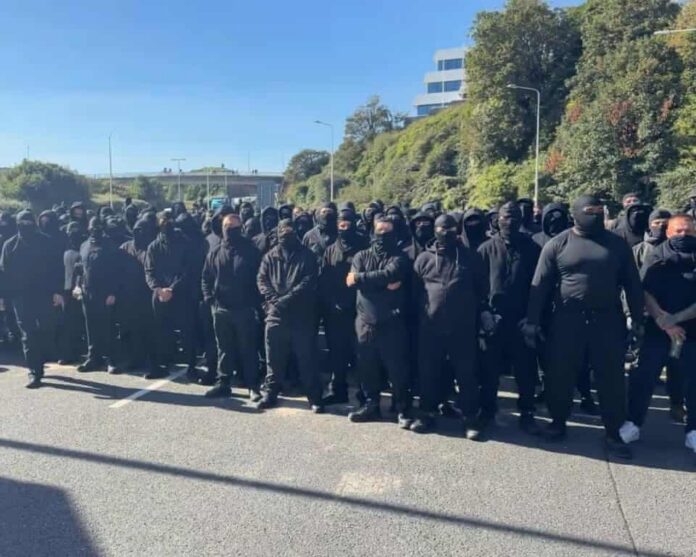
The chilling sight of black-shirted, balaclava-clad men descending on Dover and Portsmouth is a further warning of the far right’s growing confidence in Britain.
The events on the South Coast over the last week are part of an attempt to develop a new, ‘harder’, more disciplined wing of the far right, with the aim of directly targeting refugees and other minorities. In the future, it’s possible such forces can also be used against the left and the workers’ movement.
By pulling off the actions in Dover and Portsmouth, the street-based far right has just experienced some relative success. They have, once again, shifted the sickening dominant narrative surrounding migration in Britain further to the right, opening up new and dangerous possibilities.
This comes despite the fact that the parliamentary right – in the form of Farage’s Reform UK – is now going through its most severe crisis since being established. For the first time since early 2025, Reform is behind Labour in some polls. But more significantly, the sense of scandal surrounding the party’s funding is escalating.
Reform In Crisis
Farage’s attempt to put the issue of his £5 million crypto billionaire ‘gift’ to bed via the Clacton by-election backfired spectacularly. His victory over nearest rival Count Binface looked and felt more like a humiliation. Now a Channel 4 ‘sting’ documentary has opened up the party to a whole new level of scrutiny by exposing its alleged preparedness to take money from wealthy overseas donors in breach of UK law.
Meanwhile, the sight of Reform activists violently beating young women protesting Farage’s conference speech has highlighted the connection between this electoral party’s more populist approach and the racist thuggery we are seeing on Britain’s streets. Indeed, Robert Jenrick’s call for a medal to be awarded to the pensioners who attacked the women at the conference should blow away the myth that they want to protect women and children.
But now a new line of division appears to be opening up within Reform over the response to the weekend’s events. Farage initially criticised the masked protestors and has said he would ban both balaclavas and the burqa. But the home affairs spokesperson Zia Yusuf has taken a different line, emphasising that “any disorder is the responsibility of the British state, led by Andy Burnham”. Meanwhile among Reform activists and councillors there have been many pushing for full-throated support to be given to these ‘patriots’.
This division reflects a broader dilemma Reform faces. Increasingly, it is under pressure from Rupert Lowe’s more extreme Restore Britain, as well as its own activists, to adopt positions more aligned with the far-right fringe. At the same time, Farage is astute enough to realise that wholesale adoption of such a platform would start to limit the party’s support electorally. Meanwhile, a perfect storm of negative media coverage, police investigations and parliamentary standards inquiries is swirling around him. It has even been suggested Farage could pack it in and resign.
Farage Undermined
Reform’s problems are unlikely to be easily swept aside. They reflect, in part, a wing of the capitalist establishment seeking to undermine the party’s prospects of winning the next election. This section of the ruling class has chosen this moment to take Farage on for a number of reasons. One of these is the change of Prime Minister.
While Burnham is likely to be more vulnerable to pressure from working-class action than Starmer, he is still seen by the capitalists as a more competent and reliable pair of hands than his predecessor, and certainly more than Farage. They hope he will be able to implement important policies, such as the ratcheting up of militarism, on their behalf. At the same time, a small but not negligible recovery in the Tory party’s polling has also encouraged them to act now.
Many capitalists fear Farage’s maverick approach might generate future Liz Truss type market panics, in addition to the social disorder Reform has been shown to help fuel. But Trump’s recent missteps – which have been extremely costly to the interests of US imperialism – will also surely be playing on their minds. Keen to avoid a British Trump, a section of the establishment is turning on Farage and seeking to expose him. And there is ample material for them to work with in this endeavour. But we should not mistake their motives for doing so.
The ruling class is not in any way seeking to dial down the levels of racism and scapegoating in society. In fact, its need to misdirect popular anger grows every day that living standards continue to decline. Now, there is also the growing prospect of a new, global economic crisis – one potentially rivalling 2008 in scale. Should this develop, attempts to force on the working and middle classes new, punishing rounds of austerity will surely generate ferocious levels of mass anger. This will create new revolutionary opportunities for the left and workers’ movement internationally. But it will also mean the far right increasingly becomes an essential line of defence for the ruling class.
Not a Crisis of the Far Right
So a crisis for Reform is not the same thing as a crisis for the far right as a whole. In fact, the process of ‘normalising’ far right ideas and politics remains fully underway – particularly in the realm of sanitising anti-migrant attitudes, which are up 10 points versus a decade ago. The same media currently running hostile front covers exposing Reform’s affairs was weeks ago leading the racist lynching of black academic Jason Arday. It’s the same media that opened up a ‘national conversation’ about whether white people were now the victims of racism a few weeks before that. Meanwhile the social media giants – especially Elon Musk’s X – continually promote the most extreme far-right content to millions of users every day.
Indeed, social media has been the far right’s primary means of promoting its actions up to this point. Without a sizable extra-parliamentary far-right organisation, the figure of ‘Tommy Robinson’ (real name Stephen Yaxley-Lennon) has been central. Robinson himself is currently being exposed over his own financial dealings. But the weekend’s actions were also organised at a certain distance from him. They represent a diversification of far-right tactics, distinct from the larger-scale Unite the Kingdom rallies and events.
The weekend’s two far-right ‘protests’ were organised by a group calling itself ‘Patriot Platform’ which is led by Tommy Robinson’s former bodyguard Daniel Thomas (AKA ‘Danny Tommo’). Robinson promoted the events on his social media after the fact. But he did not use his massive platform to publicise them beforehand. Indeed, the Dover action was not advertised publicly at all – either by Robinson or anyone else, including Patriot Platform itself. Instead, the far right organised the event in secret, closed forums.
These were reportedly more challenging than usual for anti-fascists to infiltrate. Even the police appear to have been caught completely off guard by the event in Dover (although evidence is now emerging that they were tipped off on the Friday before the protest).This allowed the far right to temporarily close down the port – an essential piece of national infrastructure and the gateway to and from continental Europe.
These far-right mobilisations follow on from the rioting that took place earlier in the summer, including in Southampton (only a few miles down the road from Portsmouth). But the far right in Britain is also drawing on some of the tactics used in the Belfast pogrom, which had the involvement of loyalist paramilitary groups. These groups had helped to make the riots there more organised and targeted, ultimately giving them a more dangerous character.
With some success, it seems, Thomas and his so-called Patriot Platform have attempted to make their own actions more disciplined and effective. The Portsmouth event was more ‘spontaneous’ than Dover and was advertised online. But while the police were more prepared, and the far right more chaotic, they still succeeded in causing some significant disruption – blocking a road to stop buses carrying asylum seekers who had arrived by boat.
Hardened, Disciplined?
This attempt to create a more organised and disciplined wing of the far right in Britain clearly remains at a very early stage. Many previous attempts have fallen apart due to the chaotic infighting and shambolic mistakes which the actors involved are prone to. Later in the week there was also an attack on the under-19 Pakistani cricket team by a far right mob. They believed the team were asylum seekers and had to be talked down by a Reform councillor. Events like these are a reminder that this is not a formidable and intelligent fighting force. But that does not mean the far right is not dangerous.
Following on from the weekend, the atmosphere of fear and hostility for migrants and people of colour has been ratched up another notch. These events are a stark warning that must now be heeded by the workers’ and anti-racist movements. This threat is real and it is growing. And unified mass resistance, based on class-struggle methods, is the only way to decisively turn back the tide.
Many will rightly ask, where is the response to these events from the anti-racist and workers’ movement? Despite the rise in racism and in support for far-right ideas and parties, it remains the case that the majority of working-class people strongly oppose the far right. The core of the workers’ movement is firmly anti-racist. But as things stand, the huge potential power of the trade unions is failing to make itself felt in this fight. Our movement needs to reclaim the streets.
Anti-Racist Response
The initial response to these events by the campaign group Stand Up To Racism has been to call for a unity demonstration, which will take place in Portsmouth on 12 September. This is an important initiative, and mobilising for a huge turnout of anti-racists on the streets is absolutely essential. The trade union movement both locally and nationally needs to step up to this challenge.
There must be a serious mobilisation organised through workplaces and among young people – particularly focussing on bringing people onto the streets from the local area. Unions should take a lead in doing this with a programme based on bold and implacable opposition to racism, and linking this to the overall demands of the workers’ movement around jobs, pay, housing and conditions.
But one demo is not going to be enough. We need a bold, political anti-racist movement which has the labour movement at its heart. This means fighting to develop networks in towns and cities across the country which can be ready and prepared to respond to far-right threats as they develop.
We need to build a movement which is able to confront and push back the far right on the streets, including at short notice. The rapid response groups that were set up in Minneapolis to resist the ICE invasion (in the lead-up to its citywide strike) is an example we can follow here. Again, this is something the trade unions themselves should be central to initiating, using their significant authority and resources to do so.
The rising far right is a monstrous symptom of the capitalist system in decline. To build the kind of movement which can defeat these ideas once and for all requires challenging capitalism itself.
Socialist Alternative is fighting for a revolutionary break with this system, based on a mass movement that can put working-class people in control of society. We fight for public ownership over the biggest monopolies, democratic economic planning and solidarity between all people and across borders. Join us in this fight.