

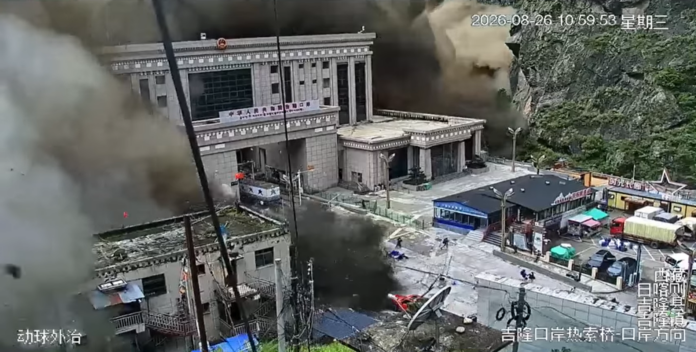
Over a fortnight has passed since flash floods devastated communities in the Himalayas. On the morning of August 26, floods went cascading down the Trishula, Langtang Khola, and Bhote Koshi rivers in Northern Nepal and neighboring Tibet. Gyirong Port—the central commercial hub between Nepal and Tibet—was wiped off the map by a wall of water, debris, and rock.
A total of 1,386 people have been confirmed dead by Nepali authorities, and a further 5,130 remain missing (September 13). At the time of writing, 118 workers in the hydroelectric projects on the Trishula remain trapped behind walls of mud and concrete, with severely overstretched rescue teams and volunteers working to rescue them. The same underprepared services also now have to deal with thousands of orphaned children left without families by the disaster.
While initial reports put the disaster down to a shock earthquake (Nepal sits on one of the most active fault lines in the world), the real underlying reason soon became clear: climate change. In particular, the deadly consequences of melting glaciers upstream from the rivers. An additional aggravating factor may have been vast construction projects in this geologically volatile border region as the Chinese regime builds dams and hydropower stations, tunnels, bridges, roads, and railways—both for “clean energy” and military-strategic reasons (to maintain its hold on Tibet). The re-engineering and narrowing of natural river valleys and flood plains, behind millions of tons of concrete, risks becoming an accelerator and magnifier of the destructive power of floods.
Since Nepal’s Maoist-led government in 2017 signed up for China’s imperialist Belt and Road Initiative, Chinese loans and construction in Nepal have also skyrocketed, partly at the expense of rival Indian imperialism. China now accounts for over half of Nepal’s foreign investment and has funded and built a dozen dams and hydropower stations in Nepal such as the plant on the Trishula mentioned above. All 12 of the China-built dams were severely damaged or flooded in the glacial-mudslide.
Climate scientists had reported for years that glaciers in the Himalayas are melting 65% faster than they were a decade ago. The result is and will continue to be an uptick in glacial lake outburst floods.
Not Simply A “Natural Disaster”
This wasn’t simply a freak “natural disaster.” It was the deadly interaction between capitalist-induced climate change, inadequate early flood detection, and the prioritization of profit and military-control policies over human life which transformed these events into an even greater catastrophe.
A government which prioritized protecting these communities over the drive for profit could have detected the impending disaster and responded accordingly, while planning employment and development in a way which wouldn’t have put communities in harm’s way.
After all, climate scientists had repeatedly warned the Nepali and Chinese governments of these risks. Others had long warned that historical flood averages were based on 50-to-100-year periods dating from before the onset of rapid climate change, which bred complacency among responsible officials. Despite its world-leading role in renewable energy, China accounts for around one-third of the world’s carbon emissions, more than the US, India, Russia, and Japan combined.
Others had repeatedly warned of the risks faced by the communities living in the mountainous valleys. Instead of relocating communities in the firing line of these environmental hazards and installing rapid evacuation routes, priority was placed on generating quick and easy profits. The unpredictable hazards of the landscape were a secondary concern for the capitalists and imperialist lenders.
Not only was a catastrophe bound to happen sooner or later, but when it did, the existing early warning systems were found to be completely inadequate. The floods took only around seven minutes to reach the towns downstream from the glacier, but a well-funded, adequately resourced and prioritized early warning system could have quite easily spotted the warning signs upstream.
Chinese Dictatorship’s Blackout
The Chinese regime responded with repression and censorship. Early recordings of the floods ripping through Gyirong Port into Tibet were widely circulated on Chinese social media, only to mysteriously disappear shortly afterwards.
The official stated figures from the Chinese regime are 43 dead and 519 missing. Those who have questioned this underreporting of the death toll online have since been penalized and imprisoned under charges of “disrupting online order,” “false disaster information,” and “spreading rumors and panic”.
But this hasn’t quelled widespread speculation that the regime is lying. As reported in The Guardian, one Weibo (Chinese social media) user was quoted in the immediate aftermath, “clearly thousands of people were swept away, yet the authorities reported only three deaths and 265 people missing.”
This is part of an unwritten policy of the Xi Jinping dictatorship: report “good” news only and always downplay numbers of fatalities This was practiced on a massive scale during the COVID-19 pandemic, with the full death toll concealed to this day. State media has been filled with news stories of government officials visiting the response sites. But anything which could cast doubt on the quality of the response could quickly turn into unrest, given the deep social, political, and economic problems facing Chinese capitalism.
How to report on the Himalayan catastrophe is an especially sensitive problem given China’s intensified repressive controls and national oppression in Tibet. In July, Beijing adopted its new “ethnic unity law,” which further tightens Xi’s Han chauvinist doctrine (“Han” refers to China’s dominant ethnic group). Under this law, promoting minority languages or reporting human rights abuses are further criminalized.
Domination By Imperialism
Nepal remains the poorest and economically depressed country in South Asia, landlocked, and sandwiched between China and India. The results of imperialism and capitalism are apparent—around 2,300 people migrate out of the country for foreign jobs each day. Meanwhile, one third of Nepal’s Gross Domestic Product comes from remittances—wages sent back home by emigrant workers to sustain their families.
The working class and poor of Nepal are faced with capitalist exploitation in multiple directions—the corrupt capitalist elite of the country itself, neighboring imperialism powers like India and China, as well as US imperialism’s institutions like the IMF.
The result is a country with abundant natural resources which are exploited—but not for the benefit of the working-class and poor. Nonetheless, the people of Nepal haven’t accepted the country’s rampant exploitation, inequality, and corruption lying down.
Aftermath Of The “Gen Z” Revolt
In September 2025, a mass protest movement shook the ruling elite, with demonstrations bringing down the government of KP Sharma Oli. At the revolt’s most visually striking moment, the country’s China-built Federal Parliament building was burned down by the protesters. Despite the dozens being murdered by police, the government was eventually forced out.
While the “Gen Z revolution” initially centered around the government’s attempts to ban social media, the social context was one of grinding poverty, nepotism, and corruption. Images of Nepal’s “nepo babies,” the children of the country’s ruling elite, circulated widely on TikTok and featured heavily in the demands and slogans of the protests.
But despite the heroism and courage of the youth who took to the streets, the movement was largely disorganized, structured overwhelmingly through platforms like Discord and lacking clear revolutionary leadership. Crucially, it lacked the involvement of the organized working class. With the exception of small pockets of strike action, the Nepali trade union movement was left largely at the sidelines, supporting the movement while not providing a lead.
The political limits of the movement were in large part an undoubtable product of the scandalous policies of the “communist” parties which ruled the country for over 13 years prior to the uprising. The governing Stalinist parties, the Communist Party of Nepal (Unified Marxist–Leninist) and the Communist Party of Nepal (Maoist Centre), despite their surface display of “Marxism,” are nothing of the sort.
Both of these parties, far from following any kind of socialist and class-based approach, came to the rescue of Nepali capitalism in the aftermath 2006 movement, which toppled the monarchy. Since entering into government, they have become key architects of capitalist and pro-imperialist policies in the country. As a result, they are widely despised by the youth. This isn’t just a simple matter of “betrayal” or them “abandoning” the ideas of socialism. Rather, the veneer of “communism” masked a bankrupt Stalinist approach.
The resulting vacuum instead brought to power the Rastriya Swatantra Party (RSP) under the leadership of Balen Shah. Shah, a former rapper and celebrity, came into office on a wave of enthusiasm driven by a mixture of youth anti-establishment feeling and populist, anti-corruption rhetoric. But in office, the RSP—a middle-class liberal party—is already proving itself unwilling or incapable of standing up to big-business and imperialist interests.
Despite the pause to the movement, the lessons remain. There is still the need in Nepal and elsewhere in South Asia for a working-class, socialist party with genuine grassroots control, rooted in the workplaces and armed with a clear socialist program of public ownership of the commanding heights of the economy—a program capable of seizing wealth and ownership from the hands of multi-millionaires and billionaires.
Socialist Change To Address Climate Catastrophe
Nepal is responsible for less than 0.1% of global CO2 emissions, yet it is its working class and poor who bear the deadly burden of a crisis which isn’t of their making. As Friedrich Engels once commented regarding the effects of the capitalist system on our planet, “nature will take its revenge.”
The climate crisis is fundamentally unsolvable within the framework of the capitalist system. ISA stands for the rebuilding of the climate struggle as an international, anti-war, and anti-imperialist climate movement based on socialist policies. One which links workers’ struggles in Nepal, China, India and beyond in the fight for a world free of environmental destruction, war, exploitation, and oppression—a socialist world.