

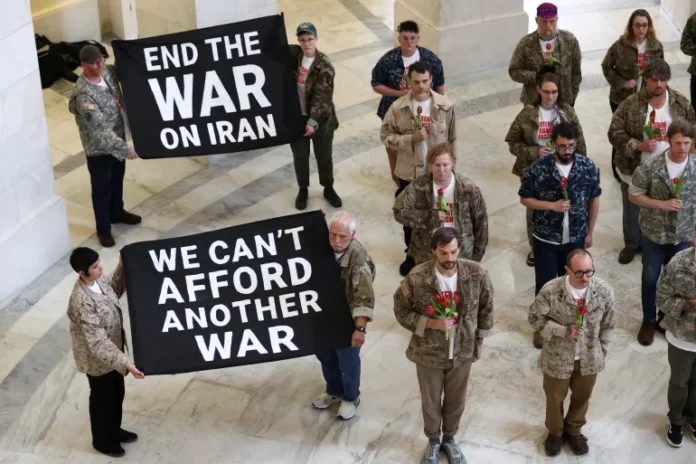
The wheels are starting to come off for Donald Trump. He launched the war in Iran to claim new ground for a US imperialism in decline. It’s now clearly become his latest and greatest humiliation—plain for just about everyone to see, in spite of Trump and his clique’s attempts to reinvent reality at every turn.
British Prime Minister Keir Starmer is “fed up.” German chancellor Friedrich Merz said, “The Americans obviously have no strategy.” Now even Trump’s right-wing allies in Europe have abandoned him.
When confronted in Congress, Secretary of War Pete Hegseth threw a tantrum: “Your, your, your hatred for President Trump blinds, blinds you to the truth of the success of this mission and the historic stakes that the president is addressing, which the American people support.”
The American public isn’t having it. They hate this war. They hate what it costs. Needless to say, the Republicans face steep headwinds ahead of the midterm elections, and Trump really doesn’t want to lose. He ran on bringing prices down and staying out of wars abroad. Unsurprisingly, he’s losing support. But a weak Trump is a desperate and dangerous Trump. This is no time to sit back and hope to watch him implode.
Fiasco In The Middle East
The war opened up with shock-and-awe, AI-driven, warp speed bombing across Iran and a promise from Trump that it’d all be over in weeks. Now into its third month, the main theater has transformed into an agonizing economic war of attrition, with Iran and the US both blockading ships from transiting the Strait of Hormuz. By halting Iranian oil exports, the US is choking their economy and also hoping to damage production: once Iran runs out of storage capacity, they’ll have to shut down their pumps, and restarting them may be impossible.
But the US has a lot to lose. Two thousand ships are stranded in the Gulf, and 20% of the world’s oil and liquified natural gas have disappeared from the market. Oil hit $126 a barrel in April, and the energy shock is working its way through the global economy. Ultimately, inflation will hit everything transported by gas. The longer Hormuz stays closed, the deeper the economic destruction worldwide—and the US is on the hook.
The new Ayatollah, in a rare statement, vowed that Iran will retain both its nuclear capabilities and its control over the Strait, saying the US has “no place there, except at the bottom of its waters.” The two sides have irreconcilable stated red lines, but neither wants a return to the missile barrages. Even if they compromise and reach a deal, it will be inherently unstable and just a matter of time before the US is compelled to return and defend its interests.
Problems At Home
This has all further isolated Trump on the world stage, and it’s creating problems at home. Trump is legally required to seek congressional approval for war after its now-passed 60th day. An increasing number of congressional Republicans are indicating they want to see this vote.
Skyrocketing prices of fuel, groceries, energy, and more are untenable for workers in this country, and more and more people know Trump is responsible. The war has burned through US arms stockpiles and now Trump has proposed a highest-ever $1.5 trillion defense budget for 2027, which would clearly come at the expense of the working class.
Trump has tanked support for his party. A record number of Republicans have chosen not to run for re-election. Democrats, whose support is also abysmal, now poll better than Republicans on the economy for the first time in 16 years. As disliked as they are, the Democrats are favored to win big in the midterms, and, desperate to stop this, Trump is throwing everything at the wall to see what sticks.
What Has Weakened Trump?
Trump has certainly undermined himself repeatedly, through his hubris, overreach, missteps, and simple ignorance. He’s been stymied by other sections of the ruling class on occasion, like the Supreme Court’s 6-3 ruling against his tariff authority.
The Democrats are full of bluster, but have proven incapable of holding Trump back. The best they could do to fight ICE was to leverage a way-too-long partial government shutdown to demand pitiful reforms like body cameras—all while ICE stayed operational and TSA agents went unpaid. Much more their speed is the extreme gerrymandering war with the Republicans, carving up district maps to engineer election victories rather than campaign on reforms that workers actually need. The Republican offensive culminated in the gutting of the Voting Rights Act, a key victory of the Civil Rights Movement, which could see total elimination of majority Black congressional districts in the South.
But to date, the most significant weakening of Trump’s authority was achieved by Minnesota’s working class, who struck a decisive blow against his deportation machine. January’s general strike in Minneapolis was the product of the accumulated experience of a year’s worth of struggle nationwide against ICE, the development of local resistance networks in the Twin Cities, and the homicidal provocations of Trump’s personal army occupying the area. This pushed a portion of the local labor leadership to call for political strike action, which spooked the capitalist class and forced the occupation to draw down. Nationwide, Republicans declared a “course correction” on immigration and a hypermilitarized invasion of a city hasn’t been conducted since. But this was still far from enough to shut down deportations completely or to stop Trump’s onslaught on other fronts.
How Do We Defeat Him?
On the night of April 25, a man rushed the security checkpoint at the White House Correspondents’ Dinner, armed with guns and knives. This act was born out of a sense of deep desperation, likely felt by countless people across the country. But individual acts of violence are incapable of bringing an end to Trump and the monsters he’s unleashed. There are no shortcuts.
Many are knocking doors for the Democrats, and more are just waiting anxiously for the midterms. But voting for the lesser evil is no recipe for neutralizing the right. The Democratic Party and its inability to make the capitalist economy work for working people paved the way for Trump’s victory. This failure to deliver gains is connected to their inability to fight Trump: the Democrats are a party of the billionaires and they’re terrified of encouraging workers to collectively fight for anything. Any time or money siphoned from the labor movement to the Democrats is a mistake.
What’s truly needed is a nationwide escalation of the Minneapolis General Strike. May 1 presented a key opportunity, which a number of labor leaders marked as a day of “No Work, No School, No Shopping.” Large demonstrations took place nationwide, but in most places, labor leaders were too afraid, unconfident, or unconvinced to actually organize real strike action. This meant that the day fell quite short of its full potential.
But look a little closer, and key actions point the way forward for struggle. From the bottom up, educators in Madison organized commitments to sick out in 70% of schools, pressuring the union to strike district-wide. Thousands of educators from across North Carolina skipped work and rallied at the state capitol. Wherever rank-and-file workers seized the initiative and organized their coworkers at every level, May Day’s potential shone through. Trump is on the backfoot and working-class people are the ones with the power to take him down. This—not waiting for the polls and not settling for parties of the rich—is a blueprint for building a movement capable of defeating him.