

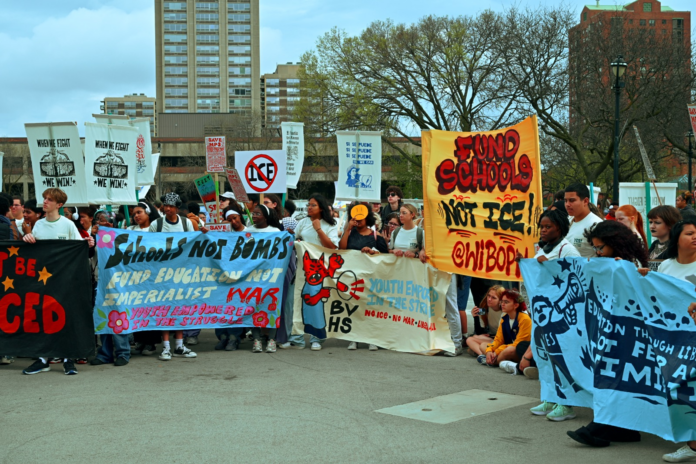
May Day this year took place in a period of extreme capitalist instability and volatility, with Trump at the helm of this system in decay. The fragile ceasefire in Iran is completely untenable, and the rich get richer off defense stocks while ordinary people pay the price at the gas pump. Though mass ICE raids have tamped down, in large part because of the historic Minneapolis strike on January 23, the construction of larger detention centers and more discreet ICE raids in suburbs across the country continue on. Trans people face more attacks as the billionaire class continues with their offensive, pushing “traditional values.” The recent gutting of Section 2 of the Voting Rights Act means a reinstatement of the racist redistricting that significantly undermines Black representation in office. All of this is happening against the backdrop of an uncomfortably warm April in many places, foreshadowing yet another record-breaking summer (with record-breaking electric bills) to come.
The slew of crises alone are not what moved labor leaders of the May Day Strong Coalition—like Sara Nelson of the Association of Flight Attendants and Greg Nammacher of SEIU Local 26—to call, in February, for May Day to be a day of “No Work, No School, No Shopping.” It was the tens of thousands of ordinary Minnesotans who, under the same slogan, bravely called out of work and marched in sub-zero weather on January 23 against ICE occupation. Inspired by Minneapolis, waves of student protests reverberated in the following weeks and millions more across the country joined in solidarity on January 30.
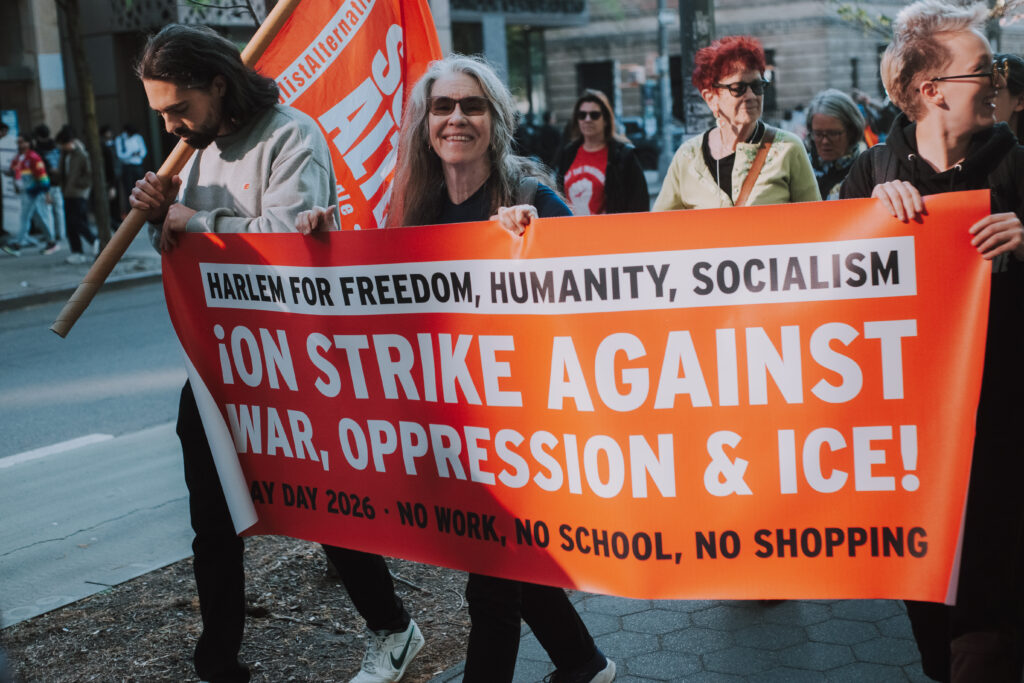
It is this pressure from below that pushed a small section of the labor movement to rise from its slumber. So, for the first time in twenty years, May Day in the US included work stoppages, alongside the hundreds of thousands of workers and young people who took to the streets. Socialist Alternative members organized strikes, sickouts, walkouts, and rallies from coast to coast.
May Day, with over 3,500 demonstrations nationwide, was a modest but notable step forward in escalating the anti-Trump struggle. While smaller in numbers than the record-setting “No Kings” protests, the militancy of several actions disrupting business as usual and, critically, limited strike action and work stoppages that took place were very significant. At the same time, the full potential of May Day was, unsurprisingly, held back by the labor leadership’s unwillingness to go all out in building for nationwide strike action.
Rank & File Organizing Is Key
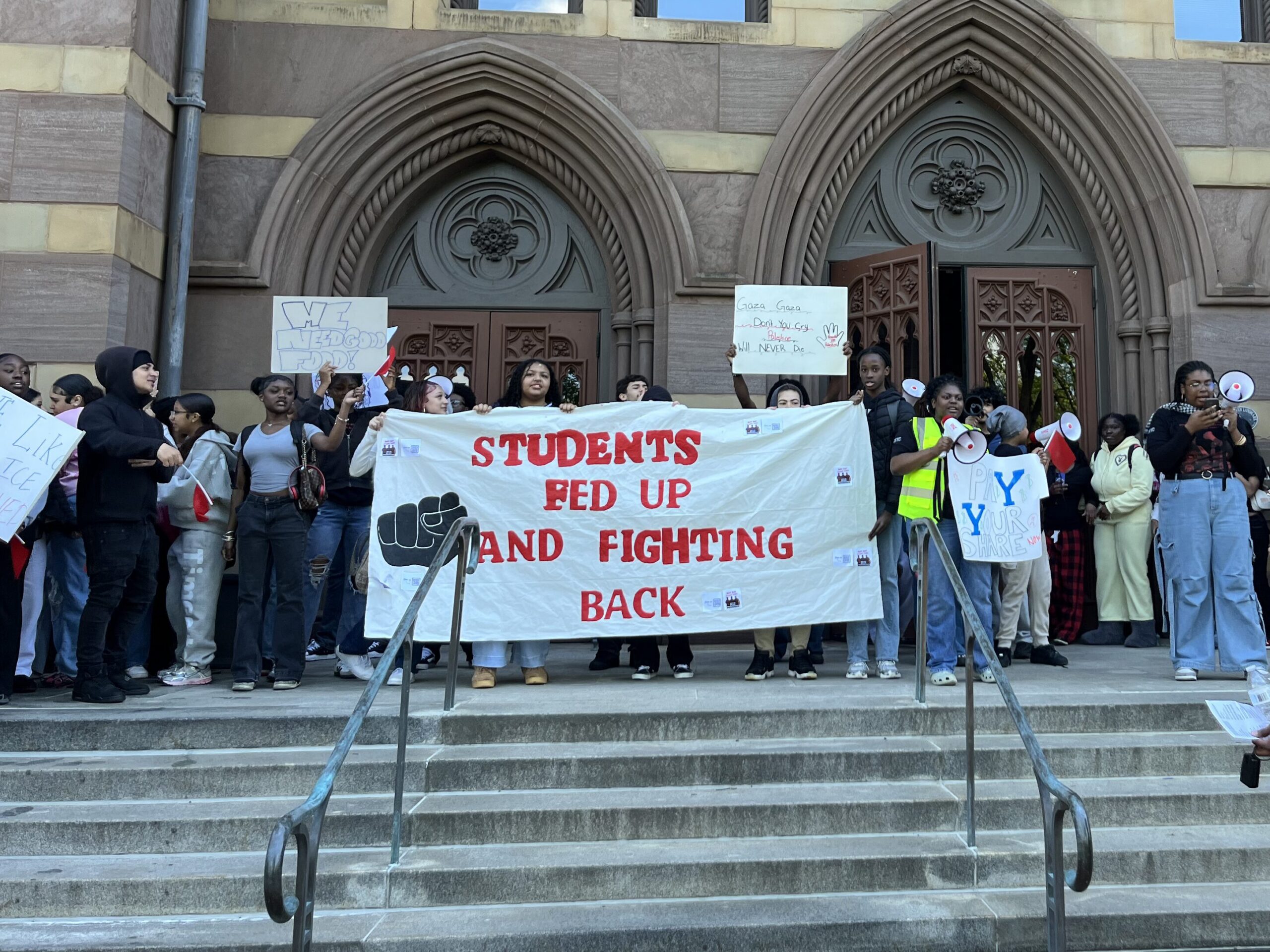
In both union and non-union workplaces, the most militant May Day action took place where rank-and-file workers drove the organizing work, from coffee workers shutting down stores across Madison, Wisconsin to educators across all of North Carolina sicking out and rallying in Raleigh. Strike action featured in places like Minneapolis, where UNITE Here Local 17 hotel workers struck two hotels. Strikes, sickouts, and marches were accompanied by student walkouts at hundreds of high schools and universities nationwide.
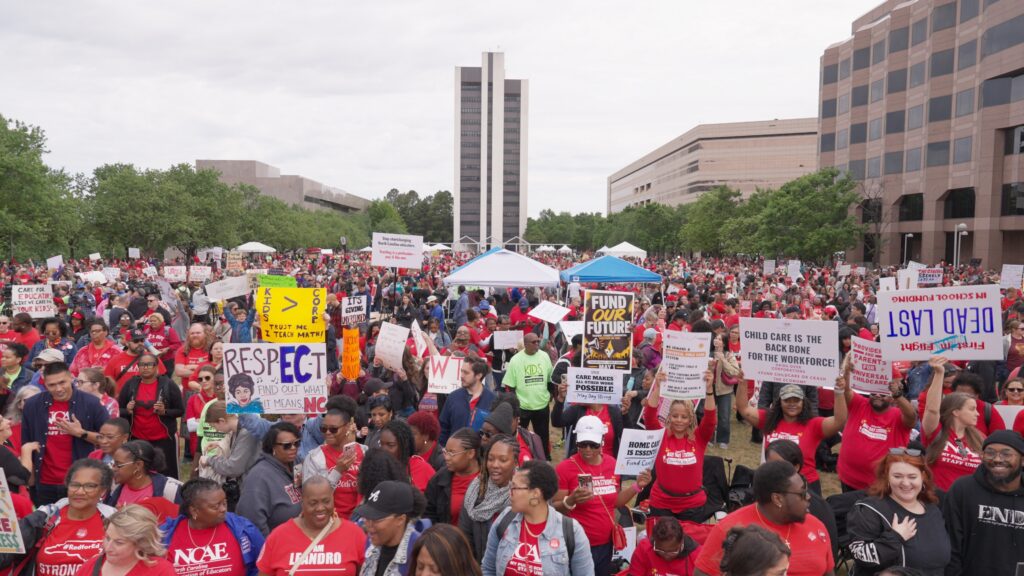
Educators were at the forefront in many cities. In late March, the North Carolina Association of Educators (NCAE) called for all educators across the state to go to the state capitol in Raleigh on May Day for a “Kids Over Corporations” rally instead of going to work. While they didn’t use the term “strike” in their statement, they pointed towards the important history of workers breaking the law, including anti-strike laws, to win key victories.
Making this real meant a month-long organizing effort of union members, including members of Socialist Alternative, collecting “commitment cards” to build for May Day. This meant doing the challenging, patient political work of addressing coworkers’ concerns. This of course did not happen without complications, including union leaders taking a hyper-localized focus that pointed away from clearly connecting Trump’s attacks nationally to local conditions. But the result was thousands of educators from at least 22 districts going to Raleigh instead of school, an important boost of confidence to workers to fight for more gains in a state where unions are being gutted and education funding is under threat.
In Madison, tireless organizing by rank-and-file union educators of Madison Teachers Inc (MTI) secured over 70% participation commitments in more than 70% of the 52 schools in the district. In the week before May Day, the union’s district-wide delegate body voted on a resolution put forward by a Socialist Alternative member to formally commit the union to a citywide sick-out on May 1 and join forces with immigrant rights group Voces de la Frontera’s citywide rally. All of this pressure forced the Madison Metropolitan School District to call off school on May 1. Just one day before May Day, nearby suburb Sun Prairie’s school district announced they too would be closing because too many educators were calling out sick in solidarity with Madison and the national movement against Trump and ICE.
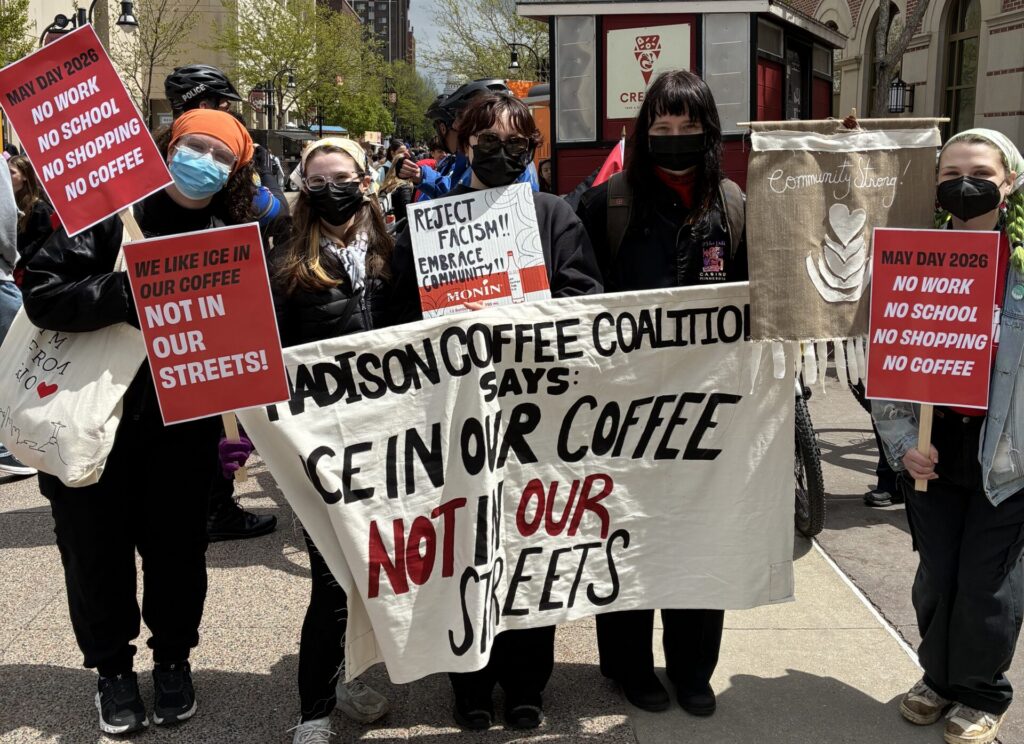
Alongside all of this, Socialist Alternative members who work in different Madison coffee shops pulled together a coalition of cafe workers across the city that organized the shutting down of several stores. Their banner on May Day read, “ICE in Our Coffee, Not in Our Streets.” All of these efforts were major victories of bottom-up organizing that should be an example to workers everywhere about what is possible when rank-and-file workers, unionized or not, take the lead.
Other small but significant direct actions against the billionaires and their corporations took place across the country. Sunrise Movement climate activists planned actions from coast to coast, obstructing traffic to the San Francisco Airport for three hours and blocking every entrance to the New York Stock Exchange. SEIU members in Chicago and NYC marched on Amazon warehouses, and protesters in Memphis blocked the entrance to an xAI data center. While most of these actions were limited in scale, they pointed toward disrupting business as usual which, carried out in a coordinated way and on a single day nationwide, is a step forward from “No Kings” days, which are purely days of mass rallies and marches. To truly be successful, these kinds of direct action need to take on a mass character. But these May Day actions can serve as a jumping-off point for continued, and more militant, struggle going forward.
Limitations & The Labor Bureaucracy
The labor leaders involved played a contradictory role in building for May Day action. On one hand, the May Day Strong Coalition’s slogan for mass work stoppages spurred real organizing in hundreds of workplaces across the country. But on the other hand, as soon as they issued this call in early February, their real actions (or lack thereof) served to hold back its potential instead of pushing it forward. Under pressure of events, and with mass anger and a mood for action from below, the bureaucracy of the labor movement can be pushed to play a progressive role. But it will often be quick to turn around and stand as a barrier to their own initiatives, hesitant to do what’s actually necessary—unleashing the full power of the rank and file—to truly rock the boat. Unfortunately because of this, the full potential of May Day was missed.
One mistake was setting the date for nationwide strike action three months out from the height of explosive struggle in Minneapolis, leading to a loss of momentum, as Socialist Alternative warned was possible. But despite the stretched timeframe, the main issue with the bureaucracy’s approach was to not engage in concrete organizing efforts to make work stoppages on May Day a reality. In most cases, leaderships are unconfident in the power of their members, and prefer to use them as a supplement to their primary method of making change: negotiations and relationships.
Going on strike is a serious thing, and no worker takes action like this lightly. It means missing a day of pay and risking retaliation from the boss. For work stoppages to reach their fullest potential on May Day would have meant union leaders putting meat on the bones of their call for “No Work, No School, No Shopping,” explaining why strike action and the power of the working class is our most powerful weapon against Trump and the billionaire class, and providing the specific steps to make it happen. While Socialist Alternative could not fill this enormous vacuum of leadership, we provided resources to the workers and students we organized alongside in the leadup to May Day.
In Chicago, the leadership of Chicago Teachers Union (CTU) relied on legalistic methods, calling on Mayor Brandon Johnson to adopt a “civic day of action.” They attempted to negotiate behind closed doors with the district to close schools on May 1, essentially a strategy of “asking permission” to take action on May Day instead of organizing from below to make it a reality as educators in Madison and North Carolina did. But last week, even after a majority of the School Board voted to accept the CTU’s proposal, the CEO of Chicago Public Schools simply vetoed it. Because they hadn’t taken the route of organizing educators, families, and the wider community to take action, and sought a shortcut instead, they found themselves on the backfoot, without the momentum to organize a rank-and-file defiance of the CEO. In fact, even worse than this, CTU’s strategy backfired and many educators and families are upset with the union.
Leading up to May Day, some labor leaders took up calling May 1 a “structure test” for Labor Day and the midterms, meaning a day to assess support, grow participation, and build readiness for future action. It’s absolutely correct to build structure tests into a longer-term escalation plan. But a real structure test would have required the unions to develop strike-ready organizing structures at every level. In reality, most labor leaders used this framing as cover for kicking the can of mass organizing down the road to funnel energy into campaigning for Democrats.
Major unions being tied to the corporate-backed Democrats remains a major barrier for the kind of militant mass action needed to actually take on Trump and the billionaires. Instead of using union dues to organize new unions and build for strong strikes, union leaders throw millions of dollars every election cycle into Democrats who fail to put up any fight against the right. The threat of Trump and the right rigging the midterms is very real—but we need to be clear that mass action has dealt a stronger blow to Trump than any Democrat. And it is only mass action that will defeat him.
The Anti-Trump Movement Continues
The messages of many May Day speeches from union leaders and Democratic politicians were the same: all we can do is hold out for the midterms and hope to win back some seats. But when we consider all that has transpired in the last six months—ICE murders, new wars, and the stripping away of basic democratic rights—waiting another six months is unbearable and untenable.
It is the role of socialists to put forth the best strategies in action alongside our coworkers and expose the limitations of the labor leadership in the process. We urgently need to distill the lessons of the best examples of strike action that took place on May Day, and to replicate this action everywhere on a wider, larger scale. The groundwork laid by mass action on May Day by parts of the workforce can sow the seeds of confidence needed for future struggle across more industries, whose involvement will be necessary to more decisively shut down the economy. Rebuilding a fighting labor movement alongside the broader anti-Trump movement will be necessary to reverse Trump’s devastating attacks on unions and the working class.
We can have absolutely no faith in the Democrats, who are more concerned with fighting gerrymandering with more gerrymandering, to take up the existential threat posed by Trump and the far right. Our fight against Trump must be connected to the need for political independence of our movement, including the need for a new party of struggle. The situation is far too dire for our movement to afford to be co-opted and kneecapped by Democrats again and again.
Lastly, our struggle needs to be socialist, one that takes on the capitalist system that has given rise to Trumpism. With each new wave of struggle, thousands of more young and working people enter the struggle for the first time, looking to fight against the system that is failing them. And we need those people to not only join the struggle, but to get organized. May Day was just one battle, and we will need you for the next, bigger battle. So, join Socialist Alternative today!