

Throughout the history of capitalism, young people have been propelled into titanic clashes with the system when they are confronted with the crushing reality of adulthood under a brutal system. The titanic “Gen Z revolts” of the past two years are no different. The mass protests toppling the government in Bangladesh in 2024 are widely cited as the first successful “Gen Z revolution” in the world. It inspired similar protests in various countries that year, including notable protests in Kenya that defeated what would have been a massive tax hike for poor and working people.
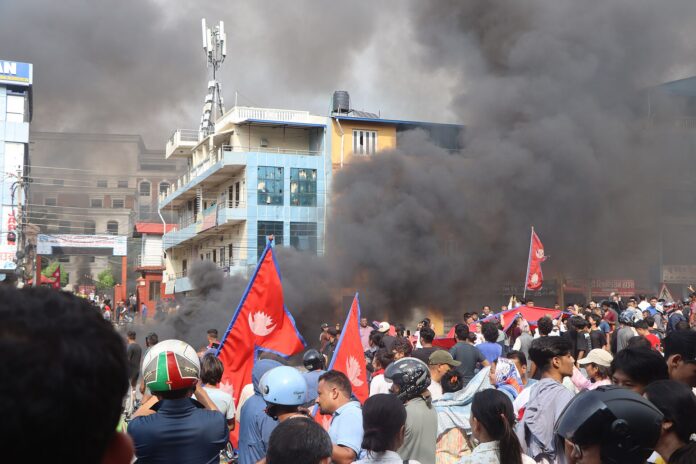
The term “Gen Z revolt” became much more popular in 2025, following the ousting of the Nepali government and the chain reaction of youth-led movements that followed, including significant movements in Madagascar, Indonesia, and Morocco. By September 2025, Gen Z anti-government movements had reached the continents of Asia, Africa, and South America, but they had a serious impact almost everywhere—for example, Italian media noted the large involvement of Gen Z protesters in the country’s general strikes and protests for Gaza.
Young people today face a world with incredibly few, if any, prospects of avoiding poverty and debt. They are growing up in a world characterized by declining living standards after the 2008 global financial crisis, punctuated by the deadliest global calamity of the 21st century in the COVID-19 pandemic, and plagued by the rise of right-wing authoritarianism around the world—all against the backdrop of a devastating climate crisis that threatens to end civilization as we know it.
In general, the world’s ruling classes have taken a reactionary turn to prepare for more war and imperialist conflict, attacking basic rights and placing the burden of these crises on the backs of workers and youth. This has made it acutely clear how little the system has to offer the working class and poor, and especially young people. Global youth unemployment was at nearly 12% at the beginning of 2026, compared to around 5% for adults. But being technically employed is not the same as having a good job or a decent wage—nearly 300 million workers globally are living in extreme poverty, earning less than US$3 a day. It is expected that around 2.1 billion people globally will be working in the informal sector this year, with limited access to basic protections, rights at work, and job security. Many of these will be young people.
What’s more, women around the world today are around 24% less likely than men to participate in the labor force. In the US, around half a million women were pushed out of the workforce in 2025, partly due to mass layoffs and partly due to the extreme costs of childcare and lack of decent wages. This is a deeply concerning trend that often means women are more reliant economically on their families and partners, which often goes hand in hand with domestic and financial abuse.
It is hardly a surprise, then, that the Gen Z protests have been characterized by a widespread and profound anger at and mistrust in capitalist institutions. The protests were sparked by different specific events, such as the increased taxes on the poor in Kenya, shortages of electricity and water in Madagascar, and wage increases for politicians in Indonesia. But in general they reflected mass anger at rising inequality, declining standards of living, corruption, and attacks on democratic rights. The movements then quickly grew into struggles against the entire governments of their countries. Despite brutal repression, many of these movements managed to win significant concessions, including the ousting of corrupt leaders.
But the new governments that replaced the ousted ones, still capitalist, have no solutions for inequality and lack of opportunity for young workers. The fundamental situation has not changed for the working and poor masses of these countries. Learning the right lessons from these revolts, then, will be crucial to ensuring the next movements can go much further.
The First Gen Z Revolt
The student-led movement that toppled the Bangladeshi dictatorship was initially sparked by the reintroduction of a “quota” system for government jobs. The quota system underlined the systematic nepotism and corruption of the Bangladeshi ruling elite in a country where 18 million youth were unemployed at the time. The initial uprising was met with severe repression by the autocratic government, including the massacre of over 1,500 protesters. It was this repression that initially pushed the working class to join the struggle, and this was what ultimately forced the state to negotiate with the students.
As the movement expanded, students called for the end of Bangladeshi Prime Minister Hasina’s violent and repressive rule. They called for tax and utility payment boycotts, and for a shutdown of all factories and public transit—a call that was broadly heeded by the working class. It was critical that the working class joined the struggle, as the only class in society that has the power and social weight to pose a fundamental challenge to the rule of the capitalists.
However, students can also play a key role, as they did in Bangladesh. Apart from their important role in sparking the movement and raising demands to draw the working class into the struggle, students unified the movement, and Bangladeshi society in general, against religious divisions that could have derailed the fightback. It was also significant that the students initially led the uprising without illusions in any imperialist powers to come to their aid, which for example became a feature of the Hong Kong pro-democracy movement of 2019. And it was critical that they didn’t stop when the Supreme Court scrapped the quota system within weeks of the protests, but instead used the increasing momentum behind them to win the Prime Minister’s ousting.
The movement showed how demands can be implemented from below, not by waiting on the government or courts. They demanded a ban of the ruling party’s student wing, the Chhatra League, but had already driven that organization out of many campuses, declaring them “Chhatra free”. And the movement did not restrict itself to universities and colleges, but marched in the cities, and blocked highways and railways.
As the movement continued into September, hundreds of factories suspended production amid a sharp upturn in workers’ protests in the garment industry, which employs overwhelmingly women workers and dominates the Bangladeshi economy with extreme levels of hyper-exploitation. Workers marched from factory to factory, spreading strikes, and organized mass protests at offices of companies and authorities—clearly inspired by the mass movement led by students in the summer.
The garment workers demanded the payment of unpaid wages, wage rises, maternity leave and pay, and an end to workplace harassment and victimization, among many other demands. To protect jobs in a period of factory closures and cuts, they also raised the demand to nationalize the factories—a key demand in a country with so many multinational companies. This demand needed to be linked to building up workers’ organizations that could lay the basis for democratic workers’ control of the industry.
Counter-Revolution in Bangladesh
Imperialism and the national military establishment, which in Bangladesh is a key part of the capitalist class, inevitably prepared for counter-revolution. The question of whether this will succeed always depends on the degree of organization of the working class, and whether it is armed with a fighting strategy and conscious socialist leadership.
In Bangladesh, the military organized an interim government to keep control of the situation on behalf of the capitalist class. Tragically, student protest leaders took on roles as ministers, mistakenly legitimizing this government. Despite being called a “leaderless” movement, there were self-appointed student leaders who, not being democratically elected or accountable to the working-class interests of the movement as a whole, integrated themselves into the capitalist machinery instead of fighting it.
So despite the lack of confidence in capitalist institutions in general, without a clear alternative, the movement’s leaders put their faith in this interim government to bring fundamental change that it would not and could not achieve. Muhammad Yunis, the head of this new interim government, has previously won a Nobel Prize in Economics for his work fighting to preserve the big capitalist institutions like the IMF and World Bank, sowing illusions that workers and youth can escape poverty under capitalism. These are the very institutions the movement needed to organize against, to struggle for the cancellation of all IMF and foreign loans.
The necessary next step for the movement would have been to take into democratic public ownership the telecommunications companies, banks, garment producers and other major corporations. In our material at the time, ISA called for the movement to launch a jobs program based on the state ownership of vast swaths of the economy for the millions of unemployed youth and poor.
We also called for the Bangladeshi youth and working class to build a mass party out of the struggle based on the unions, in opposition to the pro-capitalist parties. The student protest leaders afterward formed the National Citizen Party, which calls itself youth-led and progressive, but in practice supports nationalist and conservative demands. This is not a mass party based on the unions and genuine working-class struggle, but rather reflects the petit bourgeois character of the leading student layer.
Yunis’ capitalist policies of course did nothing to address the root of the issues that young people and workers face like inflation, corruption, and a weak job market. This left many people questioning the bloody sacrifice and whether the uprising had been worth it. As a result, the massive winner of the election in Bangladesh in February 2026 was not the party started by young leaders of the protests, or any reformist party, but the right-wing BNP—the other half of the long-ruling duopoly, which won more than two-thirds of seats. As the BBC wrote, “Although the BNP are promising to lead change in the country, the party was criticised for corruption and accused of human rights violations when it was last in government in the early 2000s.”
Revolts in Nepal & Madagascar
In September 2025, the Nepali government banned dozens of social media apps in the country in response to the viral “#NepoKid” social media trend exposing the extravagant lifestyles of politicians’ children. Politicians were afraid of the videos sparking anger over the deep inequality and corruption ravaging the country, with 21% youth unemployment. Their heavy-handed response backfired, and after the social media apps were banned, Nepali youth took to the streets and set fire to parliament buildings. Similar to other Gen Z revolts, the government cracked down brutally, with reports of over 150 people killed.
“Communist” prime minister K. P. Sharma Oli oversaw this bloody repression. Her political party, the Communist Party of Nepal-Unified Marxist Leninist, is communist in name only. The pressure of the protests forced Oli to step down, and the youth movement “elected” a new prime minister via the gaming chat app, Discord. With 7,500 votes, they chose Sushila Karki as interim prime minister, a career judge who had served on high courts in Nepal. In the recent Nepali elections this year, rapper and Kathmandu mayor Balendra Shah was elected as the new prime minister, portraying himself as the leader of last year’s protests, but with an entirely capitalist program.
In Madagascar, the military took power in the fall of 2025, following three weeks of protest by working-class youth against the cost-of-living crisis. In 2024, Madagascar’s GDP per capita was just $545, the fifth poorest country in the world, according to the World Bank. The movement grew into a call for the impeachment of President Andry Rajoelina. In early October, the elite military unit Capsat came out in support of the protesters, after which Rajoelina fled the country and Capsat’s commander was sworn in as transitional president, for what he said would be 18 to 24 months.
While former president Rajoelina was a civilian ruler, he also came to power in a coup instigated by Capsat, which backed him after he led three months of anti-government protests in 2009. This is clearly a useful part of the ruling-class playbook, to quell movements that have revolutionary potential by way of having the military appear as saviors, as a force apart from the repressive state apparatus.
In the neocolonial world, in many cases, the military comes to power with wide support, as the case of Madagascar demonstrates, where the masses were celebrating a victory of ousting a repressive regime. But these military regimes, based on the capitalist system, are not fundamentally different from the previous regimes and will also use repression against protests and strikes.
Political vacuums will always be filled by one or another of capitalism’s representatives, as long as the working class does not develop the necessary organization, socialist consciousness, and struggles to take on the ruling class and overthrow capitalism, by abolishing the domination of all key sectors of the economy by both foreign and private capital.
In Nepal and Madagascar, as elsewhere, the relief of a new face will only briefly postpone further attacks on living conditions that will return more viciously as the ruling class continues to attempt to manage its growing crises. The ruling class will continue to pursue more income to service debt and to provide super profits for foreign capital while sustaining their luxurious lifestyles at the expense of the wellbeing of the working class.
What Lessons Can We Learn?
Many Gen Z revolts have had a record of successes in ousting autocratic and repressive governments, but have not been armed with an understanding of the dynamics of the true power relations in society, defined by the struggle between the working class and the capitalist classes.
The working class and poor rightly identify the many things that are wrong in society, but it’s crucial to go further. Our movements must come to understand that what is wrong in the world is rooted in the capitalist system, and that our task is to organize to replace it. Reaching the full potential of these movements requires the working class to play a decisive leading role, but also a leadership that is consciously armed with Marxist ideas—such as the need for internationalism, an understanding of imperialism, the role of leadership and democratic workers’ organisation, the role of the state and the capitalist system.
The lack of organized independent working class and socialist forces, including a lack of Marxist leadership, along with illusions in “leaderlessness” and decentralization, have left these movements exhausted without reaching their often vague or limited goals and opened the door for the ruling class to derail the struggle and for counter-revolution. Our movements need to be armed with a socialist program, fighting for an alternate vision of society that takes companies into democratic public ownership, builds high-quality public housing, starts jobs programs, and more. Overthrowing capitalism will require the working class to take the lead—and a revolutionary party with strong roots in the class that is able to put forward such a program.
The Gen Z movements faced a conscious attempt, including from the inside, to limit the demands of the protest to not directly pose the question of who runs society. They were persuaded instead to merely look to another wing of the ruling class or the military to take power. This was in part successful on the part of the ruling class because, for many decades, even the basic idea that the working class has the leading role to play in changing society has been consciously undermined and erased. In large part, this goes back to the new era of capitalist triumphalism, set in motion by the fall of the Berlin Wall and the collapse of the Soviet Union.
In this context, the false analysis of the “end of history” and the “death of socialism” proliferated. Combined with the severe attacks on the trade union movement in the 1980s and 90s, and the entrenchment of a labor bureaucracy in most major unions around the world, the working class and the left have been severely set back on a historic scale. There is a lack of living memory of struggle and working-class methods that are being slowly rebuilt today.
In the case of Madagascar, the major trade union federation, Malagasy Trade Union Solidarity, joined the movement after about a week of protests. At this point, the protests had already succeeded in grounding society to a halt, with workers independently providing support and joining the movement on their own. The trade union leaders didn’t seek to play any leadership role in the interest of the working class to directly pose the question of who controls society. It is in this context, with no organized opposition on an independent working-class basis, that the military was able to take power.
But in this era of capitalist crisis and imperialist war, heroic movements like these will keep exploding to the forefront as young and working people rise up to resist the oppression they are forced to endure. The working class will continue to draw lessons from these battles. If assisted by organized revolutionary socialists participating side by side with them in struggle, growing layers will draw the conclusion that capitalism is the system that needs to be uprooted and, even more importantly, they will learn the methods by which this can be accomplished.
While acknowledging the crucial role played by young people in these protests with their collective courage and tenacity, ultimately the working class must take the lead in organizing across workplaces, schools, and communities to provide the leadership it was largely unable to offer during the Gen Z protests, and see itself as a revolutionary force capable of winning a socialist world. It is for that reason that ISA is fighting to build mass socialist parties around the world which can help lead these struggles toward not just overthrowing individual rotten governments, but the capitalist system that underpins them.