

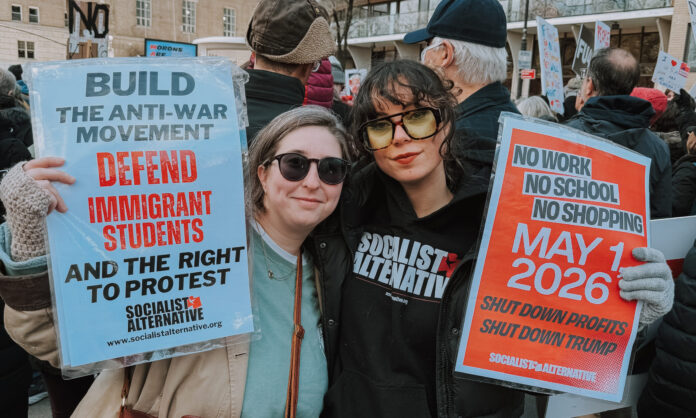
Near the end of January 2026, Google searches for “general strike” skyrocketed. This of course was on the heels of the movement in Minneapolis inspiring workers and young people by striking against ICE on January 23. Now, a section of labor leaders are calling for a nationwide day of “No Work, No School, No Shopping,” on May 1 against Trump, ICE, and imperialist war. This would be a massive step forward in the anti-Trump movement.
Political strike action is back on the table, and not a moment too soon. It’s time we go beyond mass protest and take coordinated action that hits Trump and his billionaire buddies where it hurts: their profits. Chances are, if you’ve been to an anti-Trump protest in recent months, you’ve heard a labor leader or activist mention strike action. You may have even had the thought, “Strike action sounds good, but where do I start?” If so, this FAQ is for you!
Whether you are a union worker, non-union worker, or even a student, every one of us who wants to fight Trump has a responsibility to bring the call for “No Work, No School, No Shopping” into our schools and workplaces. For most of our coworkers and classmates, there will be hesitations, fears, and questions around taking strike action. Organizing in your school or workplace for the first time can be daunting. Being equipped with clear and confident answers can help break down these barriers and prepare for collective action. Here are some common questions we’ve heard come up:
FAQ
- How can I go on strike when I can’t afford to miss work? Striking is not realistic.
Going on strike is a sacrifice for ordinary people, but it’s also one of our most powerful weapons. The question is: is a strike worth the sacrifice? Unions and workers need to ask: can I continue to treat my patients if ICE keeps raiding my hospital? Can I bring my child to school if deportations continue?
A strike that shuts down profits and business as usual is one of the most powerful ways workers can force change. Unions need to lead from the front by organizing workers to get strike-ready, using strike funds, and being willing to defy anti-strike clauses in contracts that help the bosses, not us. When we work together around common demands and strategy, we can guard against retaliation.
- Isn’t it illegal to go on strike?
For many workers it is, but the bigger and more organized the strike, the harder it is for the government and bosses to go after workers. In 2018, West Virginia teachers led a week-long illegal wildcat strike that occupied the state capitol. They shut down schools in all 55 counties and forced the state to meet their demands without a single teacher facing legal repercussions.
The laws are there to hold back struggle, but as MLK Jr. said, “One has a moral responsibility to disobey unjust laws.” When Trump and the billionaires break the law, it’s workers who pay the price like the eight people murdered by ICE just this year. We are not the same. Where fear is a real barrier, organizing a coordinated sick-out can help lower the stakes.
- Won’t strikes or boycotts harm other workers, local small businesses, or public services?
It’s no small thing to forgo pay and potentially risk your job to join a strike. But hardship is not created by the strike: it’s created by the conditions that made the strike necessary in the first place. In Minneapolis, ICE caused $81 million in lost revenue for small businesses, $47 million in lost wages for people afraid to leave home, and a $25 million increase in rental and food assistance needs.
Strikes are about taking on the forces that crush and divide workers, hollow out small businesses, and defund critical public services. We have to ask ourselves: what is the cost of doing nothing? If we are going to see long-term gains, we must be willing to accept that short-term sacrifices may be required.
- What if my city isn’t ready? We might take action in the event of a Minneapolis-style invasion, but probably not sooner.
Some labor leaders are raising that they’ll only call for strikes when things get to the level of Minneapolis earlier this year. We absolutely cannot wait for this level of devastation to hit our city before taking action.
We’ve seen the speed and ferocity with which Trump and ICE are willing to crack down, and so we must prepare to get strike-ready now. Taking nationwide action on May 1, a historic day for the immigrant rights’ struggle, is a step towards making sure ICE does not step one foot in our city and backs down where raids are already happening.
Interested in organizing a school walkout? Click here! Want to organize a sick-out in your workplace? Click here!