Donald Trump’s war and deportation machine has kicked into overdrive, tearing apart communities at home while expanding violence abroad. But across the country, resistance is shifting from isolated protests toward coordinated action. The central question is no longer whether to fight back, but how.
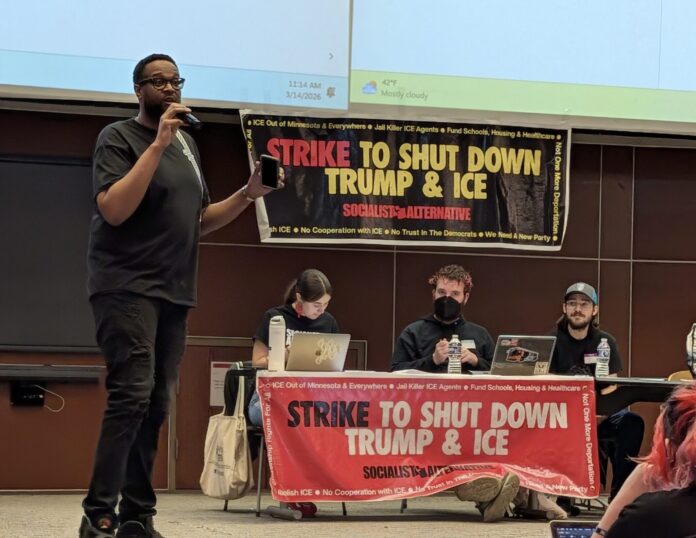
That question was at the heart of the Cincinnati Anti-ICE Action Conference (AIAC), held on March 14 at the University of Cincinnati. More than 150 participants—community members, activists, union members, healthcare workers, teachers, and students—came together to turn our collective anger into durable opposition to Trump’s agenda.
Socialist Alternative planned the conference following a surge of nationwide resistance sparked by the January 23 strike in Minneapolis. That action drew tens of thousands of new people into the anti-Trump struggle across the country, including in Cincinnati. While Cincinnati has only seen ICE traffic stops and not yet seen mass ICE raids, we need to prepare for that possibility now. And taking that fight forward requires a clear strategy and plan of action.
Cincinnatians Strategize The Way Forward
The Cincinnati branch of Socialist Alternative proposed the AIAC with endorsements from more than a dozen local organizations and left groups. The conference placed democratic discussion front and center with the aim of developing a unified strategy and concrete next steps in the fight ahead. Alongside several of the endorsing groups, including Democratic Socialists of America (DSA) and 50501, we introduced a joint resolution—“Building a Strike Ready Movement in Cincinnati”—for attendees to discuss, debate, and vote on. The day also featured several workshops led by different organizations.
Over 30 participants spoke in the full group discussion on the resolution, reflecting a strong interest in advancing strike action and drawing lessons from Minneapolis. Through shared deliberation, attendees actively amended and strengthened the resolution, which culminated in its passage by an overwhelming majority vote.
Central to the resolution is May 1, when the May Day Strong Coalition has called for a national day of “No Work, No School, No Shopping.” To translate that call into action in Cincinnati, the AIAC resolution calls for strengthening networks in workplaces and schools, establishing organizing committees, and developing the capacity for coordinated strike action.
To support this strategy, Socialist Alternative hosted a workshop at the AIAC, “Taking Strike Action Against ICE: How to Talk to Your Coworkers,” designed to translate these goals into practical organizing skills.
The case for strike action is grounded in what we already know works—that work stoppages and student walkouts combined with mass protests can disrupt business as usual. Even partial, concurrent participation nationally on May 1 would create economic disruption and a threat of further escalation, which can force Trump to back down.
But this won’t happen on its own. Getting strike ready means starting now.
Why Strike Action?
At the conference, broad agreement on the need for strike action was clear, though genuine concerns emerged. Some participants questioned whether we would be sufficiently prepared by May Day, while others showed apprehension about the risks of strike participation for poor and working-class people.
These concerns are understandable given that strikes can threaten job security, especially in unions bound by anti-worker no-strike clauses and in non-union workplaces. Strikes can impose real costs on the most vulnerable communities. But the fact is, vulnerable communities already bear the weight of Trump’s policies. Every day, working people are losing healthcare, jobs, and housing faster than mutual aid networks can respond. Defensive measures can’t keep pace with the scale of attack.
We must ask which carries greater risk: fighting back, or accepting the attacks and hardships that will come regardless? Relief efforts and legal challenges can buy us time, but they leave intact the structural conditions that generated the crisis in the first place. Confronting those structural conditions requires organized working-class power, which in turn depends on having democratic spaces where ordinary people can collectively discuss the risks and decide how to move forward.
Minneapolis showed us an example of how coordinated disruption can generate pressure. After the violence of ICE’s Operation Metro Surge, the city fought back. The general strike and mass protests disrupted business as usual so sharply that over 60 corporate executives publicly called on the Trump administration to deescalate. This wasn’t a sudden crisis of conscience—they were bleeding money, over $200 million. Within days, Greg Bovino was ousted. Weeks later, Kristi Noem was fired.
While ICE is certainly still a major threat and we shouldn’t overstate modest victories, there have been no new mass ICE operations launched since Operation Metro Surge and deportations were down 11% in February. That is the power of a deliberate, working-class fightback with strike action at its center.
Cincinnati’s Path To May Day
To start building a strike-ready movement in Cincinnati, AIAC attendees voted to approve a plan to mobilize as many people as possible for the next No Kings protest on March 28 as a stepping stone for May Day. The goal for No Kings is not just to show up, but to talk to as many people as possible about getting actively involved in building for May Day action. The plan also prioritizes outreach to Black-led organizations and calls for sustained organizing across multiple fronts, such as workplace conversations, student organizing, neighborhood canvassing, and small business engagement.
The AIAC closed by electing an interim coordinating committee of representatives from endorsing organizations. This committee is tasked with carrying out the decisions of the AIAC through May Day, including meeting with the Cincinnati AFL-CIO Labor Council, organizing a strike-ready training with local labor leaders and union members, and planning a second Action Conference after May Day.
This kind of unity is how movements build the power to win our demands. In the resolution, these demands include taxing the rich to fund public schools and expand social services, securing full citizenship rights for all immigrants, abolishing ICE, and ending the war in Iran.
A Foundation, Not A Finish Line
The outcomes of the AIAC reflect an important shift in strategy in Cincinnati. Rather than relying on isolated actions or top-down directives, participants committed to coalition-building and democratic decision-making. While the structure developing here in Cincinnati provides a small yet promising foundation, its effectiveness depends on broader union involvement, deeper engagement with community organizations, and reaching people who are not yet organized. The reality is, the project before us is far larger than Socialist Alternative, or any single organization, can carry out.
As May Day approaches, we face a compressed timeline to prepare participants for the risks and responsibilities of collective action, including strikes, sickouts, and walkouts. Strike readiness does not emerge overnight; it develops through sustained, deliberate organizing grounded in clear strategy and concrete objectives. Major events accelerate this process by drawing more ordinary people into struggle. With the ongoing horror of the war in Iran and the threat of Trump escalating even further, we must be ready for larger mobilizations and a movement increasingly willing to escalate on May Day, or even sooner.
The Cincinnati Anti-ICE Action Conference did not resolve every question facing the movement. It did, however, establish a process for addressing these questions collectively and charting a path toward united action against Trump, ICE, and forever wars.
The Cincinnati Anti-Ice Action Conference Demands:
- Abolish ICE and tax the rich to fully fund public schools, expand Medicaid and SNAP, and build high-quality, affordable, publicly owned housing.
- No cooperation with ICE! Reject all 287(g) contracts and oppose all pro-ICE legislation, including SB 172, HB 26, HB 281, and HB 544. Keep ICE out of hospitals, defend our right to record ICE activity to protect our communities.
- Implement real sanctuary city policy! Suspend evictions, ban police cooperation with ICE, and prevent immigration enforcement from entering public buildings without judicial warrants.
- No ICE in our schools and workplaces! Armed agents create unsafe working and learning conditions. Unions, non-union workers, and students must develop safety plans and prepare for strike action against workplace or school raids.
- Full citizenship and labor protections for all immigrants! Guarantee good union jobs, safe working conditions, and full workplace rights for all workers.
- Remove Flock cameras from Cincinnati streets now! End the surveillance state and eliminate all AI-powered arrest and deportation systems nationwide.
- Stop the U.S. war on Iran! Bring the troops home and close all U.S. bases abroad. Redirect outrageous military spending to adequate housing, healthcare, and wages for all.