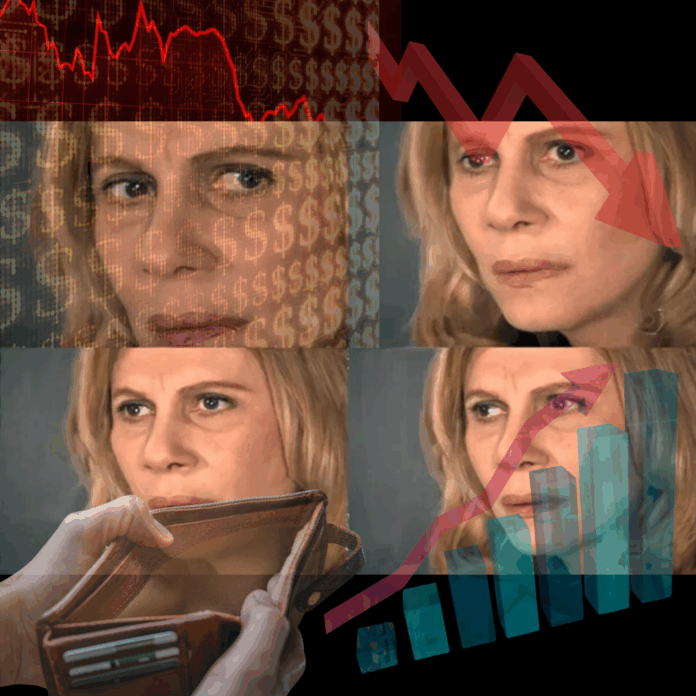
Donald Trump called the affordability crisis a “con job” and a “hoax,” but working people nationwide beg to differ. Most Americans cannot afford a $500 emergency and are living paycheck to paycheck. Basic living necessities are increasingly out of reach for working families. The cost of raising a single child has increased from $15,775 in 2023 to $20,384 currently, with absolutely basic requirements like food and diapers costing more than $5000 a year! Eggs, milk, and other essential food products are rising in cost, pressuring working people to choose between paying their bills or putting food on the table.
Our Economy: Debt & Stress
In the midst of this crisis, millions are being laid off from work. This October saw the highest number of layoffs when compared to any October since 2003, and we’re experiencing the lowest rate of hiring in a decade. Millions of working people desperately resort to gambling, and a staggering number work in low-wage gig jobs, trying to survive in an increasingly cruel economy. With 20% of Americans actively participating in sports gambling, the industry is expected to make $14 billion by the end of the decade. 62% of US workers are employed in the gig economy, and 37% rely on these low-wage, non-union jobs as their primary income.
Working people are relying on debt to cover the gap between their low wages and their mounting bills. The average credit card debt held by an individual is now roughly $10,000. Car repossessions are skyrocketing to levels not seen since the Great Recession, with three million people on track to lose their only reliable mode of transportation to work this year. And once those credit cards are maxed out and the car is towed away, people are forced to ask for charity via GoFundMe to pay for emergency situations or basic needs. All of this is happening in the supposed “richest country in the world.”
Facing the rising risk of layoffs and squeezed into buying only necessities, working people are forced to consume less, showing that for the working class, a recession is already here. As an indication, the discount retail chain Dollar Tree reported that three million more households shopped in its stores last quarter compared with the previous year. About 60% of those new shoppers came from households earning over $100,000 a year, no longer a comfortable income.
Meanwhile, Elon Musk is on the path to become the world’s first trillionaire. Palantir, BlackRock, Nvidia, and OpenAI are making hundreds of billions in revenue, profiting in a rising speculative bubble. This massive disconnect between the “real economy” and the financial markets points towards a serious risk of economic recession.
Their Economy: Speculation & Profits
We are in an economy of debt and speculation disguised as economic growth. Corporate investments in AI were responsible for over half of US GDP growth during the first six months of this year, much of which is funded by corporate debt. Billions upon billions of dollars are being spent to construct and own potential data centers and GPU chip manufacturing factories from a handful of companies. Zombie companies, corporations whose income is less than the interest they must pay on their debts, make up around 10% of the US economy.
This speculative AI economy is rooted in the general stagnation of US manufacturing. Without sufficient avenues for productive investment, capitalists are forced to bet on the next big thing. There are many reasons for this stagnation such as high interest rates, tariffs raising prices of raw materials and machinery, deportations of immigrant/migrant workers forcing workplaces to shut down, and decades of offshoring manufacturing to the neocolonial world. These factors are important, but there are much more fundamental, systemic reasons for the current economic stagnation we are in.
Capitalism is a system that prioritizes profit by any means necessary. The capitalist class is forced to engage in this ridiculous circular process of growth, speculation, and crisis. Because these mega-rich folks are aiming only to make stuff for profit, they have no regard for whether any of it is socially useful or not. As a result, they overproduce, flooding markets around the world with products. To compete with one another, they drive down wages, lower working conditions, and use government connections to get lucrative contracts to shut out others. But, eventually, with workers not having the money to pay for the very products they create, the ruling elites increasingly resort to speculation in new areas of the economy, such as AI, to boost their profits and avoid being eaten by the competition.
All it takes is any of these big, debt-riddled companies to have a bad earnings report for the entire house of cards to collapse. We are very familiar with this story—from the Asian financial crisis in the 90s, to the dot-com bubble burst of the early 2000s and the financial collapse of 2008. In each case, big businesses were bailed out, ate up the competition, and moved on to the next speculative bubble.
Fight Their Crisis—Build Our Power
A new crisis will undoubtedly fall on the shoulders of the working class as the billionaires try to save their own skin. We are up against a massive enemy, with individuals like Elon Musk having inhuman amounts of wealth and power. But the bigger they are, the harder they can fall.
We call for a socialist transformation of society—taking the top 500 corporations into democratic public ownership and running them to produce things for need, not profit. That means ending government handouts to the billionaires and instead using society’s wealth to provide high quality free education, healthcare, and expansion of social services.
What is required is building a mass working-class movement made up of students, union members, immigrants, and all working people to lead an all-out assault on the capitalist system by using working-class methods of struggle like mass protests and strikes. We need to build a working-class political party independent of the Democrats and Republicans and fight for far-reaching demands to challenge the power of the capitalist class, their political representatives, and their system as a whole.