
It is becoming clearer by the week that the world economy has entered a very unstable phase which could lead to a financial crisis, or even a major downturn, in the near future. The factors that are today pushing the world economy toward a cliff are driven by developments first and foremost in the US, but the same deep ailments are present in a whole series of other key economies. These fundamental problems are not new, but what is striking is both how numerous they are and how they are all being exacerbated at the same time.
These include inflationary pressure which has worsened due to the US war with Iran and its effect on oil prices. Inflation, in turn, is a key factor pushing up interest rates in the bond markets. Rising interest rates will increase borrowing costs for businesses and consumers as well as interest payments for governments now saddled with historically high debts. Rising interest rates could also be the trigger that punctures the massive speculative bubble around artificial intelligence, which is heavily reliant on debt-fueled investment. The bursting of the AI bubble would in itself be a decisive tipping point on the road to a global economic crisis.
But these are not the only looming crises. Climate-related disasters which affected a number of areas this past summer could be surpassed in devastating effect by the current “super” El Niño phase of global weather patterns, predicted to be the most severe on record.
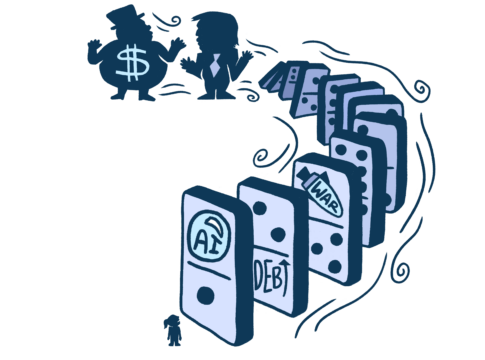
War, debt, inflation, climate related disasters, and a massive speculative bubble, all in the context of a new era of protectionism, deglobalization, and inter-imperialist (primarily US-China) conflict resemble a set of shaky dominoes. If one of them falls, it could knock down the others with devastating consequences.
Every single one of these problems is the product of a decaying crisis-ridden capitalist system. They are certainly not the result of unfolding “natural” processes. Let us look at the different factors, how they have evolved, and how they interconnect.
The War With Iran
When the US war on Iran began late in February, it led to the effective closing of the Strait of Hormuz, which previously was used to ship 20% of global petroleum and liquefied natural gas supplies.
The price of crude rose sharply, but predictions that it might reach $150 or $200 a barrel, which would tip the world economy into recession more or less immediately, did not materialize. The key reason was that major countries—including the US but especially China—drew down their massive reserves. China effectively stopped buying oil for a whole period. These moves were motivated by self-interest and certainly not altruism by the countries involved, but they did help to keep lower supply from driving the price of oil far higher.
However, this has a definite limit. The US strategic oil reserve is now at a 40-year low, China has recommenced oil imports, and the widely reported (and extremely naive) assumption by many commentators that things would be “back to normal” by September is going up in smoke. If remaining reserves are used up or even come close, oil will quickly reach $150 dollars a barrel or higher, and the world economy will again be pushed towards recession.
Moreover, far from offering hope of a rapid respite, both sides have stepped up military action in recent weeks. While fighting has not reached the level of the early stages of the war, it has included attacks on tankers which has brought the partial resumption of traffic through the Strait to a halt.
Even more ominously for the world economy, the conflict between the Yemeni Houthis and Saudi Arabia has exploded once more. Rapidly-advancing Houthi forces, which in August pledged to close the Bab el-Mandeb Strait to Saudi exports, have seized new territories and strategic islands at the opening of the Strait.
This is another major chokepoint for oil transiting from the Gulf, through which another 9% of global oil shipments pass. Its closure would prevent oil shipments bypassing the Persian Gulf and the Strait of Hormuz via pipeline to the Red Sea and then to destinations in Asia. This has been a lifeline for the battered Saudi energy industry. To add insult to injury, this pipeline was knocked out of service recently, allegedly by drone attacks from Iraqi territory. The price of crude is predictably rising rapidly, and at one point reached $110 a barrel.
Bond Markets & Debt
In recent weeks, financial analysts have spent a lot of time discussing the state of the bond markets. This is where governments finance their debt by selling bonds on which they pay interest to investors. The bond markets are central to the overall functioning of the capitalist financial system.
There has been a rapid rise in yields (the payout when bonds are sold) on government-issued bonds in the US (also called Treasuries) but also in other key capitalist countries including Japan, Germany, the UK, and France. In mid-September, the yield on the 30-year US Treasury bond reached its highest level since 2007 while the yield on 10-year bonds in Germany and the UK were also nearing 20-year highs. Twenty years ago, of course, was the eve of the 2008-9 financial crisis and global recession that had devastating consequences for tens of millions in the advanced capitalist countries as well as in large parts of the neocolonial world.
Several factors have led investors to demand a higher rate of return (the yield), which they express by selling off bonds. Inflation means returns will be lower, and persistent inflation bodes badly for even longer-term bonds. The Iran war is a key driver of inflation, spiking not just energy costs but all manner of goods transported by diesel. Historically, US Treasuries, which fund US debt, are seen as an extremely safe investment, but this may be changing. This is connected to the massive growth of state debt. This loss in confidence in the US means investors want a higher risk premium. Trump’s promise to pay out $5,000 to every US citizen if the Republicans win the midterm Congressional elections in November, and thereby add another trillion dollars to the US debt, is certainly not helping to calm the investors.
The yield on the 10-year Treasury is the benchmark for interest rates on mortgages, student loans, car loans, and much more. The rise of yields will drive up interest rates and make borrowing more expensive for governments, businesses, and ordinary people. In turn, this can push up rents, trigger layoffs, and lead to more cuts to social services.
While the market sets long-term interest rates, central banks like the US Federal Reserve set short-term interest rates. They will now also be under pressure to raise rates. The European Central Bank, for example, has already begun to do so. And despite Trump’s damnedest efforts to stop it, the Fed has now followed suit, raising rates for the first time since 2023—under the leadership of Trump’s own new hand-picked Fed chair, Kevin Warsh.
Scott Bessent, Trump’s Secretary of the Treasury, meanwhile, has orchestrated several attempted interventions to prop up the US bond market. This included pouring billions into the markets to backstop the Japanese yen. This was because of the fear that Japan, which is the biggest state holder of US Treasuries, would have to sell them to protect the value of their currency which is under pressure. Dumping even more Treasuries in the market would contribute to the upward pressure on yields and interest rates. All of Bessent’s interventions have failed.
The Growing Debt Crisis
The astronomical US debt—which just surpassed $40 trillion and represents 125% of GDP—is unprecedented in the US outside of World War II. That wartime debt was then largely paid off during the postwar economic boom. Contrary to the claims of the bourgeois “deficit hawks” who blame spending on social security/benefits, this debt mountain was overwhelmingly racked up during the bailouts of the banks after the crash in 2008 and further massive bailouts/stimulus during the COVID crash. It was also exacerbated by Trump’s two tax cuts for the rich in 2017 and 2025.
But the problem of debt is truly global and reflects the further decay of capitalism. As we recently pointed out, “Twenty years ago total world debt was $32 trillion, but after the 2008 recession and the pandemic, it now stands at around $350 trillion.” This includes corporate and consumer debt as well as government debt.
Higher interest rates combined with bigger state debt means higher interest payments for governments, cutting into funds available for all other areas. The US interest payment is estimated to be $1 trillion this year alone.
Of course Trump, the EU, and Japan will not be cutting into military spending which just keeps growing. Trump wants $1.5 trillion for the flailing US military in 2027. Hundreds of billions have also been committed to ICE’s domestic campaign of terror against the immigrant population. Meanwhile, there have been huge cuts to the US government’s food assistance program (SNAP) as well as Medicaid, two social programs vital for millions of Americans. Austerity is on the agenda in Europe and Japan as well.
As long as inflation and interest rates were low, racking up debt could be presented as largely a non-problem. This was the argument of liberal economists like Paul Krugman and proponents of Modern Monetary Theory. But since the end of the era of neoliberal globalization, and particularly since the beginning of this decade, we have entered a phase of higher inflation and interest rates making massive debt a much more serious fiscal problem.
In one extreme scenario, a fiscal or “debt spiral” can develop, a self reinforcing “economic doom loop” of higher interest payments and decreasing confidence among investors, which then drives even higher rates leading to even higher interest payments.
The AI Bubble
This brings us to arguably the biggest domino of all, the massive speculative bubble that has developed around artificial intelligence and the American Big Tech companies.
The scale of the bubble has been estimated by some analysts to be four times the scale of the sub-prime mortgage bubble in the US housing market, whose implosion triggered the 2008-9 global recession. AI-related stocks—particularly the “Magnificent Seven” of Amazon, Apple, Google, Meta, Microsoft, Nvidia, and Tesla—are responsible for the bulk of stock market gains and at least one third of GDP growth in the US this year.
No serious person denies that the valuations of tech stocks are anything other than ludicrous. Nvidia alone is valued at $5 trillion, roughly the equivalent of the GDP of Germany. As William Dalrymple put it, comparing Nvidia to Britain’s East India Company in the heydey of the British empire, “Only the US and China have gross domestic product greater than this one company’s market capitalization.” Initial public offerings by Musk’s SpaceX and soon Anthropic are only adding fuel to the fire.
What is most astonishing is Big Tech’s massive buildout of data centers. Goldman Sachs recently estimated that one trillion dollars is being invested this year alone, $581 billion of that in the US, and $439 billion in the rest of the world. At the current pace, by 2030, seven trillion could be spent globally on data centers (Financial Times, 8/27/26). Again, while it can be truly said that the US economy has become “one big bet on AI,” the scale of data center construction in other countries shows how this industry and the speculative bubble that has developed around it has also become crucial for the world economy as a whole.
Why have we had this series of speculative bubbles including the dot-com bubble at the turn of the century, the housing bubble in the 2000s, and now the AI bubble? Of course speculative bubbles or “manias” are nothing new in the history of capitalism. The underlying reason for what is happening today is the massive accumulation or “overaccumulation” of capital during the era of neoliberal globalization, which is unable to find a profitable outlet in other sectors. This has resulted in speculation on an epic scale—fueled by the giant casino of financial markets—in assets like housing or AI technology, which has still not generated significant profits for its makers or its users.
The next phase has been reached in the bubble’s development as banks and Big Tech companies themselves (despite their own enormous capital) are now trying to spread the risk from these massive investments. This involves various creative approaches.
Instead of the derivatives market as in the 2000s, this time it is private equity and the unregulated “shadow banking” sector that are at the center of risk. However, “regular” banks and ordinary people’s money, including in pension funds, are also heavily committed.
Data center leases are being turned into securities and sold in “tranches” to spread the risk. Nikkei Asia reported on July 21 that “Five US tech giants’ hidden debts soar to $1.65 trillion on opaque AI funding.” This does not appear on their balance sheets because of the use of methods like long-term lease agreements and therefore must be added to the $1.35 trillion of debt that does appear on balance sheets.
This is now also a factor in the selloff in the US bond market because the rapidly expanding market for AI debt (with a higher rate of return) is a massive gravitational pull of investors away from Treasuries. In this, we see how connected all parts of finance now are to the AI bubble.
What Happens Next?
These “creative methods” are extremely reminiscent of the methods used by the banks at the heart of the subprime bubble twenty years ago. This quote from an article on the “AI debt binge” in the New York Times is also very reminiscent:
“Last year, analysts at Barclays, the British bank, collected a string of unsourced quotes from an A.I. data center conference they attended, which ranged from ‘enjoy the ride on a rocket without seatbelts’ to the ‘best way to describe the market is bonkers.’”
What will burst this bubble? Ruchir Sharma recently made this observation in the Financial Times:
“Going back 300 years, every major bubble ended only when borrowing costs rose significantly for the companies at its core, including the serial railroad busts of the 1800s. In the last century, the era of modern central banking, all big bubbles popped after central banks sharply raised their short-term lending rates.”
Hence, the sharp increase in borrowing costs being presaged by the spike in yields on the bond markets, if it continues, could indeed be what leads to the bursting of the bubble. And while US big tech is far ahead of Chinese competitors regarding the most advanced AI models, there has been very little evidence so far of significant profits from integrating AI technology into the real economy. This too can undermine the bubble at a certain stage.
This is to say nothing about the potential for AI to destroy whole areas of employment, which would also trigger market collapse, given the key role of consumer spending in the US and other economies. In recent days, other dangers related to AI have come to the forefront of media attention, after an Anthropic employee resigned and came forward saying that AI would have the capacity to destroy humanity by the end of the decade.
There is no doubt that, as part of its own campaign of relentless self promotion, Big Tech has deliberately exaggerated both the potential benefits and dangers of this technology. However, what is also clear is that the mad dash to “win the AI race” between the Big Tech companies and more crucially, the competition with Chinese imperialism, has created a situation where these companies don’t understand many aspects of the technology they’ve created. We don’t have to believe that AI can destroy humanity within months to see that under capitalism it will be used to augment weaponry, contribute to climate destruction and pose a threat to whole sectors of employment.
A major incident, like the recent hacking of the company Hugging Face by AI “agents” acting unbeknownst to the company that owns them (Open AI), but with worse consequences, could also be the trigger by fatally undermining the industry’s credibility. Meanwhile, Trump incredibly claims that any attempt to slow down AI development is a treasonous plot and that all that the only regulation that is needed is a “a STRONG AND SMART (High IQ!) PRESIDENT.”
Is China An Exception?
In some ways, the situation in the Chinese economy seems different to what has been described here. The Chinese bond market for example, looks the exact opposite of the US, as “Japanification” and deflation flatten economic growth, with Chinese bond yields for the first time ever falling below Japan’s. Despite the Chinese AI industry—which operates largely based on “open source” technology (which the US alleges it has skimmed from their companies)—comprising a much bigger state-driven share, China is experiencing an AI bubble of its own, with different features (massive overproduction and waste) which reflect the different structure of US and Chinese capitalism.
China’s economy has been in a deflationary phase in contrast to the other key economies. This is the result of the bursting of a massive bubble in the country’s property market at the start of this decade followed by the crisis of local government finance based heavily on housing construction which had played a key role in driving overall investment. The Chinese dictatorship is creating new financial bubbles in its attempts to revive growth, channeling huge sums into the “new productive forces,” clean energy and AI, sectors which now face all the same basic features as the property market prior to its collapse.
This long term deflationary trend—comparable but worse than what Japan experienced in the last 30 years—like the speculative bubbles in the US is the result of overaccumulation, but here mostly taking the form of massive overproduction. China is also saddled with a worse total debt-to-GDP ratio—over 300%—than any other major economy. The results of overproduction and deflation domestically have been mass unemployment as demand has cratered and one round after another of wage cuts for those lucky enough to still have a job. The response of the CCP regime has been to promote a massive export drive to prevent an outright economic slump . This—alongside Trump’s endless tariff war against the world—has contributed to protectionism internationally but has not resolved Chinese capitalism’s underlying problems.
Therefore, while Chinese capitalism’s divergent features mean that its own historic crisis is not reflected in the same way, in broad terms the Chinese economy’s serious problems are a specific and analogous form of the same underlying contradictions of contemporary capitalism and an anticipation of the looming world crisis.
Climate Crisis & The World Economy
We have now entered perhaps the most severe El Niño since the 19th century. El Niños are a cyclical phenomenon that arises from changes in wind patterns and an increase in surface water temperatures in the Pacific Ocean. On top of record warming, El Niños can result in heavy rains, flooding, and landslides in some areas while others experience intense droughts.
Droughts from Europe to Africa and Australia have already been a feature of 2026, alongside massive wildfires in the Northern Hemisphere. Drought conditions have also forced the further restriction of traffic through the Panama Canal. Severe and simultaneous drought in several major grain-producing regions could lead to much more serious problems related to global food supply, precipitating mass hunger and potential revolts.
This is exacerbated by the effects of war and blockades. The blocking of the Strait of Hormuz led to a surge in the price of fertilizer, fuel, and cooking oil. There has also been a near-total collapse in the export of grain from Black Sea ports due to the four-year-long war in Ukraine.
The World Food Program is now warning that by the end of 2027 the number of acutely food-insecure people (defined as a sudden, severe lack of food that puts a person’s life or livelihood in immediate danger), concentrated in a set of countries which includes a number wracked by war, could rise to 274 million.
In a functioning global economy, drought in some regions could be mitigated by distributing surplus food and reserves from regions with good harvests. But capitalism is incapable of sustained international coordination and planning, much less so in today’s increasingly deglobalized world. In 2021, during the height of the pandemic, as there was a race to produce vaccines, instead of international cooperation, we had the spectacle of “vaccine nationalism.”
Trade War & A World Without Cooperation
The world today, characterized by growing inter-imperialist conflict, protectionism, and deglobalization, not to mention the rise of authoritarian reactionary regimes, bears many resemblances to the 1930s.
The US, while still the most powerful imperialist power, no longer plays the role of hegemon or “regulator” of the world capitalist system as it did from World War II through the 2010s. This regulating role included the IMF and the World Trade Organization. Trump instead has launched a permanent trade war against friend and foe alike while the US abandons alliances and treaties.
No one should idealize or be nostalgic for the US-led world order of the postwar period or neoliberal globalization, which meant the brutal subjugation of the bulk of humanity to the interests of American capital. But the new era of capitalism has real consequences for the managing of crises. In 2008-9, Barack Obama was able to appeal for assistance from other capitalist powers, including China, in containing the fallout from the meltdown of financial markets. China, as we pointed out then, was the engine that pulled the world economy out of the ditch. But again, in the next global financial meltdown, we are more likely to get a version of 2021’s “vaccine nationalism” than 2008-style “cooperation.”
As economic historian Charles Kindleberger put it in relation to the Great Depression: “The world economic system was unstable unless someone stabilized it, as Britain had done in the nineteenth century and up to 1913. In 1929, the British couldn’t and the United States wouldn’t. When every country turned to protect its national private interests, the world public interest went down the drain, and with it the private interests of all.” (The World in Depression, 1929-1939, p. 9)
Meanwhile, Trump ramps up a trade war with Canada. This is only the latest episode in his campaign to use tariffs as a cudgel to beat other countries into compliance with his version of US interests. However, as the whole world can see that US imperialism is in irreversible decline amidst the Iran debacle, this cudgel is proving less effective than after “Liberation Day” in April 2025. Canada’s Prime Minister Mark Carney has apparently decided to defy the mad despot to his South and continue up the escalation ladder.
But while much has changed in the world to make it an even more dangerous place, what hasn’t changed is that the ruling class will try to make the working class pay for the crisis of their system. After 2008, the American banks were bailed out to the tune of hundreds of billions while millions of ordinary people lost their jobs and their homes. In Greece’s subsequent debt crisis, the Greek masses were pauperized to make sure the payments to German and French banks kept flowing.
The skyrocketing cost of living is already driving unrest around the world, with fuel protests breaking out in country after country from Portugal, to Guatemala, to Syria. The massive protests against the Trump regime over the last year and a half show the potential for struggle to erupt in the US at an even higher level. When the AI bubble bursts and the government—whether Trump or his successor—moves to bail out Big Tech, the fury in society will be unprecedented. Big tech, its data centers and its AI slop, are already despised. The question is how to harness the indignation to stop such a bailout and bring Big Tech and finance under the control of society. Crucially, it will require the social power of the working class. The only alternative to this crisis ridden system and its existential threats is an international planned socialist economy democratically run by the working class.