

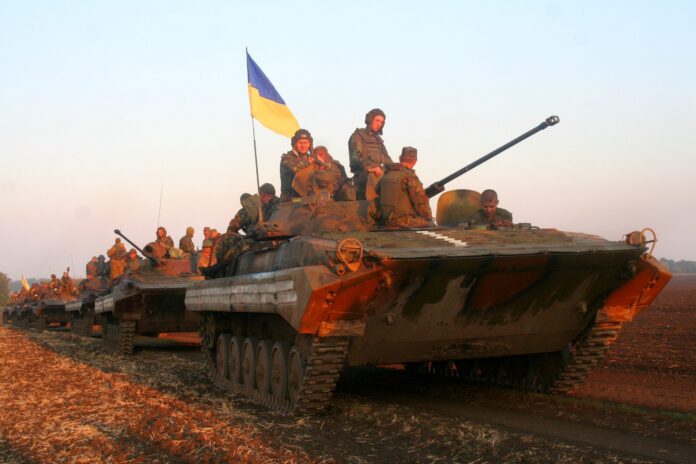
A fifth devastating winter of war awaits Ukraine. At the same time, the war is escalating and claiming more and more victims.
This year, the number of civilian casualties in Ukraine has been dramatically higher than in any other year since Russian imperialism’s invasion of the country began in February 2022. At least half a million—or as many as 700,000—Russian soldiers have been killed in the war, and approximately 150,000 Ukrainian soldiers have lost their lives, according to the latest reports.
In recent months, US imperialism has attempted to broker new negotiations leading to a ceasefire. According to the Financial Times, “The Trump administration has told European and Ukrainian officials it wants Kyiv to reach a peace deal with Russia by early January, before Democrats take control of Congress.”
But a ceasefire is still a long way off, and peace even further. The intensified attacks have also included targets beyond Ukraine’s borders. The Baltic Sea has become one of the war’s battlefields, and in November, the war reached Libya’s coast when the Russian missile corvette Merkurij was sunk by Ukrainian naval drones. In the days leading up to this, Swedish Gripen fighter jets, among others, participated in a NATO operation in Polish airspace after the Polish government reported that two Russian cruise missiles and a drone had struck its territory. If this escalation continues, it could spiral out of control and thwart all attempts to end the war at the negotiating table.
Escalating attacks must be viewed in the context of both Russian imperialism—which feels emboldened by the growing rift between the Trump administration and European imperialism—and the Ukrainian government, each attempting to gain the upper hand on the battlefield to strengthen their position at the negotiating table.
The war in Ukraine has provided a harrowing glimpse of how future wars will be fought. Electronic warfare and lethal unmanned drones equipped with AI-driven guidance systems—recent reports also claim that drones controlled entirely by AI systems have been used—are combined with meat-grinder battles in which thousands are sacrificed daily. Cities and villages are reduced to ruins, without the front lines fundamentally shifting.
For a long time, fierce fighting has raged in the city of Povkrosk in Donetsk, eastern Ukraine, and neighboring villages. Before the war, the city had just over 60,000 residents; today, fewer than 1,500. Up to 90% of the city’s buildings lie in ruins, and all public services have collapsed. And there are many Povkrosks in Ukraine today.
However, there is no indication that a decisive turning point is on the horizon in the war. Despite appallingly high death tolls, especially this autumn, Russian imperialism retains control over approximately one-fifth of Ukraine’s land area, including the Crimean Peninsula, which it annexed in 2014.
Ukraine’s Stockpiles Showing Strain
Although Ukrainian attacks are hitting an increasing number of targets in Russia and have knocked out nearly one-third of Russia’s total oil refining capacity, this cannot hide the fact that the Ukrainian air defense is finding it increasingly difficult to withstand Russian drone and missile attacks.
This is partly a result of a growing shortage of Patriot missiles. The war against Iran has depleted US stockpiles of Patriot missiles. According to estimates from the Center for Strategic and International Studies (CSIS) in November, US forces fired approximately 1,596–1,697 Patriot interceptor missiles in the war against Iran, which amounts to more than two-thirds (68%) of the original stockpile before Trump and Netanyahu launched their war. It will take at least three years to replace them, and the Patriot missiles delivered to Ukraine this year are only a fraction of previous deliveries.
“Moreover, the need is enormous. According to Carl-Magnus Haig, a professor at the Department of Defense Systems at the Swedish National Defense College, the entire global annual production of Patriot missiles would be roughly consumed just to counter the ballistic missiles that Russia is firing at Kyiv” (Sweden’s TV4 News on August 12). The shortage has also contributed to the Trump administration becoming even more inclined to withhold and/or delay deliveries of the Patriot missiles ordered and paid for by other NATO countries.
According to Zelenskyy, US deliveries of Patriot missiles to Ukraine have decreased by 75–80% this year, and it remains unclear how much of the most recent order—for 500 Patriot missiles agreed upon in October of this year—will be delivered and when.
But fewer Patriot missiles aren’t the only reason. “Since the last weeks of the summer season, jet-powered Russian attack drones have begun appearing in large quantities over Kyiv and other Ukrainian cities. These jet drones have succeeded in transforming the air war, handing Moscow the initiative and sending Ukrainian defense tech developers scrambling for solutions…
The aerial drone contest is now entering a new phase with Russia holding the strategic edge. Ukrainian President Volodymyr Zelenskyy acknowledged in late September that while Ukraine was able to intercept around 90 percent of propeller-driven Russian drones, the country was only managing to stop just over half of the new jet-powered models”, wrote the conservative American think tank Atlantic Council on October 8 of this year.
At the same time, Ukraine’s ability to mobilize more troops is dwindling. “Ukraine has always had fewer soldiers than Russia, but now that the war is entering its fifth year, the need for personnel is becoming increasingly acute, according to commanders and analysts, and some units have only half their normal strength. There simply aren’t enough forces to fully exploit the battlefield advantages offered by drone innovations. ‘With the equipment and number of soldiers we have today, it’s barely enough to hold the sector we currently control,” says a deputy commander of the Da Vinci Wolves battalion in the Pokrovsk area of eastern Ukraine, which is a focal point of Russia’s offensive’” (Washington Post, October 8).
Trump’s Power Play
The Ukrainian government’s mounting difficulties in continuing the war, coupled with the looming hellish winter against the backdrop of an ever-deepening humanitarian and economic crisis, are now being exploited by US imperialism to try to force Ukraine into ceding territory to Russia at the negotiating table. The Trump administration’s blackmail also includes restricting Ukraine’s use of the military version of Elon Musk’s Starlink, known as Starshield, withholding promised multibillion-dollar aid, and threatening to stop selling more weapons to Ukraine.
Behind the Trump administration’s cynical power play lies a desire to do even more “business” with Putin and Russian imperialism. The fact that Putin was also rewarded with a seat at the same table as Xi and Trump at the APEC meeting in Shenzhen was yet another part of this effort. This summit—which, among other things, discussed a new “security order” for Europe and decided to increase the supply of refined oil products—also sent a clear signal to European governments that they will remain on the sidelines. In the so-called trilateral talks between the US, Russia, and Ukraine held in Abu Dhabi in November, Europe’s representatives—a group of officials from the United Kingdom, France, Germany, and the EU, along with a NATO general—were relegated to a side room.
This is despite the fact that it is now European imperialism that is primarily footing the bill for the war (the Swedish government’s military aid to Ukraine alone totals 129 billion kronor—over 12 billion USD) and will be expected to pay for Ukraine’s reconstruction. European imperialism, however, can still not replace American imperialism when it comes to arms deliveries, signals intelligence, and satellite support.
Any potential concession to Putin regarding territory—even if it were to mean that the Putin regime gives up its opposition to “security guarantees” for Ukraine—would thus constitute a further setback for European imperialism, which is already under severe pressure. European governments have viewed the operations in Ukraine as both a means of asserting their position on the world stage and of buying time for their own war preparations.
But time is running out, and the war in Ukraine is becoming increasingly costly. The more distant a decisive turning point in the war becomes, the more European imperialism is forced to begin strengthen its Eastern front, both in terms of military installations and rampant warmongering about the threat from Moscow. At the same time, the outcome of the war will be used as an excuse to further accelerate the pace of military buildup and joint war preparations.
The war in Ukraine was the first war since the fall of Stalinism in 1989–91 to directly or indirectly involve all of the world’s great imperialist powers—in its essential character, a proxy war. The same imperialist powers that have been involved in the war are now trying to bring it to the negotiating table and reach an agreement based on the new borders drawn by the battlefield. All of this is happening over the heads of the masses while the war escalates, which could derail any ceasefire agreement.
A ceasefire, if it were to be achieved, would of course be welcomed by ordinary people around the world—but there should be no illusions that it would mean peace or a free Ukraine. Rather, the country would come even more firmly under the control of Russian and Western imperialism, respectively, with the constant risk that tensions between the imperialist powers could lead to new wars.
The only way to guarantee peace is by building an international movement against all imperialist powers and the capitalist system driving them into conflict for the division and redivision of the world. A strong anti-war movement outside the combatant nations, standing in solidarity with the working class in both Russia and on both sides of the conflict, would be a powerful boost to anti-war and revolutionary ideas within both Russia and Ukraine.