

Rob Darakjian is a letter carrier in NALC Branch 2902, writing in personal capacity.
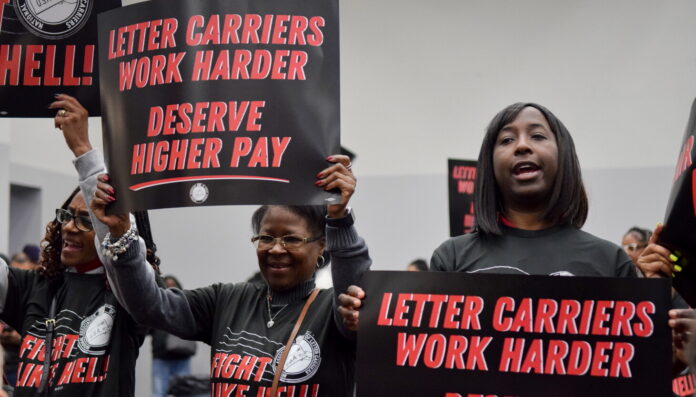
In October, the old guard of the National Association of Letter Carriers (NALC) was ousted from power by the opposition slate Concerned Letter Carriers (CLC). James Henry, a former member of the national Executive Council, and Corey Walton, host of the popular “From A to Arbitration” podcast, will now lead the NALC. This comes at a critical time, with the Postal Service facing a host of proposed cuts and contract negotiations stalling. Henry received 23,077 votes against 18,009 votes for establishment candidate Nicole Ryan, with 12,327 votes going to independent reform candidate Mike Caref, who had previously collaborated with the CLC. While turnout remained low in absolute terms, with only about 21% of letter carriers casting a vote, this election saw a sharp increase in the overall vote. The 2026 election represented a 50% increase in turnout compared to 2022, when former President Brian Renfroe was elected.
This marks the first time an opposition grouping has won the leadership of the union since Vincent Sombrotto, the widely recognized rank-and-file leader of the 1970 postal wildcat strike, came to power as president in 1978. While the labor movement as a whole is much weaker now than then, this election, like in 1978, presents an opportunity for the anger of the union rank and file—who are tired of the results of the “same-old, same-old” conservative business unionism—to be channeled into organization. The new leadership team should move to organize the tens of thousands of letter carriers who are energized by this election victory by turning the Concerned Letter Carriers from an electoral banner into an internal union caucus that is democratically run and organized.
How We Got Here
It is hard to overstate how bad Brian Renfroe’s presidency has been over the last four years for the average letter carrier. During his tenure, the COVID-19 pandemic and soaring inflation created an expectation that letter carriers would receive a substantial pay increase. In August of 2022, UPS Teamsters under the leadership of Sean O’Brien carried out a contract campaign and near strike that won substantial wage increases and the elimination of the two-tier pay structure, among other gains. In September 2023, the UAW under Shawn Fain launched the “Stand Up Strike,” which won autoworkers a 25% pay increase. Naturally, letter carriers watched these developments with hope that they would see similar pay increases coming out of their own contract negotiations. However, while Fain and O’Brien were leading relatively strong campaigns and Starbucks and Amazon workers were engaging in heroic fights to win union recognition, Brian Renfroe sat on his hands.
An internal union investigation alleged Renfroe to be guilty of absconding with union funds to pay for expensive holidays, dereliction of duty by driving an NALC vehicle while drunk, and bullying female union staff at national headquarters. Despite this, the national Executive Council voted to absolve him. At the same time, contract talks dragged on, with letter carriers left completely in the dark. Not even members of the Executive Council claimed to know what was happening, as Renfroe “bargained” with the Postal Service allegedly on his own! It was in this environment that a group of letter carriers came together across the country, in a grouping that would henceforth be known as Build a Fighting NALC (BFN).
The Birth Of A Reform Movement: BFN & CLC Take Shape
In late 2023, rank-and-file letter carriers in Minneapolis passed a resolution at their union local to demand open bargaining, meaning full transparency and regular updates from the national bargaining team on the state of contract negotiations. BFN had an organized chapter in Minneapolis. The letter carriers there understood that passing a local resolution would not be enough, but that if it caught on, it could serve as an organizing tool across the country. It was the right demand at the right moment. This resolution became the basis for a national campaign that swept through the union. Organizing a series of monthly Zoom calls in the spring and early summer, Build a Fighting NALC brought hundreds of letter carriers together from across the country. The open bargaining resolution was passed in over 44 NALC branches and state associations. BFN did not stop there. A national coordinating committee was formed that put forward a series of broader demands to organize around: an end to the two-tier pay scale which separated “non-career” and “career” employees, $30 an hour starting pay, an end to mandatory overtime, for union officers to take the wage of an average worker, and most importantly, for the union to take up the right to strike.
Parallel to the development of BFN, a grouping of existing union leaders began to discuss and formulate a leadership slate to challenge Brian Renfroe in the upcoming union election. This included members of the Executive Council who disagreed with Renfroe’s approach, as well as shop stewards, branch presidents, and rank-and-file union activists who coalesced around longtime union militant Corey Walton and his increasingly popular “From A to Arbitration” podcast. In a union where little is discussed in official union branch meetings other than routine business, Walton’s podcast appealed to letter carriers who sought advice on how to enforce the contract and provided deeper political commentary on the way forward for transforming the NALC. This was the basis of the Concerned Letter Carriers. While initially hesitant to embrace a broader program, and opposed to fighting for the right to strike, the CLC worked collaboratively with BFN in the period between the Open Bargaining Campaign and the 2026 National Union Convention.
BFN and CLC both began to attract first hundreds and then thousands of letter carriers interested in fighting back against Renfroe’s do-nothing regime. Under intense pressure, the National Executive Council conceded the open bargaining resolution at the 2024 union convention. In October, the long-awaited contract was put to the members for a vote. It consisted of a pathetic 1.3% pay increase, no elimination either of the non-career “City Carrier Assistant” (CCA) position or the two pay scales, and concessions given to management on work rules. Build a Fighting NALC took the lead in organizing a national “Vote No” campaign, encouraging letter carriers to meet in parking lots and break rooms to actively discuss the details of the contract and to pose for “Vote No” solidarity photos. Dozens of these meetings were immediately publicized on social media. At its height, this rank-and-file revolt against the contract brought over 600 letter carriers together on a national Zoom call. All of this without the official union leadership lifting a finger in support!
Ultimately, the contract was rejected by a majority of letter carriers in a historic vote, but was imposed anyway through the byzantine arbitration process whereby three “impartial” mediators decided all the details with no input from workers. Unsurprisingly, Renfroe and the old guard leadership did nothing to build any kind of movement to put pressure on the Postal Service. Thousands of letter carriers had become organizers in their workplaces around the contract battle, but were at risk of becoming deflated by this outcome. Naturally the question arose—what now?
The Election & Its Aftermath
In 2025, James Henry, Corey Walton, and other proposed members of the CLC slate began touring the country to make their case against the rotten Renfroe leadership. Their support grew as they adopted more of the demands that had attracted letter carriers to BFN. The CLC toured the country declaring their support for $30 an hour starting pay, the elimination of the two-tiered wage system, and a fighting approach to enforce the contract. Several months out from the election, they were calling for everything BFN had put forward except a commitment to fight for the right to strike. Thousands of letter carriers—many who had urged their coworkers to vote “no” on the previous contract—now donned black and yellow CLC merchandise and convinced their coworkers to vote CLC.
Now that the CLC has won, they carry a massive responsibility on their backs. Come January, the new leadership of the NALC will be in office and take over the ongoing contract negotiations. Now is the opportunity to prove to the membership that supported them what a fighting union can be. National contract rallies should be planned now for the beginning of the year. The CLC should move from an electoral slate to a permanent caucus, where program, strategy, and actions are discussed and carried through democratically.
In the arena of electoral politics, letter carriers, like working-class people more broadly, have seen candidates promise the moon and then disappear into the halls of power. It is crucial that the new leadership finds its way to sink roots among the rank and file, which will mean bottom-up organizing through mass meetings and rallies. A core part of this battle will need to be fighting for the right to strike, which will be the only way to win any serious gains for letter carriers. With a new Democratic Party majority sweeping both houses of Congress in November, and with the viciously anti-union Trump regime on the back foot, it is time to strike while the iron is hot. The CLC should demand of these new Democrats that letter carriers, as well as all federal workers, be granted the right to strike.
The NALC has suffered from decades of defeat and decay. We have to be clear-eyed about the opponent we’re facing. The Postmaster General has already threatened more cuts in testimony to Congress. Truly transforming the union into a fighting democratic organ that can not only defend against attacks from the Trump administration, but eventually go on the offensive, will require a highly engaged, well-educated, and organized membership.