
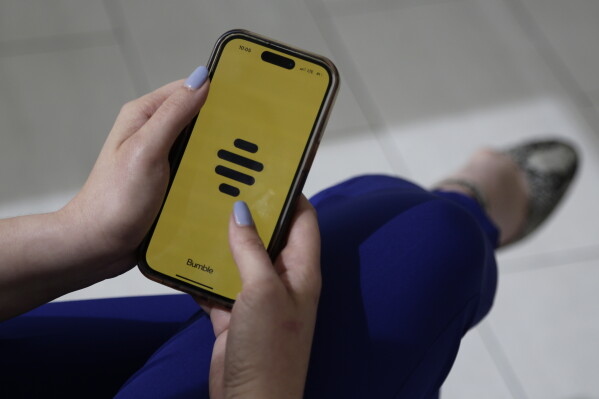
If you’re anything like nearly a third of adults in the US, you’ve plunged into the depths of a sea of dating apps in pursuit of connection, maybe even love. This is doubly true for queer people, who have reported using dating apps at almost twice the rate of their straight peers.
This technology sells us a vision of convenient dating that we can fit into our busy lives, with seemingly limitless profiles at our fingertips. Online dating promises to help us overcome a multitude of obstacles to dating in modern life: whether that’s the struggle to rebuild your social life after moving to a new city for school or work, the isolation of working from home, or the disappearance of “third spaces” for socializing. They have also become a way to explore one’s sexuality: over half of young LGBTQ dating app users have reported coming out on a dating app before telling their friends or family.
Despite the popularity of dating apps, we’re lonelier than ever. Terms like “loneliness epidemic” and “dating recession” have been thrown around to describe the sorry state of our social lives. Over two-thirds of young adults in the US report that they have gone on either no dates or only a few in the last year.
Dating apps didn’t cause our isolation, but they’re not necessarily making us feel any better. Users increasingly report dissatisfaction and even burnout—78% of respondents in a 2025 survey said they’ve felt emotionally, mentally, or physically exhausted by dating apps. The experience of swiping on the apps can feel utterly dehumanizing, more like a validation slot machine than a way to connect with the person behind the profile.
We’re being sold something alright. Rather than a tool for genuine connection, it’s a product designed to exploit your loneliness in order to make money for the investors in the multi-billion dollar dating app industry.
It’s Not You, It’s The Algorithm
Hinge boasts that it’s “designed to be deleted,” but in reality all of these dating apps are consciously engineered to prevent meaningful matches. That’s because shareholders profit most when app users are single and desperate. Match Group, the company that owns roughly two-thirds of all dating apps including Tinder and Hinge, has even been sued for employing the same deceptive and coercive practices that online gambling sites use to keep people hooked.
Dating apps collect a tremendous amount of data: not just the info we list in our bios, but also our swipe patterns, how long we look at each profile, when and where we use the app, the content and length of all our conversations, and so much more. Predictably, companies sell this data to third parties. They also use it to keep people on their platforms for as long as possible and to compel users to shell out for paid features they once offered for free.
Dating apps use this information to determine when we will be feeling our most vulnerable, sending perfectly-timed notifications to keep us glued to the app and prompting us to pay to “boost” our visibility. Their algorithms determine which profiles we will be most interested in, conveniently displaying these just after we’ve reached the daily limit of free swipes. What price must one pay to get rid of these paywalls? Turns out that’s also dictated by an algorithm, fine-tuned to estimate just how much you’re willing to pay.
These companies’ prioritization of profits above all else isn’t just frustrating, it’s downright dangerous. In recent years there’s been a documented increase in violent sexual assaults that occurred after meeting someone through a dating app, platforms that often amplify sexism and capitalist gender norms. An investigation by the Dating Apps Reporting Project revealed how Match Group has utterly failed to ban serial rapists from its platforms and has resisted implementing safety measures due to concerns that this could impact the company’s growth.
It Doesn’t Have To Be This Way
Even before they were ruthlessly monetized, dating apps offered us a mere band-aid for a deeper societal wound. Capitalism makes it extremely difficult to organically form the sort of meaningful connections we crave. Dating apps are the product of a system that demands we “optimize” our lives in order to race up the relationship escalator and “settle down”—all in the interest of fulfilling capitalist society’s expectations of what our relationships should look like. The pressures to get married and raise kids (the next generation of workers to make profits for the billionaires) can feel inescapable because that’s precisely what the system wants. On top of that, we’re forced to squeeze our romantic lives—not to mention friendships!—into the limited time we get between the long hours, multiple jobs, and side hustles that the climbing cost of living demands of so many of us.
To fix dating, we need a fundamentally different kind of society. Imagine having the breathing room to pursue your hobbies and meet new people in your community without a tremendous sense of urgency to find “the one” in the few free hours you get between shifts.
A democratically-run planned economy which bases production on human need rather than the profits of a few would not only give us much more free time, it would also remove any sort of economic pressure to be in unsatisfying relationships, or to live with romantic partners when we’d rather live alone. Dating under capitalism can feel like a matter of life and death because we’re not paid enough to live. An economic system that guarantees everyone’s basic needs, and removes the material basis for oppression based on gender and sexuality, would pave the way for our relationships to become less transactional and more based on genuine desire.