

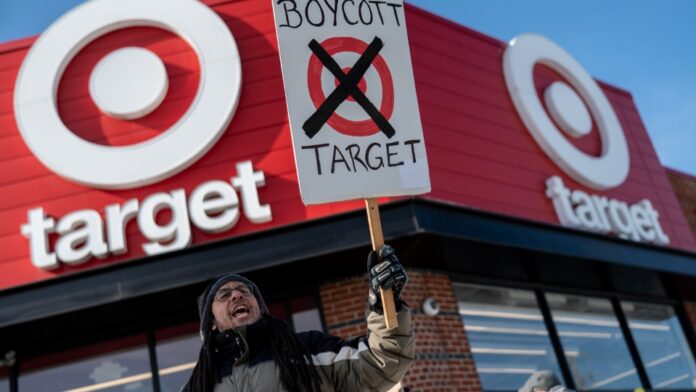
There is an increasing realization amongst ordinary people that Trump and his billionaire backers will not stop unless their profits are interrupted. The question is how to do that effectively. Over the last year, consumer boycotts that target major corporations like Target and Home Depot have gotten popular, particularly through viral social media posts. This is a welcome sign of ordinary people drawing connections between big business and their support of Trump’s right-wing agenda. But what role should boycotts play in struggle, and what are their limitations?
Boycotts Under Trump
Since Trump’s inauguration, an online campaign called The People’s Union has garnered significant participation in boycotts they dub “economic blackouts.” The stated goal is to tackle corporate greed and the rolling back of DEI programs by not shopping at a long list of corporations. Prior to the first economic blackout on February 28 last year, 16% of 1300 people polled said they planned to participate. Web traffic that day dipped 9% for Target and 5% for Walmart, but the boycott was partially neutralized by people simply shopping before or after the blackout.
While the boycott brought public attention to the complicity of these companies in Trump’s agenda, it did not disrupt profits enough to force significant concessions. Part of this limited participation is because as the cost of living goes up, working people are often forced to buy from these same major corporations, with few affordable choices to buy necessities.
While some boycotts take a targeted, one-day approach, others are simply a laundry list of companies to be blacklisted indefinitely, like the top-25 list of r/BoycottTheRight on Reddit. They often don’t have the organization for street, workplace, or campus-level mass mobilization, the kind that builds long-term activists to sustain a movement. This means that too often, viral boycott campaigns function more as private moral lifestyle choices to keep consciences clean but have no material impact in winning concrete demands.
Effective boycotts need to connect to the workers employed by the companies being targeted. Workers’ power to shut down profits is much more decisive than consumer boycotts alone, because they can stop the flow of goods and services before even reaching the consumer. For example, boycotting a massive company like Amazon without including its tens of thousands of workers means warehouses keep running. Furthermore, workers have greater organizing power: they’re smaller in number and far more concentrated than the millions of Amazon consumers.
We also need more coordinated organization, including spaces where workers can democratically discuss demands, strategy, and tactics. Without this, decisions are subject to the whims of unaccountable leaders susceptible to capitalist pressure. For example, when Atlanta Pastor Jamal Bryant abruptly declared the Target boycott over, a years-long effort led by primarily Black activists against Target’s rollback of DEI programs, he went directly over the heads of the activists involved before all demands were met, conceding instead on demands that appeal more to business owners than working people. His declaration only served to confuse and weaken the movement. These kinds of tactical decisions need to be made collectively, with a strategy to further organize consumers and bring more ordinary people into the movement.
Boycotts In History
Historically, the greatest boycotts succeeded because they were one part of a multipronged approach targeting corporate profits. Among the most important examples are the 1955 Montgomery Bus boycott against segregation, the 1960s United Farm Workers (UFW) grape boycott—launched to strengthen the Delano Grape Strike for union recognition, and the international boycott against apartheid South Africa. In each of these campaigns, workers played a central role, alongside robust on-the-ground organizing to build community support. For example, while boycotts played an important role against apartheid, the key to victory was a series of mass workers’ strikes that paralyzed industry in South Africa, including the three million-strong June 1988 general strike.
Former UFW organizer Stephen Lerner described what made the grape boycott successful:
“Support for the farm workers was intensely organized in city after city, neighborhood after neighborhood, churches and synagogues. It wasn’t just a general call for a boycott. We focused on building self-sustaining committees of supporters that could drive the work locally — the pickets, the actions, all that. It was a massive operation around the country, with thousands of active supporters and hundreds of full-time volunteers working on this.”
Without this approach, it’s virtually impossible for boycotts alone to defeat corporate power. Successful boycotts include clear targets, are well-organized, and are tied to relevant concrete demands.
The loss of historic lessons of working-class movements is rooted in the atomization of the working class through decades of neoliberal attacks. There are hopeful signs pointing to reversal of these trends, but it will require rebuilding a strong labor movement based on rank-and-file workers’ power to shut down profits.
Boycotts As Part Of A Wider Strategy
In Minneapolis, the day of “No Work, No School, No Shopping” on January 23 brought out tens of thousands of workers into the streets, spooking 60 CEOs into writing an open letter calling for deescalation. Shortly after, “Operation Metro Surge” was wound down, handing Trump his first major defeat.
Not only Trump, but the entire billionaire class can be defeated by hitting them in their pockets. But it will take a collective, democratically organized struggle with workplace action as its backbone.