

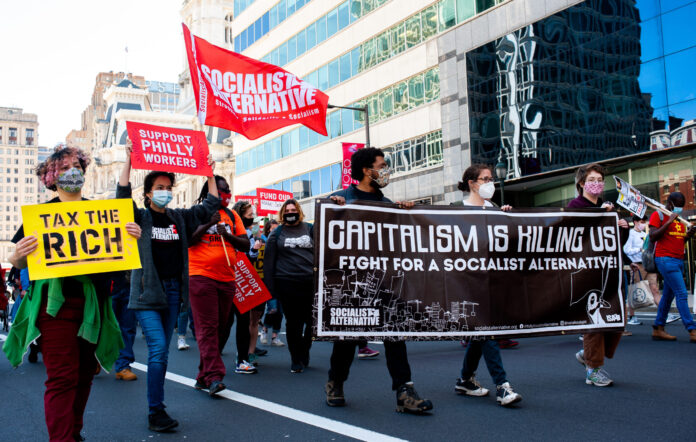
Wars, genocide, natural disasters. Unemployment, the rising costs of basic necessities like food and healthcare, sexism and racism. These are the hallmarks of the global economic system of capitalism in which working-class and poor people struggle—battling inequality, oppression, and scarcity.
According to a Gallup poll in the fall of 2025, young adults in the US generally—but particularly younger Democrats—are much less positive about capitalism than they were 15 years ago. Only 31% of Democrats under 50 have a positive view of capitalism compared to 54% in 2010. The same poll found that big business is also increasingly unpopular: only 37% of US adults have a positive image of big business, down from 49% in 2010. This tracks, as millennials and Gen Z have grown up during a global financial crisis, constant threats of recession, war, and COVID—crisis after crisis caused by runaway wealth inequality and billionaire sociopaths.
While megacorporations like Amazon work people to death and imperialist adventures in the Gulf are quickly descending into an out-of-control conflict, billionaires take celebrities to the moon and visit the Titanic. Forty-five new AI billionaires were identified in the Forbes 2026 list, with a collective wealth of $2.9 trillion.
The capitalist system threatens humanity across the planet. Because of its size and, most crucially, its relationship to production, the working class is best positioned to dismantle the horrors of our current system—and fundamentally the only force capable of building a new system based in socialist principles of equality and democratic planning.
Why Fight For Socialism?
The system we live under is not inevitable. Capitalism’s social structures and hierarchies are not rooted in human nature, despite what its ideological defenders hammer into us from birth.
Capitalism is a social and economic system which maximizes profit and wealth for the smallest section of society, which Marxists call the ruling class. Everyone who needs to work to meet their needs is part of the working class. Billionaires at the top consolidate their power through their corporate structures, courts, and legal systems, at the expense of the billions of us that actually produce and run everything.
While some individuals might climb the ladder from poverty to become part of the ruling class, most of the ruling class is already pretty entrenched, relying on generational wealth or social privilege. To build buy-in from the majority of people who keep the system going, capitalism relies on an expansive ideological and social structure that stokes the idea that climbing the ladder to extreme wealth is possible and that, until then, the struggles at our dead-end jobs are simply the natural order of things. The myth that any one of us might go from CVS cashier to become an Elon Musk bombards us daily at work, in entertainment, and on social media.
Clearly, with billions of people on the planet, we can’t all succeed and rise to the top. Therefore capitalism must stoke racism, sexism, and bigotry within the working class to ensure the majority doesn’t organize to take mass action against receiving only the crumbs from what we create, against imperialist war and the destruction of our planet. Divide and rule is a key hurdle we must overcome to build a new, socialist world.
Under socialism, we can collectively and democratically plan what our neighborhoods and workplaces look like. Democracy would be radically different; bosses would be replaced by workers’ councils that can meet to decide how to run our workplaces in the interest of providing service to our communities, not profits to shareholders. We can decide where we want clinics, grocery stores, coffee shops, and restaurants as opposed to food deserts or four Starbucks at the same intersection. By structuring society on the basis of meeting everyone’s needs, capitalist exploitation and oppression would melt away.
The system would still require a degree of representative democracy, but unlike Gavin Newsom, Nancy Pelosi, and Donald Trump, whose wealth and campaign contributions dictate how they vote, under socialism, elected representatives would take home the average wage of a skilled worker and not receive special privileges.
The Russian Revolution in 1917 is the closest example of what the working class can gain from a revolution that immediately aims to build a planned economy and genuine workers’ democracy. Against massive odds, the working class in Russia defeated a Tsar, and through the workers’ councils (known as soviets), overthrew landlordism, immediately eliminated sexist and homophobic laws, and began the economic planning needed to raise the living standards of millions.
But to defend their democratic workers’ state and all of these gains, socialist revolution needed to spread and win internationally. While the Russian Revolution inspired mass uprisings in its aftermath, tragically, no other revolution ended in victory. The Soviet Union became isolated in a capitalist world and degenerated as it struggled to survive.
Reform Or Revolution
In today’s reactionary world, there’s great pressure to fight for only the smallest gains we can get. However, the Trump administration’s cuts to the EPA, its attacks on civil rights, the Supreme Court’s overturning of Roe v. Wade, and other actions all show that past reforms we’ve won to improve our lives can be rolled back when the capitalist class decides they’re too much of an obstacle to their interests.
How should we fight this? By building mass social movements, strengthening our labor unions, fighting for our own political representation independent of the ruling-class parties, and taking to the streets to challenge every injustice. But we have to go further.
So long as we live under capitalism, a system that wasn’t built for us and isn’t run by us, we in the working class can’t simply legislate our way to a more just world, reform, or build a parallel structure to the system today. These efforts do not resolve the conflict between the ruling and working classes.
Some people believe that eventually there will be a final crisis of capitalism that results in its inevitable collapse. Families are being ripped apart by ICE in the US, millions have been murdered and displaced in Gaza—what does the worst of all worlds look like? These crises will continue indefinitely unless we fight for a revolution that can overthrow the whole system.
A Socialist World Is Possible
Our current era has features of revolution and counterrevolution. In Iran, mass movements shook the Khamenei regime before the US and Israel began their bombing campaign. The history of mass struggle shows that working people have the power to change society through building a multi-racial, multi-gender movement. These movements need an accountable, organized, working-class leadership prepared to withstand all pressures the ruling class brings to bear.
Revolutionary socialists fight to be wherever struggle develops, to push it forward and sharpen the demands of our movements, and to fight for a socialist world. This means fighting for the power to decide how we are organized, to meet our own needs, on the basis of equality and universal self-determination.