

Matt is a shop steward in the Seattle Education Association, writing in personal capacity.
When rumors circulated that ICE might be moving into an 85,000-square-foot unit in Tukwila, a suburb fifteen minutes south of Seattle, protests broke out immediately. In response to the pressure, Tukwila City Council passed a six-month ban on any ICE facilities in city limits, preventing the landlord—Sabey Corporation—from leasing the space to ICE. The ICE activity in the Seattle area is not new, as Boeing Field has been a hub of privately chartered ICE deportation flights since the Obama era. Since the heroic battle against ICE in Minneapolis, struggle against these modern-day slave catching patrols has increased. Ordinary working people in the Seattle area are saying “you are not welcome here” and taking action to fight back against ICE.
Teachers & Students Say No To ICE
On Tuesday, January 20, there were reports of ICE activity near the middle school I teach at in South Seattle, which has a significant number of immigrant students, causing the school to go into shelter-in-place. A rumor circulated that ICE was trying to cause panic among immigrant families, trying to detain them if they came to pick up their students from school. While thankfully no one from my school was detained, reports of ICE were confirmed later when a coworker told me that he was stopped by half a dozen agents while walking home from work that day.
After this scare, members of the educator’s union, Seattle Education Association (SEA), at my school felt compelled to take action in solidarity with the day of “No Work, No School, No Shopping” on January 23 in Minneapolis. While interested in taking strike action, many staff members felt that calling out of work would leave our immigrant students without the support and consistency they depend on in school. Instead, we organized a “walk-in” action on January 23 where we welcomed students before school, holding signs like “Immigrants are welcome here” and “SEA stands in solidarity with immigrant students.” Some students even joined us, and later that day, a small group of students participated in a walk-out during lunch. Over the course of the next few weeks, hundreds of students across Seattle and the neighboring cities participated in walk-outs and other actions.
Sidewalk Solidarity & Beyond
January 23 spurred ongoing efforts by SEA members to organize “Know Your Rights” trainings, to pass resolutions in solidarity with immigrant students, and to develop rapid response groups in schools. In my building, a group of parents, teachers, and community members launched a rapid response group called Sidewalk Solidarity. This has mostly been organized independently of the official union structures, with families and teachers meeting in-person at my building and in the community. Together, we divide up into shifts to support students and respond to rumors of ICE. While important, individual union and community members taking the initiative to defend against ICE on some school properties is not a replacement for the union itself taking collective action district-wide.
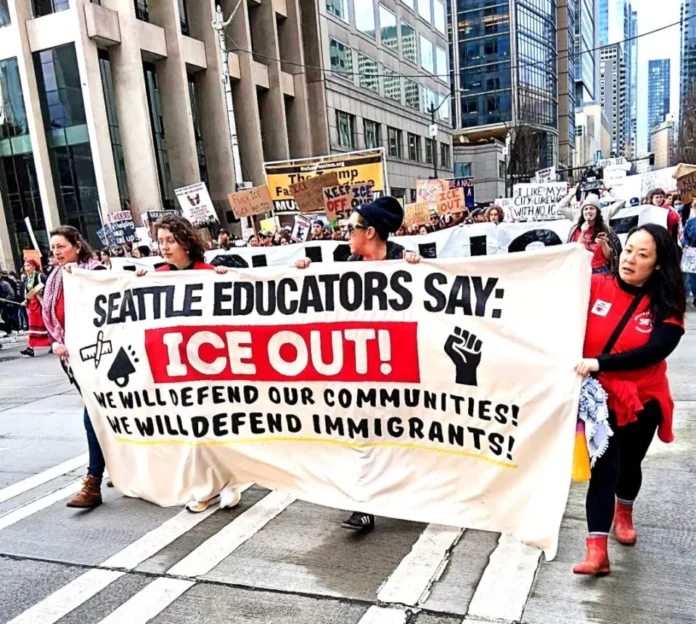
In the days following January 23, students at the University of Minnesota called for a national day of action against ICE on January 30. Members of the SEA Immigration Committee proposed a solidarity protest to union leadership, but they initially refused. Instead, the left caucus of the union—the Seattle Caucus of Rank & File Educators (SCORE)—took up the call for a protest on Saturday, January 31, eventually endorsed by half a dozen union locals and immigrant defense organizations, including the Washington EA, the statewide arm of the National Education Association. After the call developed some momentum, SEA signed on to the rally.
Two additional rallies were called in solidarity that day by tech workers and healthcare workers, both of which marched to meet the educator-led protest—5,000 people altogether were out in the streets that day. The energy was palpable, with organized workers across several sectors looking for a way forward. Unfortunately, many high-profile activists and union leaders fell short of calling for the kinds of offensive struggle that is needed. Throughout the country, we’ve seen that it takes bottom-up organizing to drag the unions into action against Trump and ICE. This can be frustrating, but it is necessary and possible. This is the kind of organizing it will take to mobilize schools on May Day and bigger battles ahead.
Unions Need To Step Up
There is a strong desire to fight back, and it’s extremely positive that both workers and students are not waiting for a mass ICE raid to hit Seattle to start organizing. However, what is missing is a clear plan for escalation if Trump does turn his sights to the Pacific Northwest. The community defense organizations like Sidewalk Solidarity are a key step in bringing together families, teachers, and staff to discuss how we can keep our students and school safe. But it will be necessary for the wider labor movement to step up and go on the offensive in solidarity with immigrant neighbors. Taking smaller actions like walk-ins is an important way to develop solidarity and organization, but ultimately it will take more offensive action like strikes to halt Trump’s attacks on immigrants and working people.
With a nationwide day of “No Work, No School, No Shopping” being called on May Day by a section of the labor leadership, all unions must take urgent steps to get strike-ready. It’s important that the president of the American Federation of Teachers Randi Weingarten is a part of this call, but without serious membership-wide preparation for strike action, including defying no-strike clauses when needed, a nationwide strike on May Day will not be possible. To build for the strongest possible ICE resistance, we need to escalate community actions to develop national coordination, and create spaces with democratic structures that bring together union members across all sectors. Socialists and working people have a key role to play in pointing toward the kind of world we need, free of racism, sexism, xenophobia, and imperialist war.