

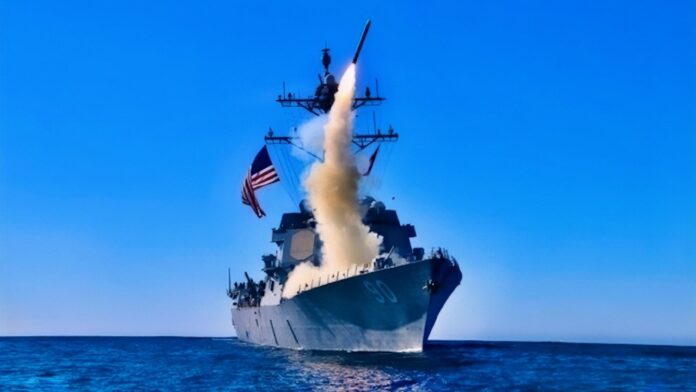
Ordinary people across the Middle East, but particularly in Iran and Lebanon, have been plunged into an increasingly catastrophic war by the US and its partner the Israeli state. Throughout the region, the war has brought destruction and death, with thousands killed and millions forced to flee their homes. The mass revolutionary movement in Iran, that earlier this year rattled the regime’s grip on power, has been decisively halted by the war.
The US and Israel have struck thousands of government, military, and infrastructure targets and unleashed a series of assassinations of Iranian officials, most notably of Supreme Leader Ali Khamenei. In retaliation, Iran has bombed targets throughout the region—from military bases, to energy facilities, to civilian centers. At the time of writing, 14 US soldiers have been killed in the war.
Trump’s war has also caused what is being described as the worst fuel crisis in history, as a major portion of the world’s oil and gas has disappeared from markets due to the closure of the Strait of Hormuz. The Trump regime didn’t have any real plan for this eventuality, despite it being the key threat wielded against the West by the Iranian regime for decades. High off his operation to kidnap Nicolas Maduro and, in one fell swoop, to transform Venezuela from an ally of China to a semi-colony of US imperialism, Trump clearly underestimated the resilience of the Iranian regime, which is prepared for a long war of attrition.
The capitalist class worldwide, and the rest of us along with it, is now in dire straits, as the fuel crisis will have spiralling effects across industries and across wide swaths of the world. With every day the war continues and the Strait of Hormuz remains closed, the risk of a 1930s-type global depression becomes greater. Trump knows he needs to get out of the war, but there is no clear path to an exit. A mass, international, working-class anti-war movement is urgently needed to bring an end to this disastrous war and to challenge the reactionary and volatile capitalist regimes responsible.
Why Did Trump Attack Iran?
Trump, never a stickler for the truth, has given a whole parade of different responses for why he is waging this war. The main one was that Iran was about to acquire a nuclear weapon that would have put the US in immediate danger. Ironically, the assassinated Khamenei had issued a fatwa (an Islamic ruling) against nuclear weapons, a ruling that died with him. Killed alongside Khamenei are several of the more moderate potential successors the US would have preferred. The new Iranian leadership is actually more hardline than the last one, and as a result of this war, military experts say that it’s far more likely to go in the direction of pursuing nuclear weapons to defend Iran from future attacks.
Many speculate that Trump needed this war to distract the public from the Epstein files. Others believe Israel duped him and dragged him into it. In truth, this war is very much a mutual imperialist project of US and Israeli imperialisms to arrogantly continue the momentum of the past several years of war in the occupied Palestinian territories and Lebanon, of regime change in Syria, and of political decapitation in Venezuela (and potentially soon in Cuba). They aim to remove their main regional opponent to create a new Middle East with US-backed Israeli capitalism as the main economic powerhouse, funded by massive Gulf state investments, with free flow of goods and services.
A big part of this means pushing back Chinese influence in the region. US hegemony defined world relations for decades in the post-WWII period, but the rise of China as an economic power has been a growing challenge to US dominance. As China became the manufacturing powerhouse of the world, it began pouring capital into infrastructure projects across the neocolonial world, as well as in parts of Europe. At the same time, China developed its military capabilities to the extent that it is now second only to the US in military spending and has more naval ships than any other military in the world.
The rivalry between the US and China is playing out in which superpower dominates in resource-rich countries and regions of Africa, Latin America, and Asia. At stake is control over a whole host of economic resources and markets, especially critical mineral resources in Africa and South America, the Taiwanese advanced chip factories, and oil production.
Secure energy supply chains are a live-or-die imperative for any capitalist superpower, and it is in US imperialism’s interest to have more direct control over the flow of oil to the Indo-Pacific, particularly to China, as well as to eliminate the Iranian threat to Israeli influence in the region. The US attack on Venezuela similarly cut off oil exports to China and established US control over the largest proven oil reserve in the world. US imperialism wants to firmly establish dominance over the Middle East—in terms of ensuring security for its most important ally, Israel, controlling energy supply chains, and securing a series of regional investments—before turning to potential military engagement directly with China.
War Produced A New Energy Crisis
The fuel crisis means big increases at the pump for US consumers, which millions of working-class and poor Americans can ill afford. Economic mayhem now wracks many Asian countries that import most of their oil and liquefied natural gas (LNG) from Gulf state producers, but are too poor to have any significant stockpiles. To conserve fuel, Sri Lanka declared every Wednesday a public holiday, and in Pakistan foreign airliners are required to bring enough fuel for their return trips. Gulf states are big exporters of both fertilizer and the inputs used to make it. Prices of fertilizer are already up 30% in some places. Without a new source of fertilizer coming onto the world market, food shortages in parts of the world will be likely.
The LNG crisis was intensified when an Iranian missile hit Qatar’s massive Ras Laffan facility in retaliation for Israel’s bombing of Iran’s South Pars gas field, paralyzing 17% of Qatar’s LNG output for up to five years while the damage is repaired. This is a non-trivial proportion of the world market, and will mean shortages for people who need LNG for heating, cooking, and electricity generation. There are clear energy haves and have-nots, as richer countries have oil reserves and financial resources that poor countries don’t. In every country, the crisis will fall hardest on the poor and working class.
The question at this stage is not so much about Trump chickening out, but about how the US can reopen the Strait of Hormuz. Without any doubt, the US and Israeli attacks are having a punishing impact on Iranian military capacity. However, at the time of writing, it remains to be seen if the US can reopen the Strait of Hormuz on a purely military basis without putting boots on the ground. With their stranglehold over an important amount of the world’s gas and oil supply, the regime in Iran has strong leverage for negotiations.
The US options for reopening the Strait militarily—from invading Kharg Island, Iran’s oil export hub, to the Navy escorting ships through the Strait—are fraught with danger. If, even in its weakened state, Iranian forces managed to hit a US naval ship, killing dozens or hundreds, retaliation by the US would be unavoidable. The more Trump tries to get control of the situation, the more likely further escalation becomes.
Putting soldiers on the ground in Iran would be a political risk for Trump of enormous proportions. Already, Trump’s right-wing coalition is beginning to splinter. Entering a ground war, and potentially a “forever” war, after Trump campaigned against the disastrous US wars in Afghanistan and Iraq, would supercharge the splintering process. There’s a developing far-right ecosystem that is against foreign wars and is dangerously antisemitic, increasingly expressing opposition to Trump himself.
Needless to say, many millions of left-wing and liberal Americans are entirely opposed to military adventurism in Iran, but their opposition is not organized. The Democratic Party, also an imperialist party, is not a real opposition to war and has proven completely toothless to stop Trump. The question for socialists, as we will get into later, is how a mass, anti-capitalist anti-war movement can develop outside of the pro-capitalist Democratic party and utilize working-class methods of struggle to bring down the Trump regime.
Unintended Consequences
The rivalry between the US and China is not one that drives the two imperialist powers to ever greater levels of development, but rather one between two depleted heavyweights who weaken one another further as the fight wears on. The US operation in Venezuela was a humiliation for China, as it was unable to play any part in supporting its ally in Maduro. The Trump regime expected a repeat of its Venezuela success in Iran, blinded by hubris from making a more realistic assessment of the staying power of the Ayatollahs. Instead of scoring a triumphant victory over another key oil-producing ally of China, the US has gifted the Chinese regime time to strengthen its military. Meanwhile, US imperialism is most likely to be weakened by a combination of failure to win decisively and the growing tensions and dissatisfaction at home.
A few weeks of war have already resulted in perverse consequences for US imperialism’s goal to gain more control over world energy supplies. The Trump regime has had to lift its own sanctions on Iranian and Russian oil to try and get more oil onto the world market. Russia is estimated to have earned nearly $1 billion more in the first two weeks of the Iran war than they normally would have.
Warfare is in the process of a transformation. First the war in Ukraine and now Iran are showing that cheaply produced drones in large quantities can be effective against much more expensive, sophisticated weaponry that takes much longer to produce. The US and Israel are already running low on munitions as the war has turned out to be considerably longer than expected. The US military has had to remove weapons from installations in South Korea and Japan, weakening the “pivot to Asia,” a years-long priority for US imperialism.
For Mass Movements To End The War
The Iranian regime is a murderous capitalist dictatorship that socialists should utterly oppose. Ironically, the war on Iran has actually helped to shore up the Iranian regime’s power, at least in the short term. The Iranian regime was at an extremely weak point prior to the war. It was forced to resort to horrifically brutal repression to put down the mass movement that erupted in response to food inflation in January, killing as many as 30,000 protesters. Far from sparking a popular revolt as Trump hoped for, the war has been the key factor in the regime getting a new lease on life. Anti-regime protests that were beginning to develop in Iranian universities in late February were completely cut across by the US and Israeli bombardment.
For years, the Iranian working class has come out in heroic struggle against the regime. The January protests erupted in more than 120 cities and in every province of the country with protesters chanting “Death to the dictator.” In 2022, the mass “Women, Life, Freedom” uprising exploded after a young Kurdish woman was killed while in the custody of the so-called “morality police” after being arrested allegedly for not wearing a head scarf correctly. This movement expressed the outrage at the oppression meted out to women in Iran by the fundamentalist religious gender-separatist regime. It is the right and responsibility of the Iranian masses to bring down the rule of the Ayatollahs.
The working class worldwide, especially in the US and Israel, have the responsibility to help organize anti-war movements to oppose their own murderous imperialist regimes that are waging war on Iran and Lebanon. Despite their differences in religion, culture, and language, working-class people internationally, including in Israel and the US, have much more in common with one another than they do with the bloodthirsty capitalist ruling classes of their respective countries. US workers have absolutely nothing to gain from the war in Iran. Economically, we are being ravaged by skyrocketing fuel prices and a likely recession, not to mention the potential for American soldiers to be sent to fight and die in Iran.
Bring Down Trump, War & Capitalism
The war is massively unpopular and Trump’s poll numbers are close to his lowest ever. In part because of the mass movement against ICE that reached its high point in Minneapolis, Trump is at his weakest point to date. The raw material exists for a mass movement to end the war in Iran, bring down Trump, and challenge the capitalist system and the billionaire class. We can use coordinated days of action like the No Kings protests to help mobilize millions to actively join the struggle against war. But we need to go much further.
A sustained mass movement needs a democratically elected leadership to organize the movement in communities, workplaces, and schools. If union leaders refuse to step up and lead an internationalist fight against imperialist war, workers should fight to replace them with new leaders who will. The Democratic Party in Congress has proven itself irrelevant as a way to fight back against this war. Working people need a new political party that will stand against imperialist wars and for international solidarity of working-class people.
The general strikes in Italy, against the genocide in Gaza, and in Minneapolis, against ICE brutality, point the way forward for a mass anti-war movement. A nationwide general strike that brings major sectors of the economy like aviation, shipping, logistics, manufacturing, and more to a halt would constitute an enormous crisis for the Trump regime and point the way toward workers taking control over the economy.
The Middle East will never be at peace so long as capitalism is the dominant world system because of the immense potential value to capitalism of the fossil fuel resources in the region, as well as the inherent rivalry of expanding regional forces. Only on the basis of a socialist federation of Middle Eastern states, with the economy under the democratic control of workers, can the masses of the region achieve peace and prosperity. Ultimately, only a global transformation along socialist lines can put an end to all wars.