

In August, Abdul El-Sayed’s victory over corporate Democrat Haley Stevens in the Michigan Democratic primary was a significant win for the wave of progressives challenging the establishment in this year’s midterms. El-Sayed unfortunately identifies explicitly as a capitalist, rejecting the socialist label, but many elements of his platform resonated deeply with working people fed up with the status quo, which were key to his victory. Chief among these were a refusal to take corporate money, including AIPAC money, as well as support for Medicare For All, the abolition of ICE, voting rights protections, AI regulation, and an arms embargo on Israel. In an era where establishment Democrats are increasingly seen as utterly incapable of solving the many crises working people face, campaigns like El-Sayed’s have gained an echo amongst ordinary people who are fed up with business as usual. His primary victory reflected the widespread support for a progressive agenda at odds with the corporate politics of the Democratic Party establishment.
But since winning the primary, El-Sayed has gone to great lengths to show the Democratic Party establishment that he will be a safe pair of hands, and in return they are showering him with establishment support. His Republican opponent, Mike Rogers, and especially Donald Trump have resorted to extremely racist attacks to try to counteract their sagging support, with Trump recently saying El-Sayed will “invite hordes of jihadis to our shores, creating a nightmare of violence and terror until you cannot even have a Christmas.” An El-Sayed victory would be historic in many ways, but if he wins, allied with the establishment, will he be able to fight for his platform?
The Primary: A Blow To The Establishment
Michigan primary races aren’t usually the focus of national attention, yet the establishment clearly saw it as a key battle that needed to be won. First, they outspent El-Sayed’s campaign by nearly 13 to 1, pouring tens of millions into attack ads and promotions for Haley Stevens. In fact, AIPAC alone spent over $35 million on the Haley Stevens campaign, more than they’ve spent on any other Democratic Party campaign in history. Unsurprisingly, Haley Stevens herself also leaned into Islamophobic dog whistles in a rant claiming that El-Sayed “wants to blame all of [his] problems on Jewish Americans,” essentially equating his openly critical rhetoric against AIPAC with a fundamental hostility against Jewish people because of his Muslim faith.
All of these attacks demonstrate how seriously establishment Democrats saw El-Sayed as a threat. His campaign has drawn support from the “uncommitted” movement, which organized people to withhold their votes for Kamala Harris in 2024 for her enabling of the Palestinian genocide. Establishment Democrats have blamed that movement for their loss in the last election and sought to quash its expression as part of a real electoral campaign. They’re also not happy that any of their party’s candidates would demand the abolition of ICE, take a stance against Israeli arms shipments, or take up demands for progressive economic reform. What the Democratic establishment would have preferred is someone like Stevens who actively champions its big business politics, not someone raising expectations beyond what they’ve already decided it’s acceptable to ask for.
However, now that he’s won the primary, most Democrats have decided this campaign is acceptable enough to support, to win back a Senate seat. Haley Stevens, Kamala Harris, Hillary Clinton, and even James Carville have vocally endorsed his campaign in the general. It may seem like El-Sayed has won the upper hand here, but these endorsements should in fact be a sign of concern to those hoping he’ll truly challenge the establishment. Leading Democrats would never fully back a candidate who they believed would pose a legitimate threat to their power structure. Rather, their co-optation and containment of El-Sayed is already well underway.
A similar process has played out with other progressive Democrats and democratic socialists, like Alexandria Ocasio-Cortez, who most recently sought to distance herself from movements against oppression (“Woke 1.0”), and Zohran Mamdani, who has abandoned any intention to curb the power of or cut funding to the NYPD. While real gains could be won if these politicians are connected to the kinds of fighting movements needed to go toe-to-toe with the establishment, seeking common ground with them leads to a rightward drift and dropping of their furthest reaching demands.
El-Sayed’s “America First” Rebrand
In a campaign commercial targeted toward independents and conservatives, El-Sayed said, “If you believe in ‘America First,’ if you believe we need to be investing here, if you believe that you want politicians who are invested in you and not bought by corporations, I hope you’ll give us a chance.”
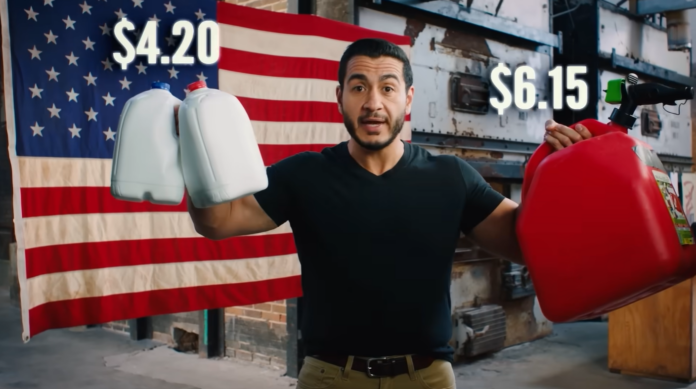
Appealing to Trump voters with an “America First” message is a key strategy of the El-Sayed campaign, especially since the start of the general election. Appearing in rallies and ads in front of a huge American flag, he’s defined himself as the real “America First” candidate, making his anti-war positions about the need to redirect the war budget to schools and healthcare at home. It’s absolutely right to call for this, but giving into nationalist rhetoric obscures the common interests of the working class across the world, erodes the basis for international solidarity and peace, and seeds the ground for supporting American capitalists against those of rival countries like China. Even far-right commentator Tucker Carlson took notice, referring to El-Sayed’s campaign as “literally Trumpian.” El-Sayed, by taking this approach and downplaying his more progressive positions, has made it possible for right-wingers like Carlson to quasi-endorse his campaign. Aligning himself with a nationalist message will ultimately complicate taking a serious anti-war stance in the halls of power.
“America First”—a right populist slogan—also makes real solidarity with immigrant workers impossible. In El-Sayed’s interview with Jesse Watters on Fox News, in an attempt to find common ground, he points out that before ICE was shooting people on the streets, the US had the Immigration and Naturalization Service (INS) which enforced immigration. So El-Sayed supports the abolition of ICE, but he’s ok with another agency basically doing the same things as ICE does but more quietly? Meeting the right halfway on these questions is giving away a lot without solving any of our fundamental problems. It shifts the question away from giving equal rights to people displaced by war, violence, and economic inequality, towards a return to the “status quo.”
In some ways, El-Sayed’s “America First” rebrand is his response to the vicious and relentless Islamophobic attacks hurled at him from the right. His often skillful responses to loaded questions like “will you disavow the Muslim Brotherhood?” expose the racism contained within them, but because of the widespread doubts about his loyalty, he takes great pains to emphasize his allegiance to the Constitution and to the flag—probably much more than any white progressive out there! While the Islamophobia he faces is completely unfair, using nationalist rhetoric only serves to reinforce the foundation on which xenophobia is built.
El-Sayed’s fundamental political weakness is that he defines himself as a capitalist who wants to reform a system he says is broken, believing that the profit motive is more a source of strength for society than the source of crisis it really is. He’s described Barack Obama as a father figure, and he’s campaigned with Kamala Harris. More and more, he’s aligned himself with the establishment and taken positions to ensure he remains viable as an acceptable candidate within their system. This, in spite of the numerous Islamophobic dogwhistles from all sides of the aisle, and his early anti-establishment rhetoric, should tell us something. When it comes down to it, El-Sayed is willing to do what it takes to win. But changing the system is going to take more than winning an election.
Fight For Working-Class Politics
If progressive demands like abolishing ICE, ending arms shipments to Israel, and Medicare For All are going to be won, we need more than just a good election campaign. We need a politically engaged working-class movement to force the capitalist class and their political representatives to concede.
Though his platform contains many elements that we, as socialists, do support, El-Sayed does not claim to be any kind of socialist. His faith in capitalism may help calm the fears of the political center, but it does not point toward the movement-building approach that would ultimately be necessary to win what his campaign is promising. Abdul El-Sayed, like Mamdani, had a chance to build on the anger against the mainstream Democratic establishment to call for a mass movement in support of his progressive agenda, but both have chosen to lean on the political establishment instead.
Progressive politicians may choose compromise over fighting for what they’ve promised, but that in no way means winning those demands isn’t possible. Abolishing ICE, winning Medicare for All, and ending arms shipments to Israel are all possible if the workers demand it! Historically, mass movements fighting for specific demands have forced politicians like El-Sayed to make a choice between siding with the movement or with the corporations and political establishment. Civil rights, women’s rights, LGBTQ rights, and workers rights would not have gotten far without the mass movements which forced those in power to take a stance one way or the other. Regardless of what the politicians say, we must continue to ramp up the pressure from below and demand real gains for working people, an end to state repression, and to the whole capitalist system!