
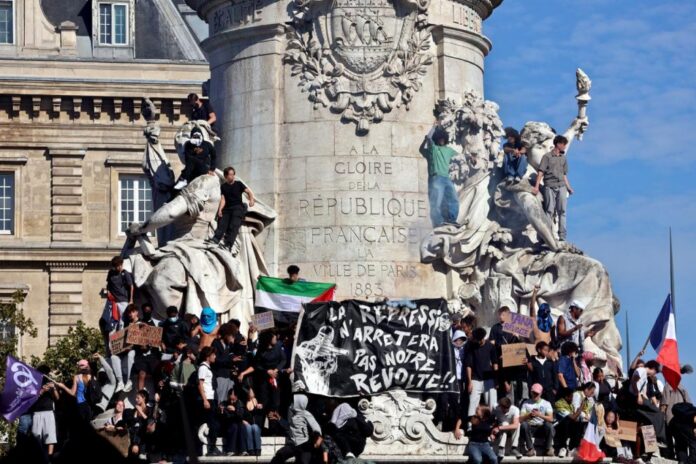
Since mid-September, a so far unstoppable wave of student protests has swept across France, led by angry high school students demanding an end to cutbacks and inequality.
The spark was a blockade at a high school in the Paris suburb of Créteil on September 18, organized by students in solidarity with their teachers, who had raised concerns about staff shortages just the day before. The protest movement’s call to action spread like wildfire via social media to other schools in the Paris area—and then to at least 39 other cities—accompanied by a growing list of demands.
Education System In Crisis
The students’ anger is directed at education cuts that have been ongoing for decades, and their disastrous consequences: large classes, long days, packed schedules, neglected and unrenovated facilities, and a shortage of teachers and support staff such as school nurses and counselors.
Another source of student frustration is the platform Parcoursup, which is used to apply for post-secondary education. The platform was launched in 2018 to replace a previous website that relied on a random selection of applications. However, the new algorithm, intended to make an individual assessment of each student, has been criticized for being discriminatory, favoring students from “elite schools” or those with university-educated parents.
Statistics from the French Ministry of Education illustrate how the cutbacks have affected teaching and the school environment. Since 2015, only 15% of all school buildings have undergone renovation or expansion. The average age of school buildings in France is 61 years, and most lack climate change adaptations; consequently, students and teachers have been forced to hold classes or take exams in temperatures exceeding 35°C (95°F). One-third of all schools are classified as overcrowded.
In 2025, 10% of class time in upper secondary schools was left without a teacher due to staff shortages, while 70% of classes in municipal upper secondary schools consist of 30 or more students. Many students are forced to prepare for final exams without support from a mentor or other teachers.
In the 2025 PISA (Programme for International Student Assessment) assessment presented in September, France recorded its worst results since records began in 2000. This decline is linked to teacher shortages, disruptive school environments, and widening economic disparities, with students from socioeconomically disadvantaged backgrounds and parents with low levels of education achieving increasingly poor academic results.
Growing Movement
At the time of writing, protests have taken place at approximately 1,800 of France’s 3,600 upper secondary schools, according to USL (Union Syndicale Lycéenne)—France’s largest union for upper secondary students—which has played a key role in spreading the movement. On September 29, USL invited the Ministry of Education to negotiate, but broke off discussions shortly thereafter because the government had failed to offer anything “concrete.” Subsequently, October 6 was declared a national day of strike action, with USL calling on other unions to join the cause. Since October 1, university students have also joined the struggle. According to Union Étudiante (France’s largest student union), over 30 universities have been blockaded in protest against the government’s proposed cuts to student financial aid and housing grants, among other things.
However, the protests have not been confined to educational institutions; in many cases, they have spilled out onto the streets. On Tuesday, October 6, more than 450,000 people took part in demonstrations across the country—according to USL and UE—with 100,000 participating in the Paris area.
Although the demonstrations have largely been peaceful, the movement has seen incidents of stone-throwing, arson, and vandalism. However, it is the French police who bear ultimate responsibility for the escalation of street violence, having responded to the demonstrations with rubber bullets, water cannons, baton charges, and tear gas. More than 215 students and approximately 85 school staff members have reportedly been injured; incidents include reports of police shooting youths in the eye with rubber bullets and an incident where a student lost a hand from a police stun grenade.
According to the French Ministry of Justice, over 700 police officers have been injured and 6,000 demonstrators arrested since the protests began. Of these, approximately 2,000 have been detained pending prosecution. About 90% of those detained are minors.
Mélenchon
France’s Prime Minister, Sébastien Lecornu of Renaissance (the same party as President Emmanuel Macron), has defended the police’s use of excessive force as “mere accidents” and condemned the way the demonstrations degenerated into “urban violence,” forcing the police to intervene. On October 6, he delivered his first speech to parliament since the protests began.
He offered no financial concessions to the student movement, proposing instead only laughable measures—such as setting aside half a school day to discuss the issues or establishing a platform for gathering complaints. He then focused all his energy on deflecting responsibility, accusing the left-wing party La France Insoumise (LFI, “France Unbowed”) of stoking the protests for its own gain. His source was an unpublished report from France’s domestic intelligence agency.
However, LFI leader Jean-Luc Mélenchon was not in parliament to face the accusations; instead, he was acting as a steward at a demonstration a few hundred meters away, calling out to the students to “be careful,” according to the newspaper Le Monde. Mélenchon has hailed the demonstrations as “the most powerful student and youth movement since 1968” and urged party members to “protect the young people.” At the same time, he has clarified that LFI does not “lead mass movements,” noting instead that they “organize themselves, through self-governance and with their own representatives.”
Mélenchon and LFI’s active support for the movement is of great importance, and shows the way forward to shift the balance of forces in the runup to next year’s Presidential elections in which Mélenchon is increasingly predicted to face off against Marine Le Pen (of the racist party Rassemblement National) in the second round. LFI should use the energy of this mass movement, and the mass support for Mélenchon among the youth, to fill its ranks with new working-class fighters and empower them with democratic structures to debate the way forward for the struggle to defeat the government and far right.
The student movement has also garnered growing support from the trade union movement, which has joined the struggle in many areas. By the time the seeds of the student protests were sown, some unions had already launched strikes and demonstrations to protest the government’s 2027 budget, which includes €54 billion in spending cuts. One of the “cost-cutting measures” being introduced is a cap on wage increases for public sector employees—in practice, a pay cut—marking the fourth consecutive year this has occurred since President Macron took office. Major unions that have joined the struggle include the CGT, Solidaire, and the FSU.
It remains to be seen whether the trade union movement can combine these demonstrations—which for many have centered on physically protecting young people from police violence—with the strikes and work stoppages necessary to force real change and stop the austerity budget.