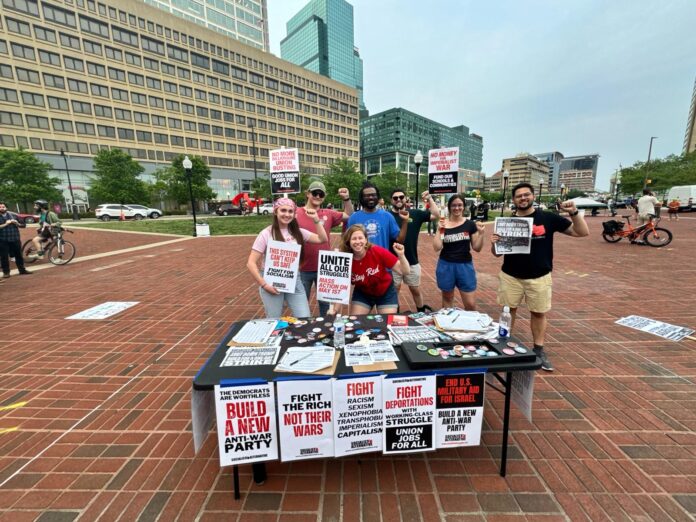
In September, a new branch of Socialist Alternative was launched in Baltimore City. Baltimore, a city often stereotyped as dangerous or unsalvageable, is home to more than half a million people. It is a majority Black working-class city, with a lasting legacy of racism and oppression. But for all the horrors the corporate media and the Trump administration likes to spew about the city, Baltimore is a place of strong community and solidarity. It is a place whose working people deserve a better standard of living for all. This city, like so many places in the world deemed unworthy of help, needs a united working-class struggle. Our new branch wants to be at the forefront of these struggles to fight Trump, the far right, and the horrors of capitalism.
Crisis In Baltimore
Since 2020, Baltimore City has experienced (and been expected to adjust to) a litany of crises. This includes a tainted water supply and the collapse of Key Bridge which resulted in workers’ deaths, impacted the daily commute of thousands of residents, and became a political pawn of both parties nationally. The neighborhoods that were already suffering physically and mentally from living next to the CSX coal pier were directly impacted by an explosion at the same location.
Just this year, Baltimore has experienced three mass overdoses all on the same block, three murders of Black people at the hands of the Baltimore Police, and one sexual assault of a 16-year-old at the hands of her cop boyfriend. Due to the headquarters of the Social Security Administration being located just outside the city, many folks are federal workers. Many workers in the public sector have lost their jobs due to DOGE cuts or are still suffering the consequences of the nation’s longest government shutdown. These are the challenging factors impacting the day-to-day lives of the working-class residents of Baltimore.
Following each of these blows, there was nowhere near the kind of mass response that would be needed to stop these attacks. The smaller campaigns that were organized around each issue have been important, but have remained largely disconnected from the broader working-class population of the city, for example with events at times that many workers couldn’t attend. While the mass “No Kings” protests this year shook cities across the country, including in Baltimore, these have dissipated and left working people who want to fight back without the lasting organization or strategy to carry it out effectively. However, it wasn’t always this way—Baltimore has an inspiring history of working-class struggle that holds many lessons for the future.
A History Of Struggle
Baltimore—a city with a nearly 60% Black population—was for many decades prominent in the working-class struggle against systematic racism. Activists such as Lillie Carroll Jackson helped to establish a strong NAACP as early as 1935, and put forward strong fights for integration in public spaces like the Gwynn Oaks Park—a one-time “whites only” amusement park. Such movements peaked after the assassination of Martin Luther King Jr., when the city experienced seven days of civil unrest, confronting both the police and the National Guard.
At one time a major port city defined by its large working class and distinguished by manufacturing and maritime industries, Baltimore has been impacted by the decline of the once powerful unions and deindustrialization. This was exemplified in the closing of Bethlehem Steel, which led to thousands of workers losing their jobs, benefits, and pensions, with many neighborhoods still feeling the effects to this day.
Racist policies like redlining have had a devastating impact on Black residents, with significant disparities between white and Black neighborhoods. This history of hyper-segregation in Baltimore, like in many US cities, still today contributes to lower life expectancies and poorer health outcomes in formerly redlined areas, according to recent studies.
Unrelenting racist police brutality and misconduct by the Baltimore Police Department led to massive protests which lasted over two weeks during the spring of 2015. That was when the city of Baltimore became the center of the uprisings following the murder of Freddie Gray, a Black man who died of injuries suffered from a “rough ride” in a police van, only months after the police murders of Eric Garner and Michael Brown.
In step with the Black Lives Matter movement, the protests highlighted Baltimore’s working-class drive to resist. Despite the poverty, decline of union membership, and ruling-class repression, working-class resilience and grit are ingrained in Baltimore’s culture.
As we build a revolutionary socialist organization in Baltimore, a major question for us is how a city that went through such a large-scale uprising after Freddie Gray’s murder could have such a lack of struggle in the decade following. Much of this can be attributed to the broad demoralization following the defeat of the BLM movement. The Democratic Party and progressive NGOs don’t have real solutions for the issues of the Black working class in a majority Black city, and Democrat leadership is often embroiled in political scandals, with two of the last four elected city mayors and one state attorney having had their terms ended as they faced state and federal indictments. Additionally, shrinking union membership means the working class has had fewer protections and fewer tools to fight. What is missing is genuine working-class leadership in the unions and in social movements that can point a way forward for united, multiracial struggle against the racist, oppressive capitalist system and for an entirely different kind of society.
Movements Today
Currently, the largest campaign in our city is to get Avelo Airlines out of the Baltimore Airport (BWI). The airline, more commonly known for its discount flights, accepted a $150 million contract with ICE to operate deportation flights. While this is a national campaign, it is disjointed from city to city, with no coordinated actions nationally. At a recent public meeting on this, we addressed this issue head-on. Don’t we want to do more than stop Avelo’s actions at BWI? ICE can just as easily use ground transport to another city where Avelo flies out of. Working in coordination with other cities as a national campaign against Avelo can help to escalate and broaden out the struggle. We should set our sights on not just ending Avelo’s contract with ICE, but also building momentum for the unionization of Avelo workers and even bigger demands like ending all airline contracts with ICE and taking airlines like Avelo into democratic public ownership to be run by the workers themselves.
While Avelo Airlines is the most prominent local campaign, it is certainly not the only one. Johns Hopkins University (JHU), the largest employer and land owner in the city, has many eyes on them. At this time, there are four active campaigns fighting against JHU for their mistreatment of workers, their private police, their poor pay, and a Data Science and AI center they are building in the city, which would sacrifice trees and the local water source.
This past fall, all four campaigns came together for a protest on JHU’s campus demanding “fair taxation, environmental stewardship, real public safety, and respect for workers’ rights.” The merging of these campaigns was an important step forward, and should be built on. But many of the speeches at the protest, like one complimenting Democratic Mayor Brandon Scott’s handling of the consistently scandal-embroiled Baltimore Police Department, don’t show the movement a way forward that is independent of the useless Democratic Party. While the need for unions was brought up, we must take these demands further, calling for the labor movement to organize actions that are politically independent of the Democrats and can draw in the working class who live in the surrounding neighborhoods and are feeling these first ripples of negative impacts of JHU’s actions.
Build The Fightback In Baltimore
While there are real challenges and setbacks in left movements today, as socialists, we must fight to strengthen even small-scale struggles where they exist. In order to successfully build a fighting force, our new branch is committed to going wherever workers and young people are moving into the struggle to fight for what we deserve. What our class urgently needs is socialist ideas to fight Trump 2.0 and the ever-growing right. This means fighting against all capitalist exploitation and oppression.
Having established a branch in one of the largest majority-Black cities in the country has been an incredible and important moment for Socialist Alternative. It shows that we are in a moment where working-class people are seeking more than what capitalism will ever provide them. It is a significant step and opportunity to fight for housing that is affordable, healthcare that is a given, and an end to all oppression—not just in Baltimore City, but internationally. If you’re interested in building the fight for socialism in Baltimore or anywhere else, get involved with Socialist Alternative today!