

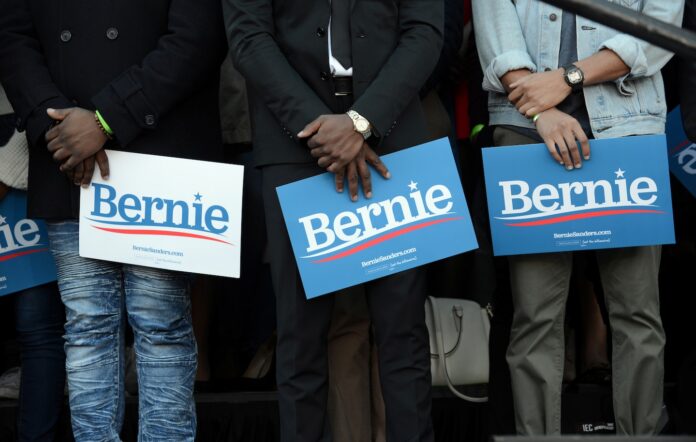
There is a growing wave of progressive and democratic socialist electoral campaigns across the country. Zohran Mamdani’s victory in New York, Abdul El-Sayed’s campaign in Michigan, and other progressive victories have demonstrated that there is an audience for candidates who challenge the Democratic establishment. These campaigns are taking place alongside growing frustration with the Democratic Party, particularly among young people who have become increasingly skeptical of the idea that their political responsibility begins and ends with voting for whatever Democrat is on the ticket.
In an attempt to break the growing support for socialist ideas, Democrats and Republicans are increasingly arguing that socialism is alienating Black and Latino voters. The right has cynically attacked socialism as a threat to the economic gains Black Americans have fought to achieve, when in reality it is the capitalist system of oppression that has kept the majority of Black people from gaining economic stability, let alone accumulating wealth. A recent Fox News opinion piece argued that Democrats are in trouble with Black and Brown voters because they have supposedly embraced socialism (they certainly have not). Meanwhile, the Democratic Party establishment has attacked these progressive candidates, raising similar concerns about whether they can maintain support among working-class and Black voters. These claims wrongly suggest that all Black people vote the same, regardless of their social class, age, and other conditions.
The Michigan Senate primary gives us a useful example of these contradictions. Abdul El-Sayed narrowly defeated establishment Democrat Haley Stevens in a race that became one expression of the broader battle over the direction of the Democratic Party. El-Sayed ran openly as a progressive (though explicitly not a socialist) and made Medicare For All and opposition to unconditional US support for Israel major parts of his campaign. He was heavily outspent, including by AIPAC-backed spending supporting Stevens, but still won the primary.
His strongest support came from younger and more progressive voters, while Stevens performed better among older and more establishment-aligned Black Democrats. The establishment used this divide to argue that the left isn’t able to appeal to Black people.
The lesson isn’t that Black workers rejected socialism, but that there is a generational and political divide in Black America. The myth of the Black monolith is showing cracks politically. Many older Black voters have a political relationship with the Democratic Party, shaped by the history of the Civil Rights Movement and the Republican Party’s attacks on voting rights and civil rights. The memory of those struggles is real and shouldn’t be dismissed as political backwardness. But for many young Black voters, having grown up in the Trump era, with the experience of the George Floyd uprising, economic insecurity, a housing crisis, student debt, police violence, and the US-backed destruction in Gaza, experience has pushed them to look in the direction of systemic change. Younger Black people can be more open to socialist ideas while many older Black voters remain tied to the Democratic Party.
Black Workers Vs. The Black Misleadership
The current electoral opening on the left is tied to a broader crisis of political leadership. Worsening living conditions and the failure of existing institutions to deliver the change young people expect drives them to look for other outlets to express their anger.
But in the absence of a mass independent workers’ party rooted in Black communities and labor struggles, political anger can move in very different directions. It can find expression through socialism and independent politics, but also nationalism, pessimism, individualism, conspiracy theories, or a return to establishment politics.
We should take the underlying anti-socialist argument by the establishment seriously, even if the political conclusion is completely wrong. The right is trying to turn the legitimate desire for Black economic security into a defense of capitalism. For many Black workers, homeownership and economic advancement represent generations of struggle against redlining, segregation, and exclusion from wealth accumulation. But those gains were not handed down by capitalism. They were fought for. And the fact that a minority of Black people have been able to accumulate property doesn’t mean Black workers share the same interests as Black landlords, corporations, or wealthy professionals.
A Black worker and a Black business owner experience racism in overlapping ways, while having opposite interests over wages, housing, taxation, and political power. The question is not whether Black people can succeed within capitalism. The system allows for some to succeed, to legitimize itself. The question is whether the majority of Black workers can gain collective control over the conditions under which they live and work.
This is where the Black misleadership becomes important. The argument that “Black voters don’t want socialism” often treats Black political leadership as if it represents Black workers as a whole. It doesn’t. Sections of the Black political establishment have become integrated into the Democratic Party, nonprofit networks, academia, corporate institutions, and capitalist electoral politics. Their political careers and institutional positions depend on maintaining relationships with the existing political system.
A new leadership is needed. But it has to develop organically from the struggle in the streets, at the workplaces, and at schools. The need for a new leadership is tied to the need for a new political party that organizes all working people in struggle and runs candidates who are tied to struggle, take an average workers’ wage, and are accountable to the movement, not to the political establishment.
Debates On The Left: Reformism Vs. Revolutionary Socialism
The Democratic Socialists of America (DSA) played an important role behind many of the recent progressive Democratic victories and is therefore one of the main targets for slander by both the right wing and the Democratic establishment. But the limitations of their strategy become clearer in the narrow context of electoral politics. Running inside the Democratic Party places even well-intentioned democratic socialist candidates inside an institution fundamentally committed to administering capitalism. Affordable housing, childcare, and higher wages would materially improve people’s lives and socialists support and fight for them. The question is whether winning reforms through closed-door negotiations builds independent working-class power.
This matters especially for Black liberation. A politics limited to reforming capitalism, espoused by DSA figures such as Zohran Mamdani, Alexandria Ocasio-Cortez, and other democratic socialists, can challenge some forms of racism, but it doesn’t fundamentally confront the system that reproduces racial inequality. This makes this approach a band-aid solution. Fighting for Black liberation ultimately means challenging capitalism itself and building the power of Black workers alongside the broader working class.
The “dirty break” strategy, which is popular in DSA and suggests a break with the Democrats sometime in an undisclosed future, doesn’t resolve this problem because the break gets deferred forever. A real break from the Democrats has to be built through independent organization, workplace and community struggle, and a political program outside of both capitalist parties. This could appeal to young people disgusted with both Democrats and Republicans.
The history of Black liberation shows why struggle has to be central. Voting rights were won through boycotts, student organizing, workplace struggle, and mass demonstrations. Ella Baker and Fannie Lou Hamer understood that political power has to be built from below. Martin Luther King Jr.’s later opposition to the Vietnam War, its connection to poverty in the US, and to capitalism reflected the same recognition that formal civil rights victories alone could not fundamentally resolve the material conditions facing Black workers and poor people.
The Need For An Independent Class Struggle
For decades, Black voters have been told that their political responsibility is to prevent Republicans from winning. Limiting the role of Black people to voting, rather than organizing an independent struggle, means that once the election is over, responsibility for solving the problems facing Black communities gets transferred upward to politicians, the courts, nonprofits, and other institutions that serve the elites at the expense of the masses. This is why struggle rooted in working-class communities is necessary before, during, and after elections.
The Democrats’ demand for Black votes is entirely contrary to the actual history of Black liberation.
Social media also creates its own problems. Algorithms reward outrage, personal branding, callouts, and ideological performance. A growing content economy means there are material incentives for commentators and activists to turn politics into a career. This doesn’t mean all influencers are insincere, but social media “activism” makes political visibility and personal branding substitutes for building an organization capable of collective action.
One negative form this can take is neoliberal antiracism, where racial justice is reduced to individual attitudes, diversity management, or institutional branding while leaving deeper economic and political inequalities untouched.
Some forms of ultra-left politics, prevalent in the online left, treat reforms and immediate struggle as distractions because they do not directly challenge capitalism. This approach dismisses the fact that fighting for reforms are key for helping workers build confidence, organization, and collective power. While Maoist and left-nationalist politics attempt to respond to the failures of US capitalism, but their weakness lies in these politics’ inability to work out a strategy that can actually organize the US working class today. These online-left politics tend to substitute ideological formulas for the patient work needed to build mass movements and organization.
Conspiratorial politics tend to replace the analysis of how capitalism and the state actually work, with explanations based on hidden forces or individual actors. Social media can amplify all of these tendencies when detached from actual organization and real-life struggle.
Fight For Political Independence, Fight For Socialism
For Black students and young workers, this conversation is especially important. Some are looking for independent politics. Others have moved toward pessimism, nationalism, or political passivity because they don’t see a realistic path forward. The answer cannot simply be your personal responsibility to “vote right” or be active on social media. History shows that the only way forward is mass action and organization.
We need a multi-racial independent mass party of the working class that fights for Black liberation and against the far right and all forms of oppression. It should connect the struggle against racism to the struggle against capitalism, run candidates, and organize labor actions and community struggles, giving Black workers and the broader working class an independent political voice.
The current left-wing wave heading into the midterm elections shows that the old political consensus in the Democratic Party is weakening, but it does not guarantee what’s next. The task of revolutionary socialists is to help turn that dissatisfaction into organization, fight for the reforms people are demanding, and ultimately build the working-class political power needed to win a revolutionary transformation of society.