Jared Kushner thought the deal was sealed. He had just worked out an arrangement with the Albanian government to build a pair of luxury resorts totalling €5 billion ($5.7 billion): one in the coastal village Zvërnec, and one on Sazan Island, a former military bunker during the Stalinist dictatorship of Enver Hoxha.
There were still a few lingering issues. Zvërnec is on Europe’s last wild river delta, so he’d have to rewrite some pesky environmental regulations. Plus, the Sazan Island location was on public land. But he could count on Albania’s notoriously corrupt ruling elite to wave those issues away. Besides, his father-in-law was Donald Trump, the leader of the free world. What could possibly go wrong? But there was one thing he hadn’t accounted for: the Albanian masses.
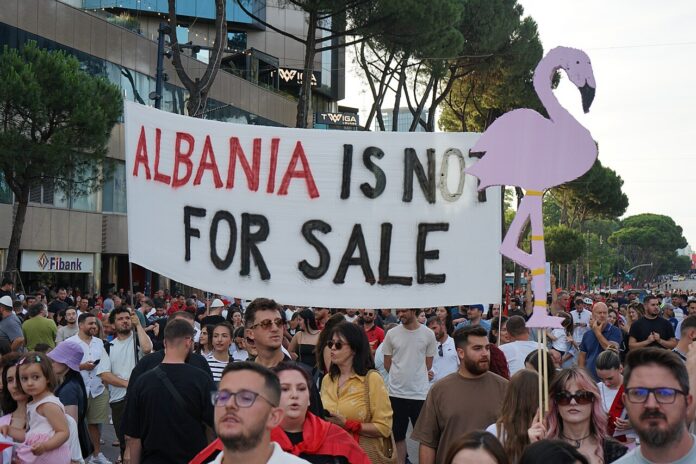
On May 23, environmental activists and local residents gathered in Zvërnec to protest while Kushner’s stooges fenced off Pishë Poro-Narta beach with barbed wire. A week later, the project’s private security violently attacked the protesters with pepper spray. Videos of the violence spread on TikTok and, by May 31, the protests had reached Albania’s capital Tirana with chants of “Albania is not for sale!” The protesters dubbed their movement the “Flamingo Revolution” after the birds whose habitat Kushner was trying to bulldoze.
The protests have continued, reaching 250,000 people on June 20. Their scope has also expanded far beyond a single development project. Protesters are calling on Prime Minister Edi Rama to resign. The main opposition party, Sali Berisha’s Democratic Party, hasn’t been spared either. Chants of “Rama in prison, Berisha in prison” are a fixture of the movement. The demonstrators are taking on a whole corrupt system, from Albania’s own ruling class to the Trump family and US imperialism.
The “Flamingo Revolution” comes on the heels of similar mass struggles in Serbia and Bulgaria. It’s also part of the wider wave of “Gen Z Revolts” that have broken out across the globe from Nepal to Madagascar. These struggles have given a voice to disenfranchised youth. But it is only through revolutionary, working-class organization and international solidarity, that the youth in Albania and internationally can realize their desires to bring about an end to corruption, poverty, war, and imperialism.
Albania For Sale
Like the rest of Eastern Europe and the Balkans, Albania is grappling with the consequences of the collapse of Stalinism in the 90s. Even by the standards of Stalinism, Hoxha’s regime was brutal, doubling down on totalitarian repression, while offering few of the gains that came from the planned economy to the majority. Nonetheless, the restoration of capitalism and accompanying neoliberal “shock therapy” hit Albania unusually hard. Berisha, the current opposition leader, consolidated his own dictatorial rule as president in the 90s and handed the country’s economy over to a series of pyramid schemes.
When the pyramids collapsed in 1997, Berisha was ousted in a mass uprising. Without any independent working-class organization, however, the remnants of Hoxha’s Party of Labour of Albania, rebranded as the Socialist Party, returned to power on a capitalist program not much different from Berisha’s. Today, Albania is dominated by a two-party system, the Socialist Party of Hoxha’s dictatorship and the Democratic Party of Berisha’s dictatorship.
Things have improved superficially since the crisis of 1997. Albania joined NATO in 2009 and began EU accession negotiations in 2022. With the European economy as a whole sinking into stagnation, Albania’s economy has been steadily expanding. But this seeming economic success story has delivered little for the country’s working class.
The boom is driven mainly by tourism and real estate, while industry has declined. Albania has the sixth-fastest growing economy in Europe but it’s also the continent’s sixth-poorest country. Unemployment has come down, but 51% of workers are in vulnerable employment, more than five times the EU average. This has enriched real estate developers, but left workers and youth with little option but to leave the country. In 2023, 43.6% of Albanians were emigrants living abroad.
This lopsided boom has made Albania a hotbed of corruption. Both ruling parties are implicated to the hilt in scandals, from Rama laundering money from an incinerator project, to Berisha using property deals to enrich his son-in-law. By 2025, growing anger at corruption, pressed Rama to at least put on a performative show of caring about corruption. He did this in the most insulting way possible, by “appointing” an AI-generated “minister” named “Diella” to tackle corruption.
Most working people would look at a situation like this and instinctively react with disgust. But if you’re a corrupt real estate investor trying to make a quick buck on the fact that your father-in-law runs the world’s biggest imperialist superpower, it’s heaven on earth.
The Trump Family’s Balkan Playground
During the neoliberal era, imperialism dressed itself in the figleaf of mutual alliances and a “rules-based order.” Now that figleaf is gone. The Trump family’s disregard for conflicts of interest is emblematic of that.
In 2021, Kushner set up Affinity Partners, an investment firm funded by the Saudi government. While formally not part of the Trump administration he’s accompanied Steve Witkoff on diplomatic missions regarding the wars in Ukraine, Gaza, and Iran. Kushner brushed aside concerns about the conflict of interest saying, “What people call conflicts of interest, Steve and I call experience and trusted relationships that we have throughout the world.”
The Balkans have been a particular target for Kushner, the Trump family, and Affinity Partners. In addition to the Zvërnec and Sazan Island developments in Albania, Kushner and Affinity Partners attempted to build a Trump Tower in Belgrade on the site of Serbia’s former defense headquarters, which was destroyed when NATO bombed it in 1999.
The Trump family’s reach into the Balkans spreads beyond Kushner. Donald Trump Jr., Kushner’s brother-in-law, visited Serbia and Romania during the 2024 elections to drum up support for his father. When the mass protests blew up against Serbian President Vučić, Trump Jr. paid Vučić a personal visit in March 2025. The following month, he made a Balkan tour specifically to boost the Trump family’s business ties. This included telecom deals in Hungary and crypto and data center deals in Bulgaria. But it was also geared towards providing political support to far-right figures across the region including Vučić, Viktor Orbán, Boyko Borissov in Bulgaria, and George Simion in Romania. In April of this year, he made a trip to Bosnia where he spoke at a business panel with Milorad Dodik, the far-right Serbian nationalist denier of the Bosnian genocide and former president of the breakaway Republika Srpska.
The Trump family’s Balkan ventures serve two purposes. They serve as a naked way for the family to profit directly off of their political positions. And they allow Trump to prop up far-right forces in the region and strengthen the reach of US imperialism.
The entwining of business deals and political patronage reached nauseating levels in Albania’s May 2025 parliamentary elections. While Kushner was signing off on his business deals, both Rama and Berisha did everything they could to declare their loyalty to Trump. Rama declared, “When Trump says that God saved him to Make America Great Again, he tells only half of the story. The other half is that He saved Trump also to make Europe wake up and get its act together.” Meanwhile, Berisha, who was under US sanctions for corruption at the time, hired Chris LaCivita, the senior adviser for Trump’s 2024 campaign. In the midst of the current “Flamingo Revolution,” Trump paid Berisha back by lifting the sanctions.
Even before the “Flamingo Revolution” the Trump family’s web of corruption in the Balkans didn’t go unnoticed. The anti-Vučić protests in Serbia began over an unrelated construction project connected to China’s Belt and Road Initiative. But the proposed Trump Tower in Belgrade soon became a target of the protests as well. In a sign of hope for the current protests in Albania, the Serbian struggle won a small but meaningful victory in their struggle when officials connected with the project were indicted for corruption and the project was scrapped. This shows that struggles like these can win real gains.
Beyond The Flamingos
While the “Flamingo Revolution” is impressive, so far it hasn’t won its demands. Rama has refused to resign or even cancel the projects. Ludicrously, he’s dismissed the whole movement as a “hybrid warfare” campaign by Iran.
The Gen Z revolts and the movements in Serbia and Bulgaria show the type of mass struggle and international solidarity that can defeat corrupt figures like Rama. But they also show the limits of what can be accomplished through “leaderless” movements organized on social media.
In Serbia, after the protests began to fizzle out, Vučić appears to have been forced to resign as president and called snap elections, but seems intent on moving over to the Prime Ministership instead. In Bulgaria, the protests did force Prime Minister Rosen Zhelyazkov to resign. But the ensuing election simply resulted in a shift from pro-EU bourgeois politicians to pro-Russia bourgeois politicians.
The fact that the movement has taken a clear stand against both Rama and Berisha is positive, especially since anti-corruption protests earlier this year were co-opted by Berisha supporters. But without an independent, organized working-class challenge, the danger remains that the movement will dissipate or simply result in a shift from Rama to Berisha.
Initially, the movement was dominated by youth and environmental activists, without a heavy presence from the trade unions. This changed on June 23 when the Union of Trade Unions joined the protest. The union leaders brought in demands against privatization, and for better working conditions and stronger collective bargaining rights. This is also a positive development, but it falls short of the working class’s full power: wielding their ability to shut down production and directly pose the question of who controls society.
To fully sweep out the corruption in Albanian society and the claws of Trump and his family, the struggle needs to escalate to strike action across the country. The movement needs to build its own independent working-class party to challenge the two-party establishment in elections and in the streets. It should link with the anti-corruption struggles across the Balkans, against Trump in the US, and across the globe in a revolutionary struggle for international socialism.
With a revolutionary socialist program, the working class can force open the books of the corrupt politicians and businessmen. They can take the economy into public ownership and, unlike under Hoxha, run it democratically under workers’ control. Instead of enriching real estate developers and the families of imperialist overlords, the economy can be democratically planned to meet human needs. And the needs of the flamingos as well.